
Table of Contents
- How Does Daylight Harvesting Work?
- 1. Set an illuminance target for the space
- 2. Measure a signal that represents the daylight zone
- 3. Adjust electric light output
- 4. Respond to changes at a suitable pace
- A daylight harvesting example using 500 lux
- Open-Loop and Closed-Loop Daylight Sensing
- Types of Daylight Harvesting Lighting Solutions
- Where Does Daylight Harvesting Work Best?
- How to Design and Commission a Daylight Harvesting System
- How Much Energy Can Daylight Harvesting Save?
- FAQs
Daylight harvesting lighting solutions use light sensors and automatic controls to adjust electric lighting as usable daylight changes. When daylight from windows, skylights, or other openings provides part of the illumination a space needs, the system reduces the output of the fixtures serving that area. When daylight fades, the fixtures supply more light. A properly commissioned system can lower daytime lighting energy use while maintaining the illumination needed for the work people do.
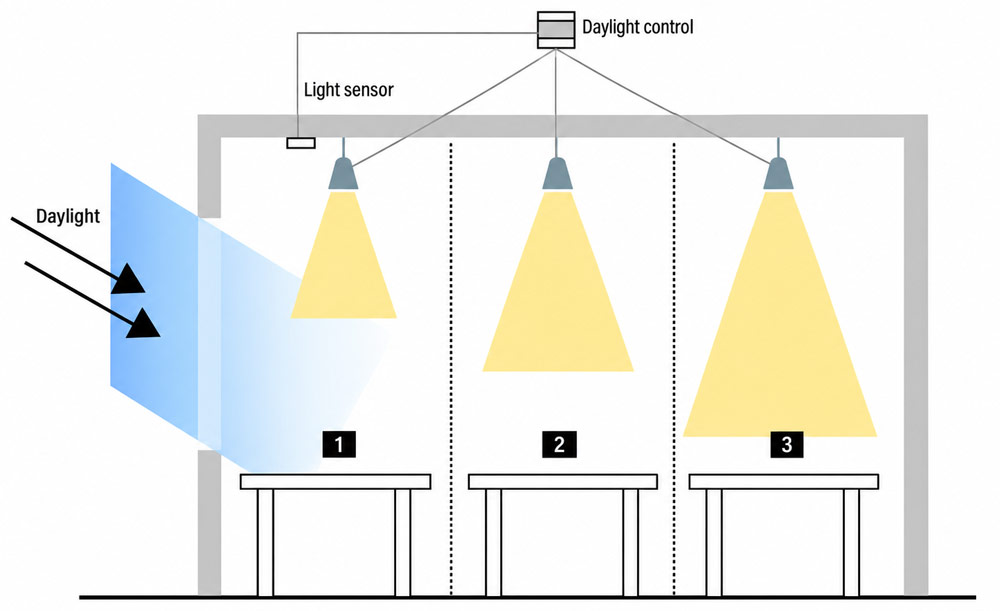
A daylight harvesting controller uses a light sensor to dim fixtures most in Zone 1 near the window, with progressively higher light output in Zones 2 and 3.
The adjustment happens by lighting zone. In an office with windows along one wall, the row of lights closest to the windows may dim substantially by midmorning. A second row may dim only slightly, while fixtures deeper in the room continue at their normal output. The same daylight-responsive principle applies to a classroom with tall windows or a warehouse with skylights, but the location and size of the zones will differ.
How Does Daylight Harvesting Work?
A daylight harvesting system has three functional parts. A photosensor detects light, a controller decides how the lighting should respond, and a driver or relay changes fixture output. These functions can be housed together in a fixture or distributed across separate devices serving a room or zone.
1. Set an illuminance target for the space
The lighting design establishes how much light should reach the surface where a task takes place. That surface, called the work plane, might be a desk, a workbench, or the floor of a circulation area. Some applications also require measurements on a vertical surface, such as a classroom board or a retail display.
Illuminance is measured in lux, with one lux equal to one lumen per square meter. A fixture’s light output in lumens describes how much visible light it emits. The illuminance at the work plane also depends on how the fixture distributes that light, where it is mounted, and how nearby surfaces reflect it.
2. Measure a signal that represents the daylight zone
A photosensor measures light within its field of view. Depending on the design, it may look toward a daylight opening or detect light reflected from surfaces inside the space. A ceiling-mounted sensor often sees a different light level from the one measured on a desk below. During commissioning, work-plane readings help establish how the sensor signal should translate into a control response.
The control system determines the ‘dependency’ for each light fixture. The dependency relates daylight illuminance measured at the photo sensor, predicts daylight workplace illuminance, then determines the desired dimming level for the fixture. The actual time dependent daylight dimming operation is then based on the dependency setting for each fixture and the photosensor signal. McNeil, A., Kohler, C., Lee, E. S., & Selkowitz, S. E. (2014). High Performance Building Mockup in FLEXLAB. Lawrence Berkeley National Laboratory, Report LBNL-1005151, § 4.2.
3. Adjust electric light output
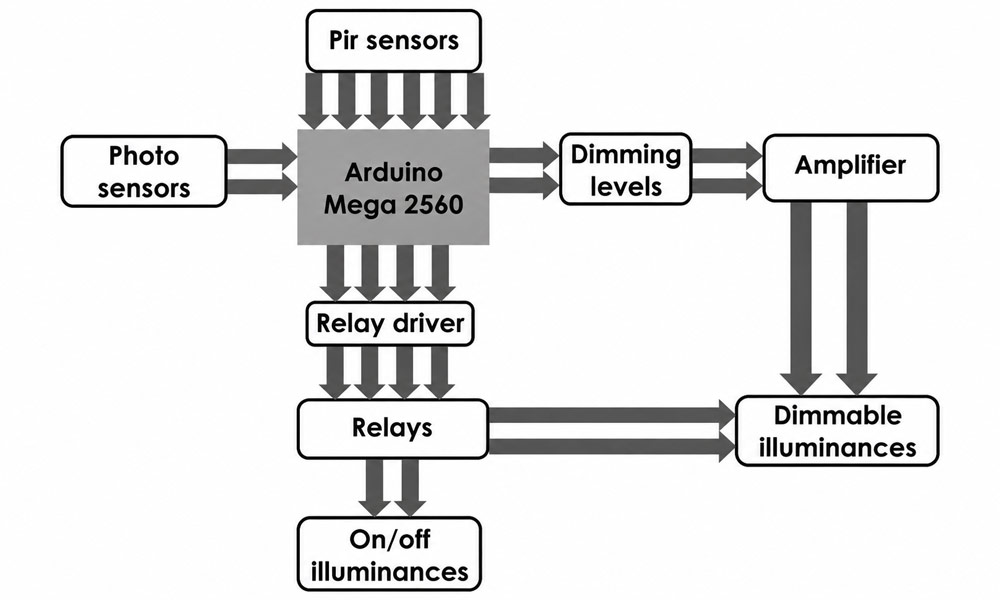
Photosensors and PIR motion sensors send signals to a daylight harvesting controller, which dims fixtures or switches them on and off.
The controller interprets the sensor signal using the settings for that zone. It may reduce driver output gradually, select a preset output level, or switch the lighting off when daylight can support the task on its own and the configured sequence allows it. When the zone needs more electric light, the controller raises output or switches the fixtures back on.
4. Respond to changes at a suitable pace
Fast-moving clouds, brief shadows, and reflections can cause short spikes or drops in sensor readings. Configurable fade rates and delays help the system respond to sustained changes without making the lights visibly chase every fluctuation. Switching controls can use different thresholds for turning on and off, a technique called hysteresis, to reduce repeated switching near a threshold.
A daylight harvesting example using 500 lux
Assume an office desk has a design target of 500 lux. The table shows how much electric light would be needed at that desk under different daylight conditions.
| Daylight reaching the desk | Electric illuminance needed | Combined illuminance |
|---|---|---|
| 50 lux | 450 lux | 500 lux |
| 200 lux | 300 lux | 500 lux |
| 380 lux | 120 lux | 500 lux |
| 530 lux | 0 lux if full shutoff is enabled | 530 lux |
These figures describe the light reaching the desk. The controller determines the corresponding dimming command from the installed system’s response. A zone configured to stay at a minimum output may continue supplying some electric light in the last scenario. If direct sun makes the desk uncomfortable, blinds, shading, or glazing can manage the incoming daylight and glare.
Open-Loop and Closed-Loop Daylight Sensing
The choice between open-loop and closed-loop sensing depends on what the photosensor can observe and how closely its readings track conditions in the controlled area.
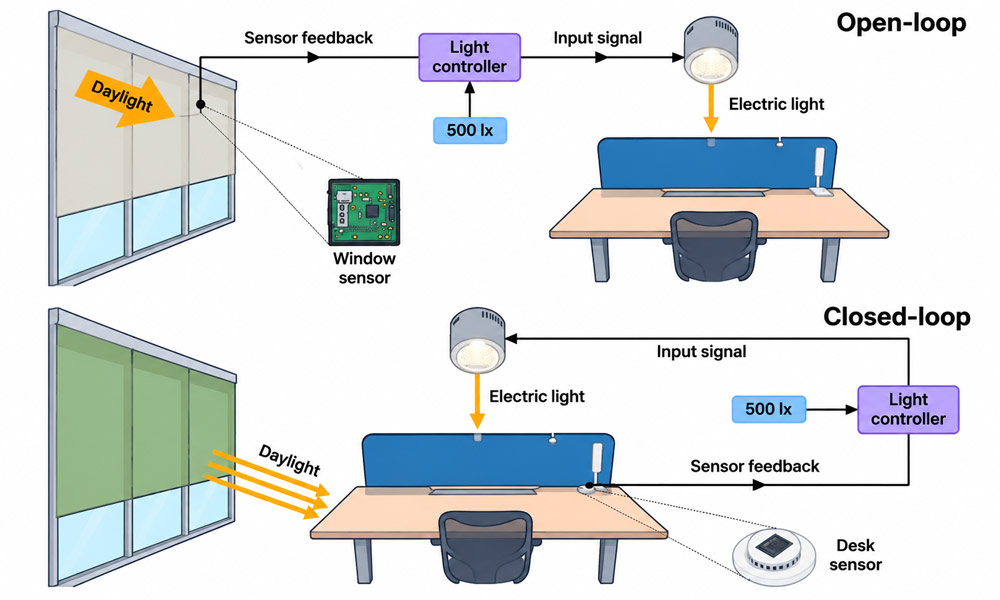
Both systems target 500 lux. Open-loop control measures daylight at the window, and closed-loop control measures daylight plus electric light at the desk.
| Sensing method | What the sensor measures | What matters in practice |
|---|---|---|
| Open-loop | Daylight from a window, skylight, or outdoor position where the controlled fixtures have little influence on the reading. | The controller uses a calibrated relationship between the daylight signal and the light expected at the work plane. Check that this relationship holds under normal shade positions and daylight conditions. |
| Closed-loop | A combination of daylight and electric light in the controlled area, commonly sensed as light reflected from room surfaces. | The controller receives feedback as fixture output changes. Aim the sensor toward a representative part of the zone and check how furnishings, reflections, and nearby fixtures affect its reading. |
An open-loop sensor can work well where daylight enters through a consistent opening and the light it sees is representative of the controlled area. A closed-loop sensor can provide closer feedback for a task area when its position and calibration are suitable. For example, a sensor looking at a bright patch of sun on the floor may cause nearby lights to dim while the desks still need more light. Changing the sensor’s view or dividing the space into smaller zones can address the cause.
Types of Daylight Harvesting Lighting Solutions
Output control and system architecture are separate design choices. A single room controller can provide continuous dimming, and a larger networked system can include both dimming and switching zones.
| Output strategy | How it works | Where it fits |
|---|---|---|
| On/off switching | A relay switches a fixture or group according to the configured light thresholds and delays. | Areas where daylight regularly provides enough light for the task and complete switching is appropriate. |
| Step dimming | Fixtures move between preset output levels, such as full, intermediate, and low. A related approach switches separate banks of fixtures to achieve several levels. | Spaces where discrete changes are acceptable. When switching banks, check that the remaining fixtures still provide suitable light distribution. |
| Continuous dimming | The controller adjusts compatible drivers across their supported dimming range. | Offices, classrooms, and other regularly occupied spaces where gradual changes help maintain stable working conditions. |
For continuous dimming, specify the lowest stable output and full shutoff behavior separately. A driver can support low-level dimming and still require a separate switching function to turn the fixture fully off. Verify that the installed fixtures dim smoothly and consistently at the levels the system will use.
For a small room, a local controller or fixture with an integral photosensor may provide the required control. A larger project can group fixtures by room, window exposure, or distance from a daylight opening. An addressable wired or wireless system can support individual fixture settings and software-based grouping. A centrally managed IoT lighting system can also show how often different zones dim, helping facility teams identify areas that stay at full output throughout the day.
Where Does Daylight Harvesting Work Best?
The strongest candidates have usable daylight at the work plane during hours when electric lights would otherwise run. A room with large windows can still have limited savings if blinds stay closed, nearby buildings block daylight, or the space is mainly used after dark. Check daylight where people work and under the shade positions they actually use.
| Space | Daylight pattern | Design priority |
|---|---|---|
| Perimeter offices | Light typically decreases with distance from windows and varies by façade orientation. | Give the window-side fixtures independent control. Evaluate a second zone where useful daylight reaches farther into the floor plan. |
| Classrooms | Desks near windows can receive much more daylight than desks across the room. | Check readings at several student desks and account for separate lighting needs at teaching surfaces. |
| Skylit warehouses | Skylights can serve broad areas, while tall racks create local shadows. | Group fixtures according to daylight distribution at aisle and work-surface level. Check conditions with the normal rack layout in place. |
| Retail spaces | Glazing may light the sales floor while displays still rely on electric accent lighting. | Identify which general lighting can dim and evaluate display lighting against its own vertical illuminance and merchandising requirements. |
A daylight zone should reflect the conditions that fixtures serve. Two rows at the same distance from a window may need separate control if they face different directions or are divided by a tall partition. Conversely, a regularly spaced skylight layout may support larger zones where measurements show a consistent daylight pattern.
How to Design and Commission a Daylight Harvesting System
Commissioning is where a lighting design becomes an operating system. A photosensor and dimmable fixtures provide the hardware. The zone assignments, sensor position, and final settings determine whether the system delivers the intended illumination in daily use.
1. Map the daylight zones. Identify windows, skylights, obstructions, and work surfaces. Use daylight modeling or on-site measurements to determine where natural light makes a meaningful contribution. Assign the fixtures serving those areas to appropriate control groups.
2. Choose representative sensor positions. Check the field of view against partitions, shelving, bright finishes, and the controlled fixtures. For a closed-loop sensor, verify that the light it sees changes in a way that corresponds to light at the task surface. For an open-loop sensor, check that the daylight reference remains useful under normal shading conditions.
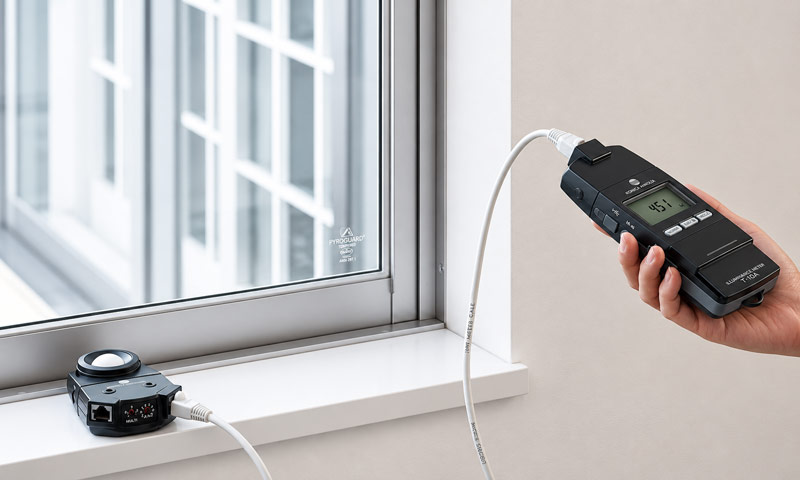
A lux meter measures illuminance near the window, and readings at several work surfaces help calibrate daylight harvesting controls for the entire zone.
3. Calibrate with a light meter. Take readings at representative work-plane points after finishes and major furnishings are in place. Verify that the installed electric lighting can meet the design target under little or no daylight. Then check the response with daylight present and adjust the setpoint or sensitivity as needed. A single bright reading next to a window gives limited information about the rest of the zone.
4. Test the full operating range. Check dimming as daylight increases and recovery as it falls. Where the sequence includes full shutoff, verify when it occurs and how the fixtures return. Walk through adjacent zones during testing to catch unintended changes in fixture groups. Review fade rates and delays under conditions that can produce rapid changes.
5. Record the final settings and readings. Keep the zone map, sensor locations, target readings, minimum output, switching thresholds, and response delays with the project records. If a tenant fit-out moves partitions or changes the work layout, those records give the facilities team a starting point for recalibration.
When performance falls short, the symptom can help locate the problem. Lights that dim too far may point to a sensor viewing an unusually bright surface. Lights that stay bright in strong daylight may point to an obstructed sensor, an aggressive setpoint, or a fixture group that was assigned incorrectly. Repeated changes near a threshold call for checking the delay, the separation between thresholds, and whether the sensor sees light from fixtures that have just switched on or off. If output is unstable at a fixed dimming level, check driver compatibility and the minimum stable setting.
How Much Energy Can Daylight Harvesting Save?
A 2012 meta-analysis of commercial lighting controls estimated that daylighting strategies had an average lighting energy savings potential of 28% across the research it reviewed. For an individual project, the result depends on how much of the lighting load is in daylit zones, how often the space operates during daylight hours, and how far fixture power can fall while the space still meets its lighting requirements.
Based on this meta-analysis, the best estimates of average lighting energy savings potential are 24 percent for occupancy, 28 percent for daylighting, 31 percent for personal tuning, 36 percent for institutional tuning, and 38 percent for multiple approaches. Williams, A., Atkinson, B., Garbesi, K., Page, E., & Rubinstein, F. (2012). Lighting Controls in Commercial Buildings. LEUKOS, 8(3), 161–180.
A project estimate starts with a baseline that provides comparable lighting service. Use the same fixtures and operating hours when evaluating the effect of adding daylight control alone. Measure input power or use validated metering data. A dimming percentage describes the control setting, and the corresponding electrical draw depends on the driver and fixture.
For example, suppose one zone draws 0.80 kW under baseline operation and averages 0.48 kW with daylight harvesting during five comparable daytime hours per workday. If those conditions apply on 250 workdays, the estimated annual savings for that zone are:
(0.80 kW − 0.48 kW) × 5 hours × 250 days = 400 kWh per year
For a building-wide estimate, calculate savings for each zone over representative periods and add them together. Measurements from a bright week and an overcast week may show different results, and shade use or seasonal changes can alter the average. For a project payback calculation, apply the relevant electricity rate to the estimated savings and account for equipment, installation, and commissioning costs.
FAQs
1. Can daylight harvesting be added to an existing LED lighting system?
Yes. Start by checking whether the existing fixtures support dimming and which control interface their drivers accept. If compatible fixtures near windows share a circuit with fixtures deeper in the room, addressable controls or revised grouping can give the window-side lights independent control. Where the installed equipment supports only fixed output, the retrofit may involve compatible drivers, replacement fixtures, or switching where that strategy is suitable and permitted.
2. Can daylight harvesting and occupancy sensors work together?
Yes. Photosensors and motion sensors provide different inputs to the controller, and a single device can incorporate both. In a meeting room, the vacancy sequence can switch the lights off after everyone leaves. When someone returns and enables the lights, the daylight sequence can limit output to the level the room needs. The project’s control sequence determines how automatic-on, manual-on, and vacancy settings interact.
3. How does daylight harvesting differ from dusk-to-dawn lighting?
Dusk-to-dawn light bulbs use an ambient light threshold to determine when nighttime lighting begins and ends. A building can use both approaches. For example, an open-sided parking structure can dim fixtures near its openings during the day, while exterior wall lights use dusk-to-dawn switching for overnight illumination.
4. Is daylight harvesting required by building energy codes?
It can be required in qualifying spaces. In the United States, for example, Section C405.2.4 of the 2024 International Energy Conservation Code addresses daylight-responsive controls for general lighting in qualifying daylight zones, subject to exceptions. The edition adopted by the project’s jurisdiction and any local amendments determine the applicable zone definitions, control functions, and verification requirements.
5. Can daylight harvesting work with tunable-white lighting?
Yes, when the fixtures and controls support independent adjustment of light output and correlated color temperature, or CCT. The daylight control can manage intensity while a schedule or scene selects a warmer or cooler appearance. During commissioning, check work-plane illuminance at the color settings the space will use. Some tunable-white fixtures deliver different amounts of light as their warm and cool LED channels change output.
