

Table of Contents
- Why Indoor Extension Cords Are Unsuitable for Outdoor Lighting
- How to Identify an Extension Cord Suitable for Outdoor Use
- Why Low-Wattage LED Lights Still Need the Correct Cord
- Protect the Plug Connections as Carefully as the Cable
- Plan the Cord Route Around How the Garden Is Used
- For Permanent Landscape Lighting, Plan the Power Source First
- Warning Signs That Require You to Stop Using the Setup
- FAQs
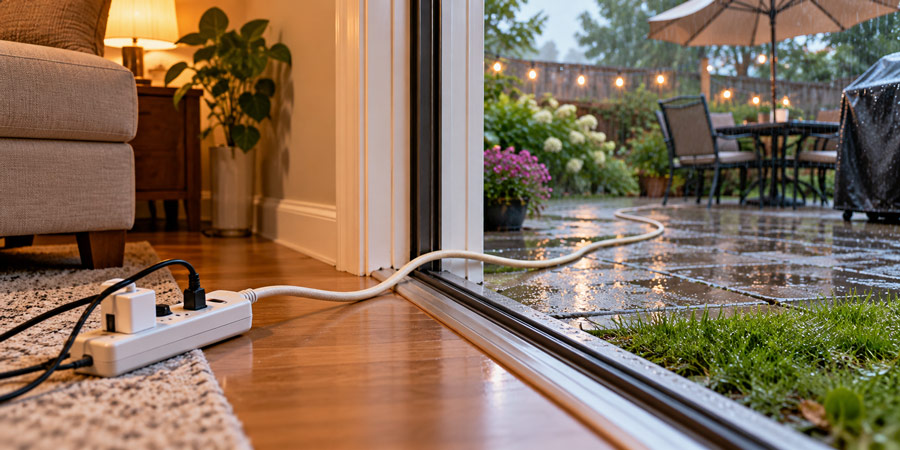
No. Indoor-only extension cords should not be used outside, even for low-wattage LED lights, a dry evening, or a covered patio. Outdoor lighting requires a cord specifically marked for outdoor use, suitable electrical protection, and connections protected against the conditions they will encounter.
For garden lighting, the challenge extends beyond getting electricity to the fixtures. A connection that looks dry when you arrange the lights can encounter irrigation water, damp vegetation, or overnight condensation while the system is running.
That leads to a useful design principle: evaluate the power route under the conditions your lights will operate in, including the hours when nobody is outside watching them.
Why Indoor Extension Cords Are Unsuitable for Outdoor Lighting
An extension cord has two separate jobs: carrying the electrical load and protecting its conductors in the intended environment. Meeting the first requirement does not establish that it meets the second.
An indoor cord might have enough electrical capacity for a few garden lights while still being unsuitable for exposure to moisture and sunlight. Its thickness, color, or three-prong plug does not establish an outdoor rating.
A Covered Patio Still Requires Outdoor Equipment
A roof reduces direct rainfall, but the space beneath it can still experience wind-driven moisture, condensation, cleaning water, and splashes.
The complete route matters, too. A plug may sit beneath an overhang while the cable crosses a damp planting bed. The conditions around the most exposed section determine what protection that section needs.
For lighting design, this means assessing the entire journey from the outlet to the fixture. A sheltered starting point does not make the rest of the installation sheltered.
Nighttime Changes the Conditions Around the Connection
Imagine connecting patio lights on a warm, dry afternoon. During the evening, someone waters nearby containers. Later, the lawn irrigation starts. Overnight, moisture collects on exposed surfaces.
These are ordinary garden activities worth considering before choosing a power route. Planning around them can prevent an apparently convenient connection from becoming the most vulnerable part of the lighting system.
How to Identify an Extension Cord Suitable for Outdoor Use
Start with the product label and instructions. Look for an explicit statement such as “for outdoor use” or “indoor/outdoor.”
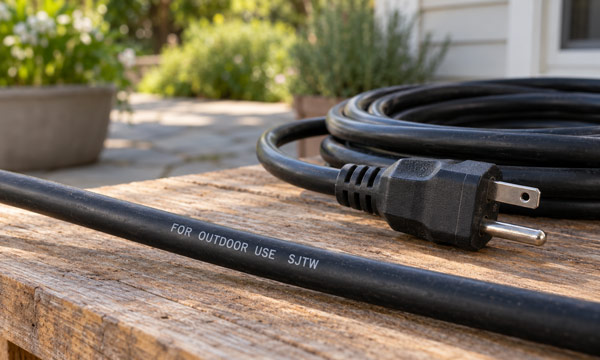
Clear outdoor-use markings help distinguish outdoor extension cords from indoor cords when planning garden lighting.
In common North American flexible-cord designations, a W indicates suitability for outdoor use. SJTW is one example. Confirm the complete cord assembly’s intended use rather than relying on a partially readable marking.
| What to check | What it tells you |
|---|---|
| Outdoor-use marking | Whether the cord is intended for an exterior environment |
| Amperage or wattage rating | Whether its capacity meets the connected equipment’s requirements |
| Length and conductor size | Whether the cord is appropriate for the distance and load |
| Plug and grounding arrangement | Whether it preserves the grounding required by the connected equipment |
| Independent safety certification | Whether the product has been evaluated by a recognized testing laboratory |
Choose the shortest length that comfortably reaches the equipment without tension. Follow the cord manufacturer’s load guidance for that length. A lower AWG number indicates a larger conductor, but conductor size alone does not establish an outdoor rating.
If the markings are missing or unreadable, use a cord with a clearly identifiable rating.
Why Low-Wattage LED Lights Still Need the Correct Cord
LED lighting can make an unsuitable connection seem harmless because the total power consumption looks small.
Suppose a garden has eight 12V fixtures rated at 5 watts each:
8 lights × 5 watts = 40 watts of fixture load
That landscape lighting wattage calculation helps establish the demand on the low-voltage system. It does not establish whether an extension cord can safely sit outside.
For a transformer-fed system, distinguish between:
- The fixture load: the lights connected to the transformer’s low-voltage output.
- The supply load: the input current drawn by the transformer from the household supply.
Select supply equipment using the transformer’s input specifications and installation instructions. Its maximum output capacity is not automatically its actual input consumption.
Most importantly, the cord feeding the transformer still carries household supply voltage. The fact that the garden fixtures operate at 12V does not make the upstream cord a low-voltage cable.
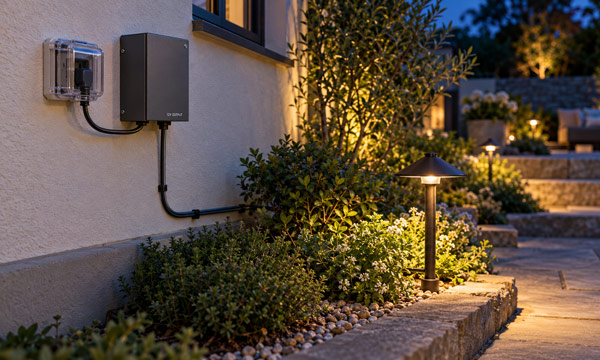
A landscape lighting transformer powers 12V garden lights, while its input cord still carries household supply voltage.
Low power consumption helps with load planning. Outdoor suitability still requires its own check.
Protect the Plug Connections as Carefully as the Cable
An outdoor-rated cable jacket does not make an ordinary plug-to-socket connection suitable for every kind of water exposure.
For outdoor lighting, inspect three places separately:
- The connection at the wall outlet.
- Any connection between the extension cord and the lighting equipment.
- The cable entry points and connections at the equipment itself.
An exposed outlet needs suitable weather protection while equipment is plugged in. A separate cord connection may need a purpose-made protective enclosure compatible with its plugs and intended exposure. Follow the enclosure’s mounting and installation instructions.
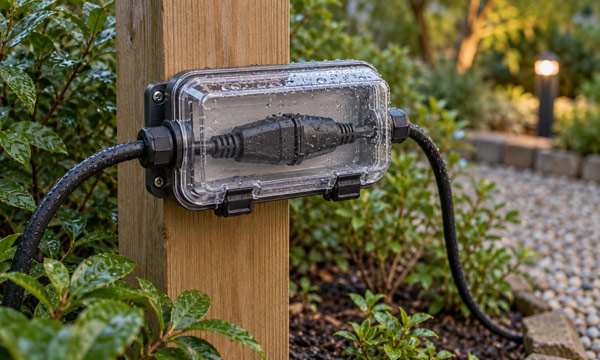
A raised outdoor connection enclosure helps protect extension cord plugs from moisture and contact with damp soil.
Keep connections away from standing water and locations where runoff collects. Raising a connection above soil can reduce exposure, but height alone does not provide weather protection.
A Fixture’s IP Rating Does Not Cover the Power Supply
A garden light’s IP65 rating describes protection provided by that particular enclosure under specified test conditions.
It does not automatically apply to a separate extension cord, plug connection, power adapter, or outlet.
This distinction matters when a weather-resistant fixture is connected through less protected accessories. Evaluate each component’s rating and installation requirements individually.
Use GFCI Protection
Outdoor cord-connected equipment should have ground-fault circuit interrupter protection.
A GFCI detects an imbalance in electrical current that can indicate electricity escaping its intended path. An ordinary circuit breaker primarily responds to excessive current, so it does not provide the same protection against electric shock.
GFCI protection adds an essential protective function. The cord and connections must still be suitable for their environment.
Plan the Cord Route Around How the Garden Is Used
A useful lighting layout should work during normal garden activity, not just while the fixtures are being installed.
Before choosing the route, consider these situations:
Watering and cleaning. Check where sprinklers spray, where pots drain, and where someone will wash the patio. A location beneath a table may still receive water from cleaning.
Furniture and foot traffic. Allow for chairs being pulled back, doors opening, and people walking through after dark. A cable should not become a trip hazard or be pinched beneath furniture.
Garden maintenance. Consider where trimming, mowing, edging, and digging happen. A route that looks discreet against a planting border may place the cable directly in a maintenance area.
Access to disconnect power. Keep the supply connection accessible. You should be able to disconnect the lighting without reaching through wet foliage or moving heavy furniture.
These checks often reveal that a different outlet or power-supply location would produce a better installation than a longer cord.
For Permanent Landscape Lighting, Plan the Power Source First

Positioning the transformer near a suitable outdoor outlet and routing low-voltage cables neatly helps keep garden paths clear of loose cords.
An outdoor extension cord is a temporary power accessory. Its outdoor rating does not make it a substitute for permanent wiring. If garden lighting depends on the same extension cord every evening, review whether the property needs a properly located outlet or a different system layout.
For a permanent low-voltage installation, position an outdoor-rated 12V landscape lighting transformer where it can connect to a suitable supply according to its instructions. Use the appropriate low-voltage cable and compatible connections to distribute power to the fixtures.
Transformer Placement Affects Both Sides of the System
Consider a flower bed at the far end of a garden.
Placing the transformer beside the bed might shorten the low-voltage cable, but it could also require an inconvenient household-voltage supply route across the property.
Placing it near a suitable outlet may simplify the supply connection while increasing the distance to the lights. That longer secondary run then requires careful landscape lighting wire sizing to control voltage drop.
The practical approach is to plan both sides together:
- Where can the transformer receive power correctly?
- How far must its low-voltage output travel?
- Would dividing the lights into separate cable runs improve the layout?
- Would an additional professionally installed outlet provide a better location?
This makes power distribution part of the lighting design from the beginning. Fixture positions, transformer placement, and cable routes should support one another.
Warning Signs That Require You to Stop Using the Setup
Stop using the affected equipment if you notice:
- A hot plug, socket, or section of cord.
- Discoloration, melting, or a burning smell.
- Cracked insulation, exposed conductors, or damaged plug parts.
- Loose connections or intermittent power.
- Repeated protective-device trips.
Hot plugs and sockets can indicate deteriorated connections, and damaged cords should be replaced. Continuing to operate the lights because they still illuminate can allow the problem to worsen.
If water surrounds an electrical connection, keep away and have the power disconnected safely before anyone handles it. Have persistent faults or damaged fixed outlets checked by a qualified electrician.
A reliable outdoor lighting installation should remain practical through watering, maintenance, and changing weather. Choosing the correct cord is one part of that work; a well-planned supply location can remove the need for an extension cord altogether.
FAQs
1. Can You Bury an Outdoor Extension Cord for Landscape Lighting?
No. A standard outdoor extension cord should not be buried to create a permanent lighting supply. Outdoor suitability and direct-burial suitability are separate characteristics. An underground installation needs cable and connections specifically approved for that installation method, with the required protection and installation details.
2. Can You Connect Two Outdoor Extension Cords Together?
Avoid connecting extension cords end to end. Use one appropriately rated cord of the required length for an approved temporary application. Each additional connection introduces another exposed connection point. If the distance makes a single suitable cord impractical, review the power-supply location.
3. Can an Outdoor Extension Cord Stay Outside During Winter?
An outdoor-use label alone does not establish suitability for every winter temperature. Check the manufacturer’s temperature limits and instructions, keep connections clear of snow and meltwater, and put the cord away when the temporary use ends. Avoid leaving extension cords exposed to snow or severe cold for extended periods.
4. Can You Use an Outdoor Smart Plug or Timer With an Extension Cord?
Only when the device’s instructions permit that arrangement. Some outdoor smart plugs require a direct connection to a fixed outlet. When selecting timer controls for landscape lighting, check the approved connection method, exposure limits, and compatibility with the lighting or transformer load.
5. Can You Repair a Damaged Outdoor Extension Cord With Electrical Tape?
No. Taping damaged insulation is an inadequate repair and does not restore the cord’s original protective construction. Disconnect the cord safely, remove it from use, and replace it. Do not continue using a damaged cord because the connected lights still work.
References & Sources
- Electrical Safety Foundation International. (n.d.). Outdoor electrical safety check: Tips for the safe outdoor use of electricity.
- Electrical Safety Foundation International. (2020, January 6). Extension cord safety tips.
- Electrical Safety Foundation International. (2023, April 25). Extension cord safety – Video short.
- Garrett, R., & Kyle, S. B. (2002, November). An evaluation of the U.S. Consumer Product Safety Commission’s electrocution reduction program. U.S. Consumer Product Safety Commission.
- UL Solutions. (n.d.). Wire and cable application guide.
- U.S. Consumer Product Safety Commission. (1990, May 1). Limit extension cords to reduce risk of fire.
- U.S. Consumer Product Safety Commission. (2012, April). Household extension cords can cause fires.
