
Understanding Landscape Lighting Wattage
Typical Wattage for Landscape Lighting
How Many Watts for Path Lights?
How Many Watts for Trees?
How Many Watts for House Uplighting?
How Many Watts for Garden Beds?
How Many Watts for Decks, Patios, and Outdoor Living Areas?
Low Voltage Landscape Lighting Wattage
LED vs Halogen Wattage
Do Higher Watts Mean Better Landscape Lighting?
How to Choose the Right Wattage
Wattage and Beam Spread
Wattage and Color Temperature
Avoiding Voltage Drop
FAQs
Choosing the right wattage for landscape lighting is not about making your yard as bright as possible. It is about using enough light to make outdoor areas safe, attractive, and functional without creating glare, wasting energy, or overpowering the natural look of the landscape.
For most modern landscape lighting systems, LED fixtures between 1 and 12 watts are enough for the majority of residential applications. Small path lights may use only 2 to 5 watts, while larger spotlights for trees, walls, and architectural features may use 6 to 12 watts or more. The exact wattage depends on what you are lighting, how large the area is, how far the light must reach, and the brightness level you want.
Understanding Landscape Lighting Wattage
Wattage measures how much electricity a light fixture uses. In the past, people often used wattage as a rough way to judge brightness. A 50-watt halogen bulb was brighter than a 20-watt halogen bulb, so wattage became associated with light output.
With LED lighting, wattage is no longer the best measurement of brightness. LEDs use far less power than older incandescent or halogen bulbs. For example, a 5-watt LED landscape light can often produce a similar useful brightness to a much higher-wattage halogen fixture.
The better measurement of brightness is lumens. Lumens tell you how much visible light a fixture produces. However, wattage still matters because it affects energy use, transformer size, wiring, voltage drop, operating cost, and heat output.
A good landscape lighting plan considers both:
- Watts: how much power the fixture consumes
- Lumens: how much visible light the fixture produces
For residential landscape lighting, the goal is usually subtle illumination, not floodlight-level brightness.
Typical Wattage for Landscape Lighting
Most residential LED landscape lights fall into a low-wattage range. Small accent lights may use only 1 to 3 watts. Path lights commonly use 2 to 6 watts. Spotlights and uplights usually use 4 to 12 watts, depending on the height and width of the object being illuminated.
Older halogen systems often used 10, 20, 35, or 50 watts per fixture. LED systems can usually achieve the same effect with much lower wattage.
|
Landscape Lighting Use |
Typical LED Wattage |
Common Brightness Range |
Best For |
|---|---|---|---|
|
2–6 watts |
100–300 lumens |
Walkways, garden paths, driveway edges |
|
|
1–4 watts |
50–200 lumens |
Stairs, deck steps, retaining walls |
|
|
Small garden accent lights |
1–5 watts |
50–250 lumens |
Flowers, shrubs, small landscape beds |
|
Uplights for small trees |
3–7 watts |
150–400 lumens |
Ornamental trees, small palms, shrubs |
|
Spotlights for medium trees |
6–12 watts |
300–700 lumens |
Trees, columns, statues, facades |
|
Wall wash lights |
4–10 watts |
200–600 lumens |
Walls, fences, textured surfaces |
|
Deck and patio lights |
2–8 watts |
100–500 lumens |
Seating areas, posts, railings |
|
Driveway entrance lights |
5–12 watts |
300–700 lumens |
Gate posts, address signs, entry columns |
These ranges are practical starting points. The right wattage can still vary depending on fixture design, beam angle, fixture placement, color temperature, and the darkness of the surrounding materials.
How Many Watts for Path Lights?
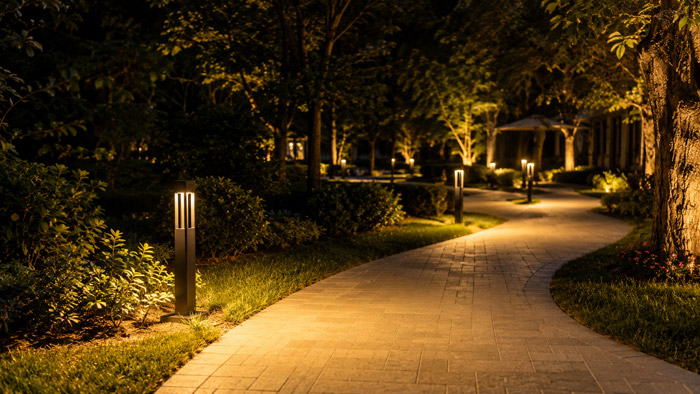
Path lights are usually designed for visibility and safety, not dramatic brightness. For most walkways, 2 to 5 watts per LED path light is enough.
A path light that is too bright can create glare and make the walkway less comfortable to use. Instead of lighting every inch of the path evenly like an indoor hallway, outdoor path lighting should create gentle pools of light that guide movement.
For narrow garden paths, 2- or 3-watt LED fixtures may be enough. For wider walkways, driveway borders, or areas with dark paving materials, 4 to 6 watts may be more appropriate.
Spacing also affects wattage. If fixtures are close together, each one can use lower wattage. If fixtures are spaced farther apart, each fixture may need slightly more output.
A common approach is to place path lights about 6 to 10 feet apart, alternating sides when possible. This gives the path a natural rhythm and avoids a runway effect.
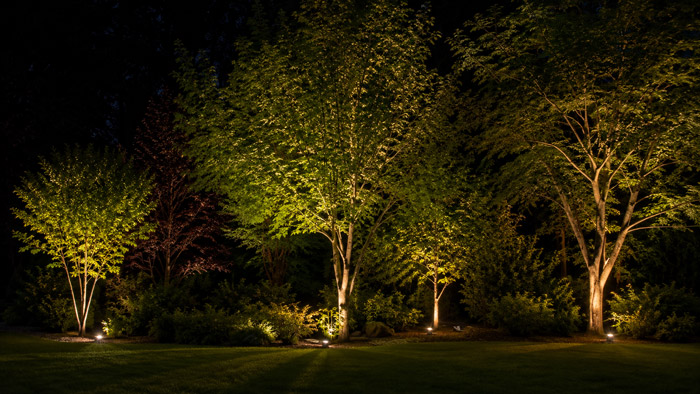
Tree lighting depends mainly on the size of the tree.
Small ornamental trees may only need one 3- to 5-watt uplight. Medium trees may need one or two fixtures in the 6- to 10-watt range. Large trees with tall trunks or wide canopies may need multiple fixtures, often 8 to 15 watts each.
The goal is not to blast the entire tree with light. A better result usually comes from lighting the trunk, branching structure, or canopy from carefully chosen angles.
For a small Japanese maple, crepe myrtle, or young palm, a low-watt LED uplight can create enough drama. For a large oak, pine, or mature palm, you may need stronger fixtures or several lower-wattage fixtures placed around the tree.
Beam angle matters as much as wattage. A narrow beam concentrates light and reaches higher into a tree. A wider beam spreads light over a larger area but may not travel as far.
How Many Watts for House Uplighting?
House uplighting usually requires more power than path lighting because the light must reach taller surfaces. For most homes, 5 to 12 watts per LED uplight or spotlight is common.
Use lower wattage for small columns, short walls, and narrow architectural details. Use higher wattage for two-story facades, large stone walls, tall columns, and broad surfaces.
The color and texture of the building material also matter. Light-colored siding, stucco, or stone reflects more light, so lower wattage may work well. Dark brick, dark wood, or matte stone absorbs more light, so the fixture may need more output.
Avoid placing very bright fixtures directly under windows or aiming them where they can shine into living spaces. Good house lighting should highlight architecture without causing glare inside the home.
How Many Watts for Garden Beds?
Garden beds usually need soft lighting. In many cases, 1 to 5 watts per fixture is enough.
Small accent lights can highlight flowers, ornamental grasses, shrubs, and decorative stones. Because garden beds are usually viewed from close range, overly bright fixtures can flatten the landscape and make plants look harsh.
Low-wattage lighting is especially effective when multiple small fixtures are used instead of one strong light. This creates depth and prevents one area from becoming too bright.
For delicate plants, low wattage also helps preserve a natural nighttime appearance. The best garden lighting often looks like moonlight or soft reflected light rather than artificial spotlighting.
How Many Watts for Decks, Patios, and Outdoor Living Areas?
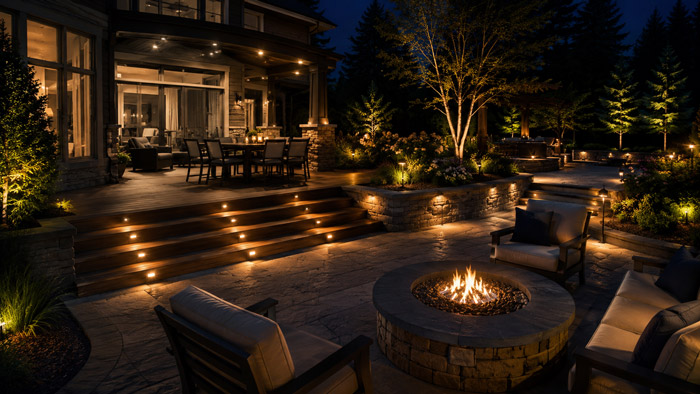
Decks and patios need enough light for comfort, safety, and basic activity. However, these areas should still feel relaxed. Most deck and patio lighting uses 2 to 8 watts per LED fixture, depending on the fixture type.
Step lights and rail lights are often only 1 to 4 watts. Post lights may use 3 to 6 watts. Wall lights or downlights for outdoor seating areas may use 5 to 10 watts.
For outdoor dining or seating areas, it is usually better to use several low-watt fixtures instead of one very bright fixture. This reduces glare and creates a more comfortable atmosphere.
If task lighting is needed for grilling, food preparation, or outdoor kitchens, that specific area may need a brighter fixture. Even then, the light should be aimed carefully to avoid shining into people’s eyes.
Low Voltage Landscape Lighting Wattage
Most residential landscape lighting systems are low voltage, commonly 12 volts. The transformer converts standard household voltage into safer low-voltage power for outdoor fixtures.
When planning a low-voltage system, total wattage is important. You need to add up the wattage of every fixture connected to the transformer.
For example:
If you have:
- 8 path lights at 4 watts each = 32 watts
- 4 uplights at 8 watts each = 32 watts
- 2 step lights at 3 watts each = 6 watts
The total fixture load is:
32 + 32 + 6 = 70 watts
A transformer should not usually be loaded to its absolute maximum. A common recommendation is to use only about 80% of the transformer’s rated capacity. For a 70-watt lighting load, a 100-watt transformer would typically be more appropriate than a 75-watt transformer.
|
Total Fixture Wattage |
Recommended Transformer Size |
Notes |
|---|---|---|
|
Up to 40 watts |
60-watt transformer |
Suitable for small path or garden systems |
|
40–80 watts |
100-watt transformer |
Common for small to medium residential layouts |
|
80–120 watts |
150-watt transformer |
Good for larger front yards or mixed lighting |
|
120–240 watts |
300-watt transformer |
Suitable for larger properties with many fixtures |
|
240–480 watts |
600-watt transformer |
Used for extensive systems or large estates |
Transformer sizing should also consider future expansion. If you may add more fixtures later, choosing a slightly larger transformer can prevent the need for replacement.
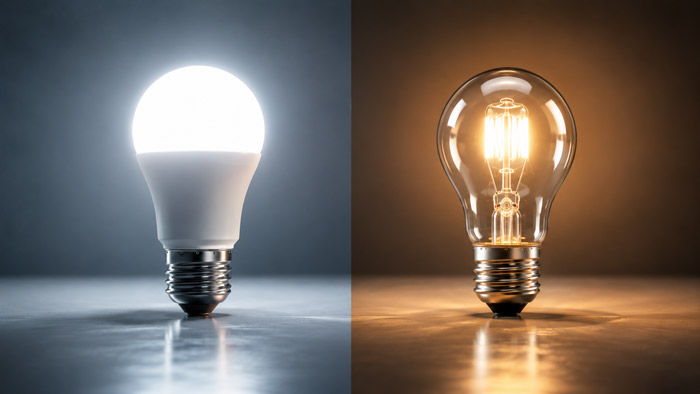
LED landscape lighting is much more energy-efficient than halogen lighting. This is one of the main reasons LED fixtures have become the standard choice.
A halogen path light might use 20 watts, while an LED path light may use only 3 or 4 watts for a similar practical effect. A halogen spotlight might use 35 or 50 watts, while an LED spotlight may use 7 to 12 watts.
This difference becomes significant across a full system. A landscape lighting system with twenty halogen fixtures could easily use several hundred watts. A comparable LED system may use less than 150 watts.
Lower wattage also means less heat, lower operating cost, smaller transformer requirements, and less strain on wiring.
See also: de Souza, D. F., da Silva, P. P. F., Fontenele, L. F. A., Barbosa, G. D., & Jesus, M. de O. (2019). Efficiency, quality, and environmental impacts: A comparative study of residential artificial lighting. Energy Reports, 5, 409–424.
Do Higher Watts Mean Better Landscape Lighting?
Higher wattage does not automatically mean better lighting. In many cases, using too many watts creates worse results.
Common problems caused by excessive wattage include:
- Glare from exposed fixtures
- Washed-out plants and architecture
- Light shining into windows
- Harsh shadows
- Higher energy bills
- Larger transformer requirements
- More noticeable light pollution
Good landscape lighting is layered. It uses the right amount of light in the right places. Some areas should be brighter for safety, while others should remain dim to create contrast and depth.
The best nighttime landscapes usually have a mix of softly lit paths, accented trees, highlighted architecture, and darker areas between them.
How to Choose the Right Wattage
Start by deciding what each fixture needs to do. A step light has a different purpose than a tree uplight. A path light has a different purpose than a wall washer.
For safety lighting, choose enough wattage to clearly define walking surfaces, steps, and edges. For accent lighting, choose enough wattage to reveal shape and texture without overpowering the object. For architectural lighting, choose wattage based on height, surface color, and viewing distance.
A practical method is to begin with moderate wattage and adjust as needed. With LED systems, many fixtures are available with replaceable lamps or adjustable output. This makes it easier to fine-tune the effect after installation.
Fixture placement can often solve brightness problems better than increasing wattage. Moving a light closer, changing the angle, using a narrower beam, or adding a second low-watt fixture can produce better results than using one powerful fixture.
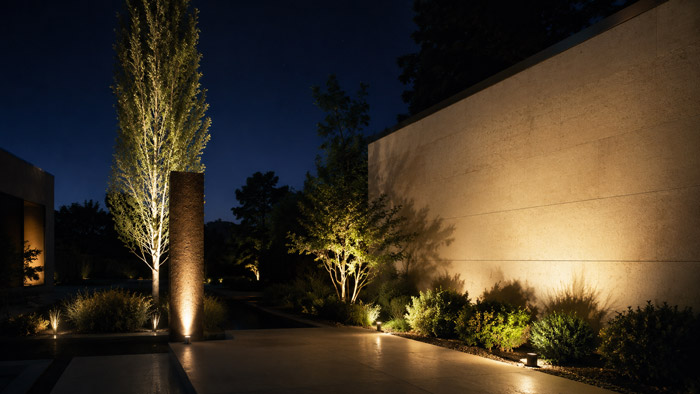
Beam spread controls how wide or narrow the light appears. Two fixtures with the same wattage can look very different if one has a narrow beam and the other has a wide beam.
A narrow beam is useful for tall trees, columns, and vertical accents. It concentrates the light, making it appear stronger. A wide beam is better for walls, shrubs, and broad surfaces, but it spreads the light out and may appear softer.
Because of this, wattage should not be chosen alone. A 7-watt narrow spotlight may look brighter than a 10-watt wide floodlight in a specific spot because the light is focused into a smaller area.
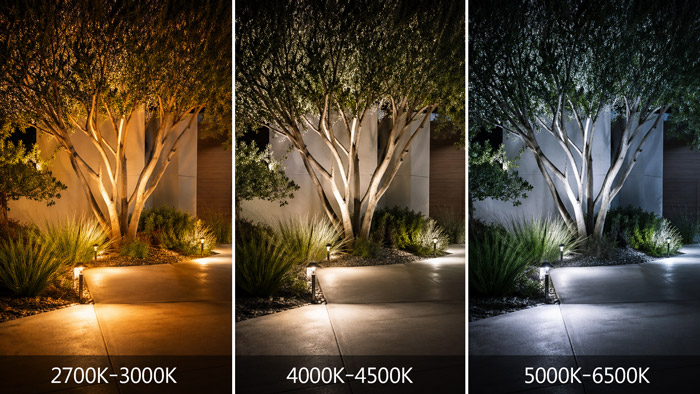
Color temperature affects how bright light feels. Warm white light, commonly around 2700K to 3000K, is popular for residential landscape lighting because it feels natural and comfortable.
Cooler light can appear sharper and brighter, but it may also feel less inviting in outdoor residential spaces. Very cool lighting can make plants and stone look unnatural.
Because warm light feels softer, some people are tempted to increase wattage. This should be done carefully. For most homes, warm low-wattage lighting creates a better result than high-wattage cool lighting.
See also: Yang, W., & Jeon, J. Y. (2020). Effects of correlated colour temperature of LED light on visual sensation, perception, and cognitive performance in a classroom lighting environment. Sustainability, 12(10)
In low-voltage landscape lighting, voltage drop happens when electricity travels through long wire runs and loses power along the way. Fixtures at the far end of the cable may appear dimmer than fixtures close to the transformer.
LED systems are less demanding than halogen systems because they use fewer watts, but voltage drop can still matter.
To reduce voltage drop:
- Keep wire runs reasonable
- Use thicker cable for longer runs
- Avoid overloading one cable line
- Use proper transformer taps when available
- Divide large systems into multiple runs
Using lower-watt LED fixtures helps reduce the problem because the system draws less current.
How do I calculate the electricity cost of landscape lighting?
To calculate the electricity cost, multiply the total system wattage by the number of hours used, then divide by 1,000 to convert watts to kilowatt-hours.
Formula:
Total watts × hours used ÷ 1,000 × electricity rate = daily cost
For example, a 100-watt LED landscape lighting system running 6 hours per night uses:
100 × 6 ÷ 1,000 = 0.6 kWh per night
If electricity costs $0.15 per kWh, the daily cost is:
0.6 × $0.15 = $0.09 per night
This means many LED landscape lighting systems cost only a few dollars per month to operate.
How many landscape lights can I put on one cable run?
The number of landscape lights on one cable run depends on the total wattage, cable gauge, run length, and transformer capacity. For LED systems, one cable run may support several fixtures because LEDs use low power.
However, it is better not to place too many fixtures on a single long run. A balanced layout with multiple shorter cable runs usually provides more consistent brightness and better long-term performance.
For larger systems, dividing lights into zones is often the best approach.
What gauge wire should I use for landscape lighting?
The most common wire sizes for low-voltage landscape lighting are 12-gauge, 14-gauge, and 16-gauge.
For short runs with low-wattage LED fixtures, 14-gauge or 16-gauge wire may be enough. For longer runs or systems with more fixtures, 12-gauge wire is usually a better choice because it reduces power loss.
As a general rule, use thicker wire when the cable run is longer, the fixture load is higher, or the lights are far from the transformer.
Should landscape lights be wired in series or parallel?
Landscape lights should usually be wired in parallel, not series.
In a parallel layout, each fixture receives power independently from the main cable. This helps maintain more consistent brightness and makes the system easier to troubleshoot.
A series connection is not recommended for most landscape lighting because if one fixture fails or has a connection problem, it can affect the rest of the lights on that circuit.
What IP rating is best for outdoor landscape lights?
For outdoor landscape lighting, look for fixtures with at least an IP65 rating. This means the fixture is protected against dust and low-pressure water jets, making it suitable for most outdoor conditions.
For fixtures installed near sprinklers, wet garden beds, or exposed areas, IP66 or IP67 may be better. For lights installed in areas that may be temporarily submerged, such as pond edges or drainage-prone zones, IP68-rated fixtures are usually required.
A proper IP rating helps prevent water damage, corrosion, short circuits, and premature fixture failure.
