
Table of Contents
- Choose a power source that fits the way you use your shed
- Lighting the path and entrance
- 1. Light the last turn in the path
- 2. Position the door light with the door open
- Lighting the shelves and potting bench
- 3. Aim the interior light at the fronts of the shelves
- 4. Set up the bench light with a full pot on the worktop
- 5. Let daylight reach the bench from the side
- Evening lighting for the garden and porch
- 6. Turn one garden-facing window into a lantern
- 7. Choose porch lighting from a seated position
- 8. Give the entrance and workbench different controls
- A two-light layout for a small shed without electricity
- FAQs
Park in your driveway after dark, switch off the headlights, and open the passenger door. Can you see where your foot will land? From that same spot, can you tell where the front walk turns and which door a guest should use? A pair of garage lanterns can light up an entire driveway and still leave someone holding a casserole, wondering how to get to the porch.
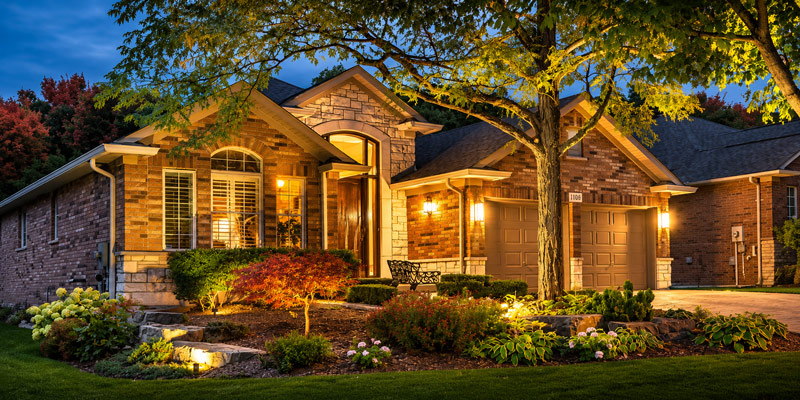
The most useful front yard landscape lighting ideas come from walking that route. On a rough landscape lighting plan, mark where people get out of the car, change direction, step up, and reach for the door. Then pick one thing you would enjoy seeing after everyone is inside. It might be the peeling bark of a birch or the low stone wall you built around a flower bed. That last choice is what makes the yard feel like yours.
Light the route from the driveway to the front door
1. Light the ground beside a parked car
An empty driveway is a poor place to judge driveway lighting. Pull a car into its usual spot and watch what happens to the light from the garage. The vehicle may cast its deepest shadow directly beside the passenger door, exactly where someone steps out.
Try a low, shielded fixture in the planting bed on the walkway side of the parking space. Aim it across the strip of pavement where passengers put their feet, and keep it clear of the open door. On a two-car driveway, try the arrangement with both vehicles home. Then sit in the driver’s seat and look toward the street. The paving should be visible from that lower viewpoint, with the lamp itself hidden by its shield.
2. Put a pool of light just beyond a bend
On an L-shaped walk, a light just beyond the turn can show a visitor the next few feet of paving before they reach the corner. Try it on the outside of the bend, where the beam can reach across the junction. Stand several paces back. A good position lets you see both where the current stretch ends and where the next one begins.
For a straight walk, start with two sample lights at their intended height. Walk through the space between them while looking ahead. If the edge of the path disappears midway, bring the lights closer together or try a broader beam. Check the planting beside them, too. A fixture that clears freshly planted lavender in April may send half its light into the leaves by August.
3. Check the steps on the way back down
Porch steps can look beautifully lit from below. From the top landing, a visitor leaving the house may see a bright driveway beyond several treads that seem to blend together. The view from above is the one worth designing for first.
A shielded light recessed into a sidewall can cast light across the tread so its front edge is visible. A concealed fixture beneath a handrail can do a similar job. Check the full width people use, including the bottom landing. Look for shadows cast by railing posts, too. A dark stripe halfway across a tread can look like another edge. Moving the fixture a little sideways can clear up the pattern.
4. Give the latch side of the front door some light
A recessed porch often looks dark from the sidewalk even when the ceiling fixture is on. Let a little light reach the vertical wall beside the door handle. That patch helps a guest recognize the entrance from an angle and gives them light where they need it to find the bell or read a keypad.
One of the simplest tests for front door lighting takes two people. Have someone stand at the bell holding a package while you open the door from inside. Can you see their face? Can they read the keypad with their free hand? If their shoulder puts the keys in shadow, try a shaded light to one side. On a pale porch, reflecting a little light from the wall can be enough.
5. Make the house number readable from both directions
Raised metal numbers can cast a second set of digits on the siding when a narrow spotlight hits them from the side. A small, shielded light above a matte plaque usually gives the numerals a clearer outline. Dark numbers on a pale backing, or pale numbers on a dark backing, also give the light less work to do.
Read the address from both directions on the sidewalk. From one approach, the number may be perfectly clear. From the other, a porch post or the top of a hedge may hide the final digit. In that situation, moving the plaque a few inches can solve a problem that a brighter lamp would leave in place.
Give the trees, planting beds, and house a sense of depth
6. Choose the part of the tree you want to see
When lighting an ornamental tree, start with what you like about it in daylight. A Japanese maple may owe its character to the fine outline of its branches. If it grows against a pale wall, try lighting a patch of wall behind it. The branches appear in silhouette, and even the small gaps between them become part of the view.
A river birch in an open lawn calls for a different approach. Aim a shielded accent from one side at the fork of the trunk. The curls of bark cast small shadows that reveal their texture. Check the aim again after the leaves fall. A beam that ended in dense foliage in July may have a clear line to an upstairs window in November.
7. Try two angles on brick or stone before choosing one
Light skimming down the face of rough stone brings out ridges, deep joints, and the work of the person who laid it. It also reveals patched mortar. Before repeating that effect across the house, try it on one section. Then move a broad-beam fixture farther from the wall and compare the softer wash. You can decide which details deserve attention from the sidewalk.
The beam angle of a spotlight matters when the target sits beside glass. At a distance of 8 feet, a circular 25-degree beam aimed straight at a flat surface is about 3.5 feet wide. A 40-degree beam at the same distance is about 5.8 feet wide. For a 4-foot masonry pier beside a front window, that difference gives you a reason to try the narrower beam first. Light fades beyond the nominal beam edge, so finish the test by looking out through the window.
8. Give a seasonal flower bed something worth lighting in winter
Picture a bed of hostas around a boulder. A light aimed into the middle of the leaves can look lovely in June. After the first frost, the same beam may pass over the empty bed and land on the siding. Aim a small, shielded light across one shoulder of the boulder and the composition works through both seasons. Summer leaves interrupt the light. In winter, the stone still has shape.
This works particularly well in a shallow front yard. Choose a boulder, planter, or low evergreen on the opposite side of the garden from the porch. From the street, the eye travels diagonally between that feature and the entry. A stretch of darker planting between the two gives even a narrow bed a foreground and a background.
9. Design one view from the living room
Take a seat in the front room with the blinds at their usual height and the reading lamp on. A landscape fixture that disappears behind a shrub from the sidewalk can be the brightest thing in sight from the sofa. Rotate its shield toward the house or shift its position until you can see the lit trunk or wall comfortably from your chair.
If the strongest feature in the window is the reflection of your own table lamp, switch it off briefly. If the garden suddenly comes into view, try moving the indoor lamp to one side. It is a surprisingly effective adjustment to make before adding another light outdoors.
How the layout changes with the front yard
| Front yard layout | A layout to try | The detail that decides whether it works |
|---|---|---|
| A townhouse with a short setback and a shared front walk | Use the stoop’s sidewall to direct light across your steps. Let reflected porch light pick up a planter beside the door. | From the shared walk, check that the lamp face stays hidden as you pass the adjoining entrance. |
| A single-story house with a 24-foot walk that turns at a flower bed | Keep the existing porch light on. Try one path light just beyond the elbow, then use a movable sample to locate any gap between the car and the turn. | Park the larger household vehicle in its usual space. Its shadow will show whether the first stretch needs its own light. |
| A sloping corner lot with two street approaches | Light the upper landing from the house side. Give the lower path entrance its own shielded light if the slope hides it from above. | Look uphill from both sidewalks. The downhill view can expose a lamp that appears well shielded from the porch. |
Before fixing the positions, walk the route once after rain. Wet paving can reflect a lamp as a bright streak right across the edge of a step. If you are comparing two arrangements in photos, stand in the same place and lock the camera exposure for both shots. Then make the final choice on foot, where you can judge the moment a turn becomes visible or a reflection crosses your line of sight.
FAQs
1. How much does it cost to install front yard landscape lighting?
A reasonable starting allowance for residential landscape lighting installation is $150 to $400 per installed fixture. At that rate, an eight-light front yard comes to roughly $1,200 to $3,200. When comparing quotes, ask whether each one includes the transformer, cable, labor, and restoration of disturbed paving. A cable route that crosses a finished driveway can change the price considerably.
2. Is 2700K or 3000K better for front yard landscape lighting?
Both are warm white. Of the two, 2700K has a more golden appearance and is a good starting point for red brick, cedar, and warm-toned stone. 3000K looks slightly more neutral and can suit gray masonry. The easiest way to choose between 2700K and 3000K landscape lighting is to shine both samples on the same surface with your porch light on. You will see which one fits the entrance you already have.
3. Do solar landscape lights work in a shaded front yard?
They can work in partial shade, though less sunlight on the panel generally means a shorter run time after dark. For a decorative planter, that may be fine. For a shaded route you regularly use late in the evening, wired low-voltage lighting provides more predictable coverage. A solar fixture with a separate panel is another option when the planting bed is shaded but a nearby spot receives direct sun.
4. How many landscape lights can one low-voltage transformer power?
Add the input load of the fixtures you intend to connect and compare it with the transformer’s permitted load. Use the VA rating, or volt-amperes, when the fixture manufacturer supplies it. For example, ten fixtures rated at 5 VA each add up to 50 VA. Check the limit on each output as well as the total capacity. On a long cable run, wire size and voltage drop also affect how much voltage reaches the last fixture.
5. Should front yard landscape lights stay on all night?
For most homes, decorative tree and wall lights can go off after the household’s usual arrival time. A landscape lighting timer can handle that schedule while the entrance operates separately for late arrivals. If a motion sensor controls the entry, walk toward it from the sidewalk to check that the light comes on before you reach the first step. Then walk the route at an unhurried pace to make sure it stays on until you reach the door.
