
Table of Contents
- Part 1. What Does Hardscape Mean?
- Part 2. What Is the Difference Between Hardscape and Softscape?
- Part 3. What Are Common Examples of Hardscape?
- Part 4. What Materials Are Used in Hardscaping?
- Part 5. What Goes Into a Hardscape Installation?
- Part 6. Why Is Hardscape Important in Landscape Design?
- Part 7. How Do You Plan a Hardscape Design?
- Part 8. How Does Hardscape Affect Drainage?
- Part 9. What Is Hardscape Lighting?
- Part 10. What Hardscape Design Mistakes Should You Avoid?
- Part 11. Where Is Hardscape Used?
- Part 12. How Do You Maintain Hardscape?
- Part 13. FAQs About Hardscape
Hardscape refers to the nonliving, constructed elements of an outdoor landscape, including patios, walkways, retaining walls, driveways, decks, and built-in garden features. These elements give an outdoor space its structure and provide surfaces for walking, seating, and everyday use.
A stone patio surrounded by flowers is a simple example: the patio is hardscape, while the flowers belong to the softscape. Understanding how these elements work together helps you create an outdoor space that looks balanced and functions well.
Part 1. What Does Hardscape Mean?
In landscape design, hardscape describes the built or deliberately placed features that organize an outdoor environment. These features may sit at ground level, rise vertically, or provide an overhead structure.
Common hardscape materials include:
- Concrete and concrete pavers
- Brick and natural stone
- Gravel and decorative rock
- Timber and composite decking
- Metal used for edging, fences, and structures
Hardscape does not have to be made entirely from stone or other mineral materials. A wooden deck or pergola also qualifies because it serves as a constructed landscape feature.
The related term hardscaping describes the process of designing and installing these elements.
Part 2. What Is the Difference Between Hardscape and Softscape?
Hardscape provides the physical framework of a landscape. Softscape consists primarily of its living horticultural elements, including trees, shrubs, flowers, lawns, and ground covers.
Landscaping brings both together.
| Feature | Hardscape | Softscape |
|---|---|---|
| Main elements | Patios, paths, walls, decks, and fences | Trees, shrubs, flowers, and grass |
| Primary role | Defines spaces and supports outdoor activities | Adds planting, shade, seasonal interest, and habitat |
| Typical materials | Stone, concrete, brick, wood, and metal | Living plants |
| How it changes | Changes through construction, repairs, and weathering | Changes through growth and seasonal cycles |
| Routine care | Cleaning, inspections, and material repairs | Watering, pruning, feeding, and plant care |
For example, a garden path provides a defined walking route, while planting along its edges adds color and softens its appearance.
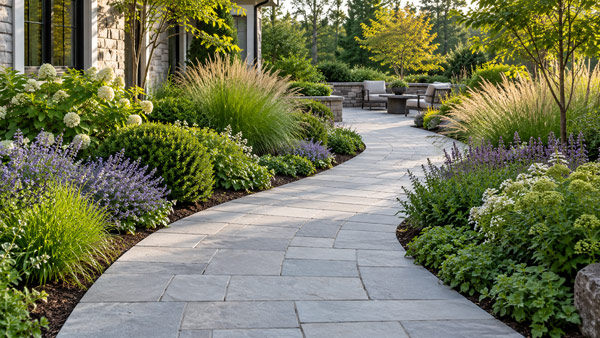
Stone paving defines the garden path, while surrounding plants show how hardscape and softscape work together.
A successful landscape considers both elements from the beginning. The paving should leave enough space for plants to mature, and the planting should preserve access to paths, entrances, and seating areas.
Part 3. What Are Common Examples of Hardscape?
Hardscape appears in nearly every type of designed outdoor space. Its form depends on how people need to use the property.
Patios and Outdoor Living Areas
Patios provide a stable surface for dining, relaxing, and entertaining. They may be built from concrete, pavers, brick, or natural stone.
Their layout should accommodate furniture and allow people to move comfortably around tables, chairs, and doors.
Walkways and Driveways
Walkways connect entrances, gardens, patios, and other destinations. Their design influences how people move through the landscape.
Driveways also belong to hardscape, but they need materials and construction suitable for vehicle loads. A paving system intended for a garden path may be unsuitable for a driveway.
Retaining Walls and Garden Edging
Retaining walls hold back soil and help create usable areas where ground levels change. Their design must account for soil pressure, drainage, and nearby loads.
Garden edging has a smaller role. It separates planting beds from lawns, paths, or gravel areas and helps maintain clear boundaries.
Outdoor Steps
Steps connect different elevations between entrances, terraces, and garden areas.
Consistent dimensions, suitable surface texture, and clear visibility help people recognize changes in level.
Decks, Pergolas, and Fences
Decks create raised platforms for outdoor activities. Pergolas define overhead space and may support climbing plants or shade systems.
Fences provide boundaries, screening, and privacy. Although these structures often use wood, they remain part of the hardscape.
Built-In Garden Features
Other examples include masonry fire pits, outdoor kitchens, fixed seating, fountains, and constructed pond surrounds.
For a planted water feature, the constructed basin and surrounding paving are hardscape, while its aquatic plants are softscape.
Part 4. What Materials Are Used in Hardscaping?
The most suitable hardscape material depends on the feature’s purpose, exposure, maintenance needs, and relationship with the surrounding architecture.
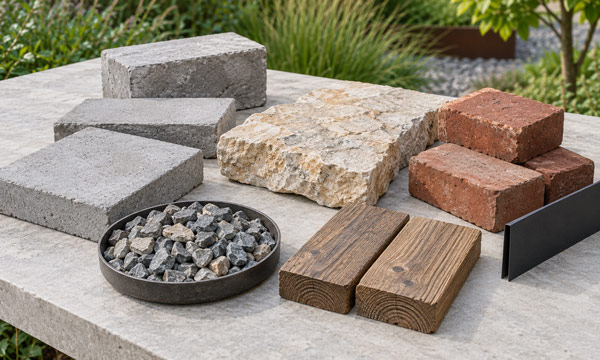
Concrete pavers, natural stone, brick, gravel, timber, and metal provide distinct textures and practical options for hardscape design.
| Material | Common applications | Main advantages | Important considerations |
|---|---|---|---|
| Poured concrete | Patios, paths, driveways, and steps | Creates continuous surfaces with several finish options | Requires appropriate joints, drainage, and crack control |
| Concrete pavers | Patios, walkways, and driveways | Offers varied patterns and allows individual units to be replaced | Needs a correctly designed base, joints, and edge restraint |
| Brick pavers | Paths, courtyards, and patios | Provides a traditional appearance and distinctive color | Use paving products suitable for the intended exposure and traffic |
| Natural stone | Patios, steps, walls, and garden paths | Offers natural texture and variation | Strength, porosity, and wet slip resistance vary by stone and finish |
| Gravel | Informal paths, decorative areas, and seating spaces | Suits flexible layouts and informal garden styles | Loose material can migrate and may be difficult for some users to cross |
| Wood | Decks, fences, pergolas, and screens | Adds warmth and works well for raised structures | Requires suitable detailing and protection for outdoor exposure |
| Composite decking | Decks and raised seating areas | Provides consistent boards and varied finishes | Heat buildup, expansion, and support requirements vary by product |
| Metal | Edging, fences, screens, and structural details | Creates slim profiles and defined boundaries | Corrosion resistance and exposed surface temperatures need consideration |
Evaluate samples under actual site conditions when possible. A surface that looks attractive indoors may appear different in direct sunlight or become uncomfortable when wet or hot.
Part 5. What Goes Into a Hardscape Installation?
A finished hardscape surface is only one part of the installation. Much of its performance depends on the support beneath it.
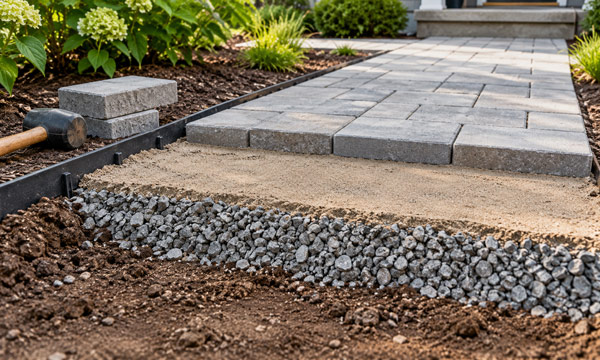
A paver walkway under construction reveals the bedding sand and aggregate base that support a stable hardscape surface.
A conventional paver installation commonly includes:
- Prepared ground: Unsuitable material is removed, and the supporting ground is assessed.
- Aggregate base: A properly specified and compacted base supports the paving.
- Bedding layer: A suitable setting layer provides consistent support beneath individual units.
- Pavers and joints: The surface units and jointing material work together as a paving system.
- Edge restraints: Appropriate restraints help keep the paved area in position.
The exact construction varies with soil conditions, climate, drainage, and expected loads. Permeable paving, mortared stone, concrete slabs, and raised decks require different approaches.
A single standard base depth should therefore never be applied to every hardscape project.
Part 6. Why Is Hardscape Important in Landscape Design?
Hardscape gives outdoor spaces a practical purpose and a clear layout.
Creates Usable Outdoor Areas
A patio provides space for furniture, while paths connect the places people use most often. These features make an outdoor area easier to access and enjoy.
Organizes the Landscape
Walls, edging, paving patterns, and level changes help distinguish entrances, dining spaces, planting areas, and private corners.
This organization can make a compact garden feel more intentional without filling it with additional features.
Helps Address Changes in Ground Level
Properly designed retaining walls, terraces, and steps can make sloping areas more useful.
Their success depends on suitable structural support and drainage, particularly where the work affects substantial slopes or nearby structures.
Can Reduce Irrigated Lawn Area
Replacing selected lawn areas with patios, paths, or decks can reduce the amount of landscape requiring irrigation. The result depends on the overall planting and water management plan.
Part 7. How Do You Plan a Hardscape Design?
A practical hardscape plan begins with how the space will be used.
1. Identify the Main Activities
Decide whether the priority is outdoor dining, entertaining, everyday access, privacy, or a quiet seating area.
The activities should determine the size and position of the main features.
2. Map Existing Site Conditions
Record buildings, doors, trees, property boundaries, utilities, slopes, and existing drainage routes.
Observe where sunlight falls and where water collects after rain.
3. Establish Clear Connections
Connect frequently used destinations with direct, comfortable routes. Consider how people will travel between the house, driveway, garden, and seating areas.
Avoid layouts that force people to take unnecessary detours.
4. Keep the Material Palette Consistent
Choose a small group of complementary materials. Repeating a paving color, wall finish, or edging detail can connect different areas of the property.
Use changes in material where they help identify a different function or destination.
5. Leave Space for Plant Growth
Allow room for mature plant sizes and consider the effect of roots on nearby structures.
Planting should frame outdoor spaces while preserving clear walking routes and access for maintenance.
6. Coordinate Lighting Before Construction
Include cable routes, fixture positions, and access points in the initial plan. Coordinating landscape lighting design with the hardscape layout makes it easier to integrate lighting into walls, steps, and paved areas.
Part 8. How Does Hardscape Affect Drainage?
Hardscape changes how rainwater moves across a property.
Conventional concrete and many other solid surfaces limit infiltration. Water must be directed toward an appropriate drainage destination rather than allowed to collect beside buildings or on walking surfaces.
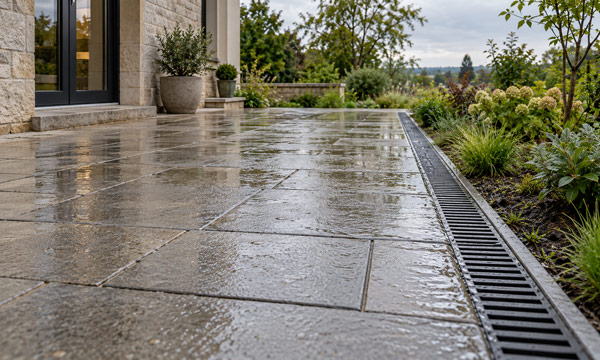
A linear channel drain collects runoff along the patio edge, helping direct rainwater away from the house and walking surface.
Permeable paving offers another approach. A correctly designed system allows water to pass through the surface or joints into underlying layers, helping reduce surface runoff. Its performance depends on the complete pavement system and site conditions.
Leaving gaps between ordinary pavers does not automatically create an effective permeable pavement.
When planning drainage, consider:
- Surface levels and drainage directions
- Soil infiltration conditions
- Water arriving from roofs or neighboring areas
- Drainage behind retaining walls
- Access for clearing drains and inspecting outlets
Drainage should be resolved alongside the layout and construction details.
Part 9. What Is Hardscape Lighting?
Hardscape lighting illuminates built landscape features such as walls, steps, patios, and paved routes.
Fixtures may be recessed into a structure, concealed beneath an edge, or positioned beside the feature they illuminate.
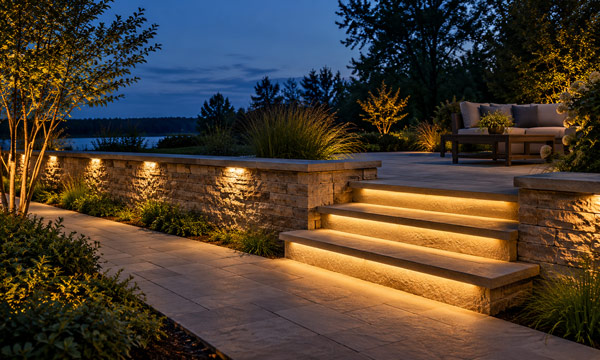
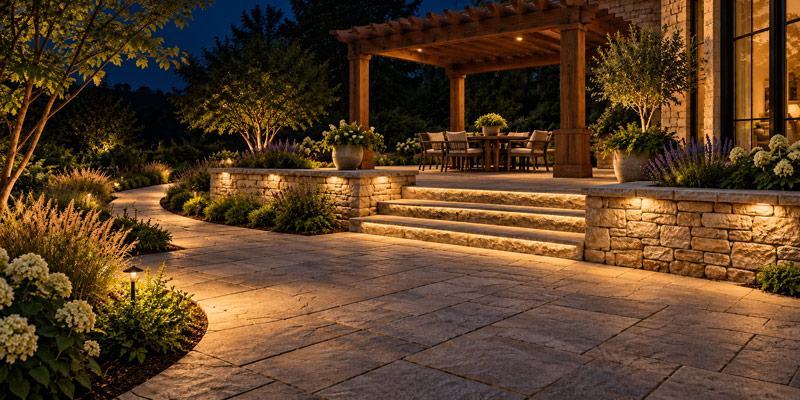
Warm hardscape lighting beneath wall caps and step edges highlights stone textures and makes changes in elevation easier to see at night.
| Hardscape feature | Common lighting approach | Main purpose |
|---|---|---|
| Retaining walls | Under-cap or recessed wall lights | Reveals the wall face and nearby boundaries |
| Outdoor steps | Riser lights or concealed linear lighting | Makes changes in elevation easier to recognize |
| Walkways | Shielded path lights or suitable recessed fixtures | Defines the walking route |
| Patios | Wall lights, overhead lighting, and task lighting | Supports seating, dining, and outdoor activities |
| Textured masonry | Carefully aimed accent lighting | Reveals surface texture and selected details |
Light the Features People Need to See
On masonry structures, hardscape lighting for retaining walls can reveal boundaries and illuminate adjacent areas.
Position fixtures so the light reaches the intended surface while keeping bright light sources out of normal viewing angles.
Match Path Lighting to the Layout
The appropriate spacing between pathway lights depends on fixture height, light distribution, path width, and surrounding illumination.
Check the layout after dark, paying particular attention to bends, intersections, and level changes.
Choose Color Temperature Intentionally
Both 2700K and 3000K landscape lighting are common warm-white options. Their appearance differs, so compare them against the actual brick, stone, concrete, or timber being illuminated.
Color temperature alone does not determine visibility. Light distribution, brightness, contrast, and glare also matter.
Control Brightness and Operating Hours
Use shielded, carefully aimed fixtures and the lowest light level that serves the intended activity. Timers, dimmers, and motion controls can limit unnecessary operation and light spill.
Part 10. What Hardscape Design Mistakes Should You Avoid?
Several common decisions can reduce the comfort and durability of a hardscape project.
- Paving more space than necessary: Excessive paving can reduce planting opportunities and make the landscape feel harsh.
- Choosing materials only by appearance: Wet traction, heat exposure, and maintenance also affect suitability.
- Ignoring expected loads: A driveway and a pedestrian path require different construction considerations.
- Underestimating ground preparation: Attractive paving cannot compensate for inadequate support.
- Leaving drainage unresolved: Water problems are difficult to address once surfaces and structures are complete.
- Creating awkward transitions: Abrupt edges and poorly coordinated levels can interrupt movement.
- Overlighting the space: Excessive brightness can create glare and make outdoor seating uncomfortable.
Part 11. Where Is Hardscape Used?
Hardscape supports different activities across residential and commercial settings.
| Setting | Typical hardscape features | Design priority |
|---|---|---|
| Front yards | Entrance paths, driveways, steps, and boundary walls | Clear access and a coherent entrance |
| Backyards | Patios, decks, outdoor kitchens, and fixed seating | Comfortable everyday use |
| Small courtyards | Compact paving, built-in benches, and screens | Efficient use of space |
| Sloping gardens | Retaining walls, terraces, and steps | Stable, connected outdoor areas |
| Hotels and restaurants | Dining terraces, walkways, and courtyards | Guest circulation and comfort |
| Public landscapes | Plazas, paths, seating, and paved gathering areas | Accessibility, durability, and maintenance |
The same material may serve several settings, but its specification and installation must suit the intended use.
Part 12. How Do You Maintain Hardscape?
Hardscape needs regular inspection and care to preserve its appearance and function.
Remove leaves and accumulated debris, particularly around drainage openings and shaded areas. Use cleaning products and methods approved for the specific material.
Inspect paved surfaces for settlement, loose units, damaged edges, and uneven transitions. Check decks, fences, and pergolas for loose fixings or deteriorated components.
After heavy rain, look for standing water or new erosion around paved areas and walls. Repeated drainage problems deserve investigation.
Keep lighting lenses clean and check that growing plants have not blocked the intended light distribution. Fixtures and connections should remain accessible for servicing.
Part 13. FAQs About Hardscape
1. How Much Does Hardscaping Cost?
Hardscaping costs depend on the feature being built, its size, material specifications, site access, excavation requirements, and installation complexity.
A small gravel seating area and a structural retaining wall involve very different work, so a single price per square foot cannot represent every project.
Request itemized installed quotations covering ground preparation, materials, drainage, labor, removal of waste, and any lighting. Compare quotations against the same scope and construction specifications.
2. Can You Install Pavers Over an Existing Concrete Patio?
Yes, a paver overlay may be possible when the existing concrete is sound and the proposed system suits the application.
The installer must assess drainage, slab defects, added surface height, door clearances, and connections to surrounding steps or paths. An overlay should not be used to conceal an unstable or badly deteriorated slab. Existing problems need to be addressed before the new surface is installed.
3. Why Do Weeds Grow Between Pavers?
Weeds can grow when windblown seeds settle into dirt and organic debris that accumulate in paving joints. Their presence does not necessarily mean they have grown upward from beneath the entire pavement.
Remove established weeds, clear accumulated debris, and restore the correct jointing material for the paving system. Joint maintenance requirements differ between conventional and permeable installations, so follow the system manufacturer’s guidance.
4. Do You Need to Seal a Paver Patio?
Follow the paver manufacturer’s recommendation for the specific product. A compatible sealer can help protect appearance and reduce staining, but its suitability depends on the paving material, finish, and exposure.
Surface preparation and application conditions matter. Clean the paving, observe the specified drying and curing requirements, and avoid excessive application, which can create haze or an unwanted surface film. Sealing does not repair settlement or structural defects.
5. Can You Add Hardscape Lighting After Construction?
Yes. Surface-mounted fixtures and lights positioned beside paved areas can often be added to an existing landscape.
Recessed installations usually require more investigation because cable routes, mounting space, drainage, and maintenance access must be accommodated. Adding lights in concrete may involve cutting or drilling, depending on the fixture and structure. Assess the existing construction before selecting the installation method.
