
Improved Nighttime Safety
Enhanced Outdoor Appearance
Better Use of Outdoor Spaces
Increased Property Value and Curb Appeal
Subtle Illumination Without Glare
Greater Energy Efficiency
Weather Resistance and Long-Term Durability
Improved Landscape Security
Key Benefits at a Glance
Choosing the Right Lighting Design
Conclusion
FAQs
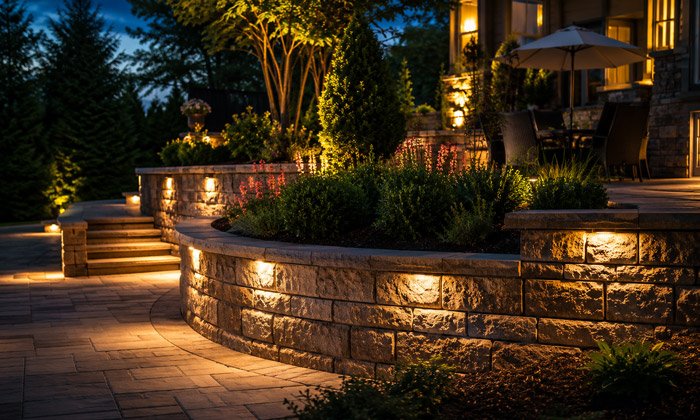
Retaining walls are commonly used to control soil erosion, create level areas, and improve the structure of an outdoor space. However, their value does not have to end when the sun goes down. Hardscape lighting can transform a retaining wall into a functional and attractive nighttime feature while improving the safety and usability of the surrounding landscape.
Hardscape lights are typically compact LED fixtures installed beneath wall caps, steps, ledges, or other masonry surfaces. Because they are integrated into the structure, they provide subtle illumination without creating visual clutter.
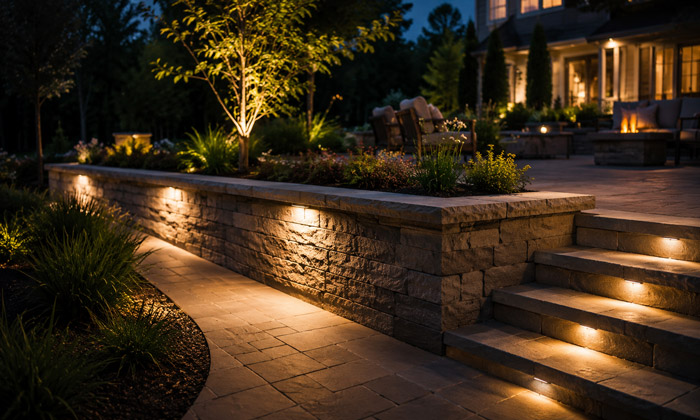
One of the most important benefits of retaining wall lighting is improved safety. Retaining walls are often located beside walkways, patios, driveways, stairs, or changes in elevation. In poorly lit conditions, these features may become difficult to see and increase the risk of trips or falls.
Properly positioned hardscape lights make wall edges, nearby pathways, steps, and uneven surfaces more visible. The soft downward light helps people move through the area safely without the harsh glare produced by oversized floodlights.
Bhagavathula, R., & Gibbons, R. B. (2023). Lighting strategies to increase nighttime pedestrian visibility at midblock crosswalks. Sustainability, 15(2), 1455.
Hardscape lighting adds depth and visual interest to a retaining wall. During the day, the wall may serve mainly as a structural feature. At night, integrated lighting highlights its texture, shape, and materials.
Stone, brick, concrete, and natural rock surfaces often appear more dramatic under warm, low-level illumination. Light and shadow can emphasize the craftsmanship of the wall and make the entire landscape feel more refined.
A well-lit retaining wall can extend the practical use of patios, seating areas, gardens, fire pits, and outdoor kitchens. Without adequate lighting, these spaces may become uncomfortable or unusable after sunset.
Hardscape lighting creates a welcoming environment for evening meals, family gatherings, and outdoor entertainment. Because the fixtures are installed directly into the wall, they provide useful illumination while preserving open space.
Increased Property Value and Curb Appeal
Professionally installed landscape lighting can improve the overall presentation of a property. An illuminated retaining wall creates a polished appearance and shows that attention has been given to both design and functionality.
This can strengthen curb appeal and make outdoor areas more attractive to potential buyers. While lighting alone may not determine a property’s value, it can increase the perceived quality of the landscape and make the home more memorable.
Subtle Illumination Without Glare
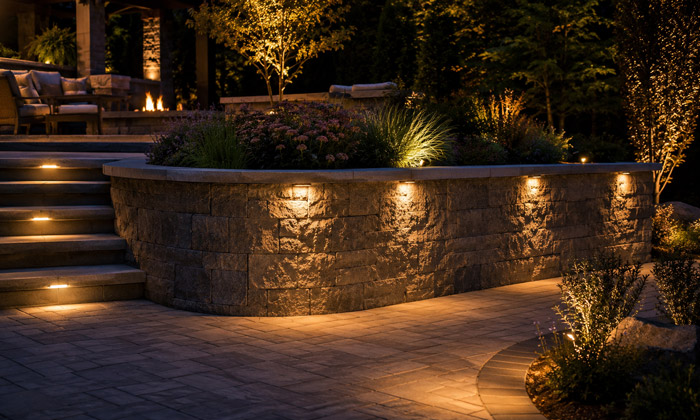
Hardscape lighting is designed to blend into retaining walls and other permanent structures. Most fixtures direct light downward or across the wall surface rather than shining directly into people’s eyes.
This controlled illumination reduces glare and excessive brightness. It also helps preserve the comfortable atmosphere of an outdoor area. The result is usually more elegant than using exposed lamps or high-powered security lights.
Most modern hardscape lighting systems use LED technology. LED fixtures require relatively little electricity and can operate for many years before replacement is necessary.
Pattison, P. M., Hansen, M., & Tsao, J. Y. (2018). LED lighting efficacy: Status and directions. Comptes Rendus Physique, 19(3), 134–145.
Low-voltage systems are especially popular for residential landscapes because they provide effective illumination while keeping energy consumption low. Timers, photocells, and smart controls can further reduce unnecessary power use by operating the lights only when needed.
Weather Resistance and Long-Term Durability
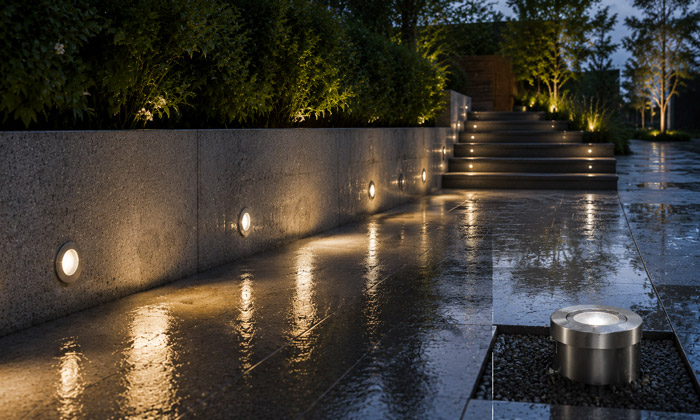
Quality hardscape fixtures are built for permanent outdoor installation. They are generally made from durable materials such as stainless steel, aluminum, brass, or weather-resistant composites.
When correctly installed, they can withstand rain, moisture, temperature changes, and regular exposure to outdoor conditions. Their recessed or concealed placement also provides additional protection from accidental impact.
Lighting a retaining wall can contribute to a more secure property. Dark areas around side yards, driveways, gardens, and property boundaries may create hiding places or make suspicious activity harder to notice.
Low-level hardscape lighting improves visibility without making the landscape feel overly bright. It can also complement pathway lights, entry lights, and other security features to create more consistent illumination around the property.
Painter, K. (1996). The influence of street lighting improvements on crime, fear and pedestrian street use, after dark. Landscape and Urban Planning, 35(2–3), 193–201.
|
Benefit |
Practical Value |
|---|---|
|
Improved safety |
Makes wall edges, paths, stairs, and elevation changes easier to see |
|
Enhanced appearance |
Highlights stonework, texture, shape, and landscape design |
|
Extended outdoor use |
Makes patios and entertainment areas more comfortable after dark |
|
Increased curb appeal |
Creates a polished and professionally designed appearance |
|
Reduced glare |
Provides controlled, downward-facing illumination |
|
Energy efficiency |
LED fixtures consume less power and have a long operating life |
|
Outdoor durability |
Weather-resistant fixtures provide reliable long-term performance |
|
Better security |
Improves visibility around dark areas and property boundaries |
Choosing the Right Lighting Design
The effectiveness of retaining wall lighting depends on fixture placement, brightness, spacing, and color temperature. Fixtures should be positioned evenly enough to provide useful illumination without creating excessive bright spots.
Warm white light is often suitable for residential retaining walls because it creates a comfortable atmosphere and complements natural stone, brick, and wood. Cooler light may be appropriate for modern concrete walls or contemporary landscape designs.
Portnov, B. A., Saad, R., Trop, T., Kliger, D., & Svechkina, A. (2020). Linking nighttime outdoor lighting attributes to pedestrians’ feeling of safety: An interactive survey approach. PLOS ONE, 15(11), e0242172.
The lighting should also match the function of the space. A retaining wall beside a walkway may require brighter and more consistent illumination, while a decorative garden wall may need only soft accent lighting.
Hardscape lighting makes a retaining wall safer, more attractive, and more useful after dark. It highlights construction details, improves visibility, supports outdoor activities, and adds a professional finishing touch to the landscape.
With energy-efficient LED fixtures, careful placement, and weather-resistant materials, retaining wall lighting can provide long-lasting value without overwhelming the outdoor environment.
Can hardscape lighting be added to an existing retaining wall?
Yes. Many existing retaining walls can be retrofitted with low-profile fixtures installed beneath capstones or along masonry joints.
Installation difficulty depends on access to the wall, available wiring routes, construction materials, and whether sections of the cap need to be temporarily removed.
What voltage is best for retaining wall lighting?
Most residential hardscape lighting systems use 12-volt low-voltage power. A properly sized transformer is required to support the total fixture wattage.
The system should also account for cable length and voltage drop, especially when lights are installed far from the power source.
What waterproof rating should outdoor hardscape lights have?
Fixtures should be specifically rated for outdoor and wet-location use.
An IP65 rating is suitable for protection against rain and dust, while IP67-rated fixtures provide stronger protection in areas exposed to heavy moisture, irrigation systems, or temporary water immersion.
How can voltage drop be prevented in a long retaining wall lighting system?
Voltage drop can be reduced by using thicker landscape cable, dividing fixtures into multiple wiring runs, choosing an appropriately sized transformer, or using hub and loop wiring methods.
Professional voltage testing should be completed before the final installation is sealed.
What maintenance does retaining wall lighting require?
Maintenance usually includes cleaning fixture lenses, removing soil or plant debris, checking cable connections, inspecting seals, and replacing damaged components.
Periodic inspections help prevent corrosion, moisture intrusion, uneven brightness, and premature fixture failure.
