


1. Illuminating Concrete Walkways
2. Improving Stair Safety
3. Creating Driveway and Parking Guidance
4. Highlighting Architectural Walls
5. Lighting Concrete Floors
6. Enhancing Patios and Outdoor Living Areas
7. Adding Light to Concrete Countertops
8. Illuminating Pools and Water Features
9. Creating Decorative Patterns and Signage
10. Supporting Emergency and Directional Lighting
Comparison of Common Concrete Lighting Applications
Important Installation Considerations
Conclusion
FAQs
Lights embedded in concrete combine illumination with structural design. Instead of adding visible fixtures after construction, lighting can be integrated into floors, walls, stairs, pathways, countertops, and outdoor features. This approach creates a clean appearance while improving safety, visibility, and atmosphere.
The best applications depend on the location, lighting purpose, installation method, and required durability.
1. Illuminating Concrete Walkways

Concrete walkways are among the most practical places to install integrated lights. Recessed LED fixtures can define the edges of a path, highlight changes in direction, and improve visibility at night.
Low-level lighting is usually more effective than bright overhead fixtures because it guides movement without creating excessive glare. It is especially useful for:
- Garden paths
- Hotel and resort walkways
- Residential entrances
- Public plazas
- Commercial courtyards
Outdoor fixtures should have suitable waterproof ratings and strong housings that can withstand moisture, temperature changes, and foot traffic.
Both, M., Reis Junior, P., Hentges, T. I., & Reis, M. A. F. (2024). Photoelectric effect on concrete artifacts produced with the addition of luminescent substances and polymer residues. Journal of King Saud University—Engineering Sciences, 36(1), 19–22.
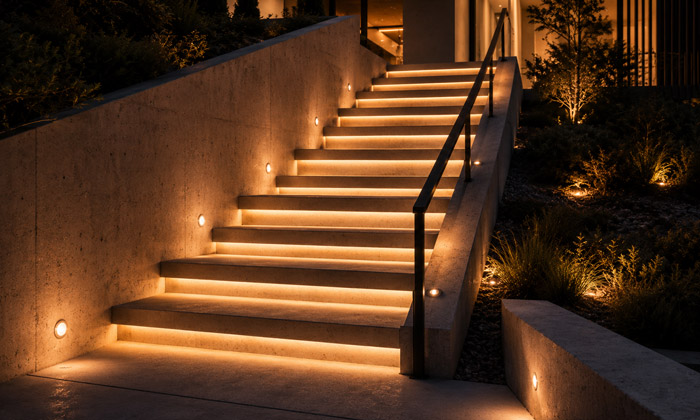
Lights installed in concrete stairs make each step easier to see. They can be placed in stair risers, side walls, handrail bases, or adjacent concrete surfaces.
This application is valuable in both indoor and outdoor environments. Properly positioned lights reduce the risk of trips and falls while giving the staircase a modern architectural appearance.
For the best result, the light source should illuminate the tread without shining directly into a person’s eyes. Warm or neutral white LEDs often provide comfortable visibility.
3. Creating Driveway and Parking Guidance

Concrete lighting can help define driveways, parking areas, ramps, and vehicle entrances. Recessed ground lights may be used to mark boundaries, indicate traffic direction, or highlight obstacles.
Fixtures used in these areas must be rated for vehicle loads. Standard decorative lights may crack or fail when exposed to repeated pressure from cars and trucks.
Wang, W., Sha, A., Lu, Z., Yuan, D., Jiang, W., & Liu, Z. (2021). Cement filled with phosphorescent materials for pavement: Afterglow decay mechanism and properties. Construction and Building Materials, 284, 122798.
Well-planned driveway lighting can improve navigation while preserving a clean surface with fewer visible poles or wall-mounted fixtures.
4. Highlighting Architectural Walls
Concrete walls can be illuminated from within, below, or behind. Linear LEDs placed in recessed channels create clean lines of light, while small embedded fixtures can produce focused accents.
This technique works well for:
- Building entrances
- Feature walls
- Reception areas
- Restaurants
- Retail spaces
- Landscape walls
Lighting can emphasize concrete texture, reveal formwork patterns, or create dramatic shadows. Grazing light placed close to the wall is particularly effective for highlighting surface detail.
Tuaum, A., Shitote, S., Oyawa, W., & Biedebrhan, M. (2019). Structural performance of translucent concrete façade panels. Advances in Civil Engineering, 2019, 4604132.
Embedded floor lighting is useful for navigation, zoning, and decorative effects. It can guide visitors through a building, identify different areas, or create illuminated patterns.
Common locations include museums, shopping centers, airports, entertainment venues, and luxury residences. In industrial or commercial spaces, floor lights may also indicate restricted zones, emergency routes, or equipment boundaries.
The fixtures should be flush with the floor to prevent tripping and simplify cleaning.
6. Enhancing Patios and Outdoor Living Areas
Concrete patios often benefit from subtle integrated lighting. Lights can be installed around seating areas, outdoor kitchens, fire features, planters, and patio edges.
Unlike freestanding fixtures, embedded lights do not occupy usable space. They also reduce visual clutter and can remain protected from accidental movement.
Dimmable LEDs are a strong choice because the lighting level can be adjusted for dining, entertaining, or general nighttime visibility.
7. Adding Light to Concrete Countertops
Concrete countertops can include illuminated edges, recessed task lighting, or translucent sections. LED strips may be concealed beneath overhangs or inside prepared channels.
This technique is often used in:
- Kitchen islands
- Bars
- Reception desks
- Retail counters
- Bathroom vanities
The main advantage is a smooth, customized appearance. However, wiring routes, ventilation, access panels, and heat control must be planned before the concrete is poured.
8. Illuminating Pools and Water Features
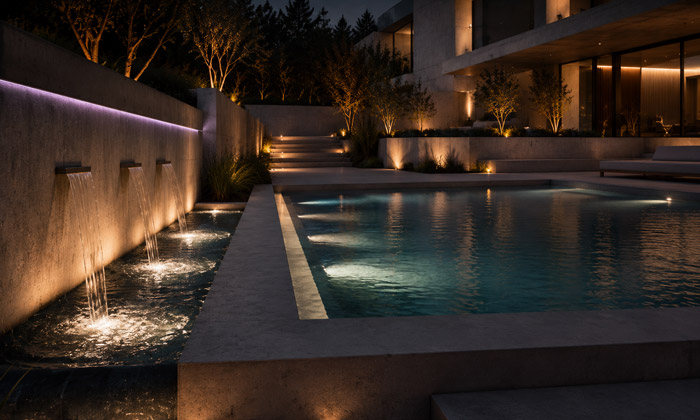
Concrete pools, fountains, and decorative water features can incorporate underwater or perimeter lighting. The lights may highlight moving water, define edges, or improve nighttime safety.
All fixtures used near water must be designed for wet environments. Electrical installation should follow applicable safety regulations, including proper grounding, low-voltage systems, and waterproof connections.
Colored LEDs can create visual effects, while white lighting provides a more natural and timeless appearance.
9. Creating Decorative Patterns and Signage
Lighting can be arranged inside concrete to form lines, symbols, logos, numbers, or geometric patterns. This is particularly effective in commercial buildings, public spaces, hotels, and branded environments.
Fiber-optic strands or small LED modules may be used where individual points of light are required. Linear LED channels are better for continuous illuminated shapes.
Decorative concrete lighting should be designed with maintenance in mind. Components that cannot be accessed after installation may be difficult and expensive to replace.
10. Supporting Emergency and Directional Lighting
Integrated lights can improve wayfinding in corridors, staircases, tunnels, parking structures, and public facilities. They may mark exits, evacuation routes, platform edges, or changes in floor level.
This type of lighting should remain clear during normal use and emergency conditions. Where required, it should be connected to backup power and designed to meet local building and safety codes.
Comparison of Common Concrete Lighting Applications
|
Application |
Main Purpose |
Recommended Lighting Type |
Key Requirement |
|---|---|---|---|
|
Walkways |
Navigation and safety |
Recessed low-level LEDs |
Waterproof construction |
|
Stairs |
Step visibility |
Riser or side-mounted LEDs |
Low-glare placement |
|
Driveways |
Boundary and traffic guidance |
Drive-over ground lights |
High load resistance |
|
Concrete walls |
Architectural emphasis |
Linear or grazing LEDs |
Accurate beam positioning |
|
Floors |
Wayfinding and zoning |
Flush recessed fixtures |
Slip- and impact-resistant design |
|
Patios |
Ambience and visibility |
Dimmable recessed LEDs |
Weather resistance |
|
Countertops |
Task and decorative lighting |
Concealed LED strips |
Planned wiring access |
|
Pools and fountains |
Safety and visual effects |
Submersible LEDs |
Certified waterproof installation |
|
Signs and patterns |
Branding and decoration |
Fiber optics or LED modules |
Replaceable components |
|
Emergency routes |
Direction and evacuation |
Continuous or marker lights |
Backup power and code compliance |
Important Installation Considerations
Concrete lighting must be planned before pouring whenever fixtures, conduits, channels, or mounting boxes will be embedded in the structure. Late changes can require cutting or drilling, which may damage the concrete or increase installation costs.
The design should account for:
- Fixture dimensions and placement
- Electrical conduits and junction boxes
- Drainage around outdoor lights
- Heat produced by lighting components
- Access for repair or replacement
- Expansion and movement of the concrete
- Required brightness and beam direction
LED lighting is generally the preferred option because it consumes little energy, produces limited heat, and offers a long operating life. Low-voltage systems are often suitable for outdoor and decorative applications, but the final electrical design should match the environment and local regulations.
Cantisani, G., Di Mascio, P., & Moretti, L. (2018). Comparative life cycle assessment of lighting systems and road pavements in an Italian twin-tube road tunnel. Sustainability, 10(11), 4165.
The best uses for lights in concrete are applications where illumination, safety, and architectural design need to work together. Walkways, stairs, driveways, walls, floors, patios, countertops, pools, signage, and emergency routes can all benefit from carefully integrated lighting.
Successful results depend on early planning, durable fixtures, correct waterproofing, and accessible electrical components. When these factors are considered before construction, concrete lighting can provide a clean appearance, reliable performance, and long-term practical value.
How long do lights embedded in concrete typically last?
High-quality LED fixtures can operate for 30,000 to 50,000 hours or longer.
Actual service life depends on heat management, moisture protection, electrical quality, and how frequently the lights are used.
How much does it cost to install lighting in concrete?
Costs vary according to fixture type, project size, wiring complexity, concrete thickness, labor rates, and whether the lighting is installed during construction or added later.
Installation during the initial concrete work is usually more economical.
Can concrete lighting work with smart home systems?
Many embedded LED systems can connect to smart switches, timers, motion sensors, dimmers, and mobile applications.
Compatible drivers and controllers must be selected before installation to ensure reliable operation.
Do embedded lights weaken the concrete structure?
Properly planned lighting channels and fixture openings should not significantly reduce concrete strength.
However, oversized recesses, incorrect drilling, or cutting through reinforcement can create structural problems, so load-bearing areas require professional assessment.
Are lights in concrete suitable for freezing climates?
Yes, provided the fixtures, seals, cables, and mounting components are rated for freeze-thaw conditions.
Effective drainage is essential because trapped water can expand when frozen and damage both the fixture housing and surrounding concrete.
