

Lumens to Watts Calculator
1500 Lumens to Watts: Different Light Sources Compared
Why Lumens Do Not Convert Directly to Watts
Is 1500 Lumens Equivalent to a 100-Watt Bulb?
How Bright Is 1500 Lumens in Practice?
Is 1500 Lumens Suitable for Outdoor Lighting?
How Much Electricity Does a 1500-Lumen LED Use?
FAQs
1500 lumens is roughly comparable to the light output of a traditional 100-watt incandescent bulb. An LED producing 1500 lumens could use 15 watts at an efficacy of 100 lumens per watt—but its actual wattage depends on the product.
The distinction matters: “100W equivalent” describes approximate brightness, while the actual wattage tells you how much electrical power the light draws.
For a conventional 100-watt replacement, about 1600 lumens is the U.S. Department of Energy’s reference point. A 1500-lumen bulb is close, but it produces slightly less total light.
U.S. Department of Energy. (2023, June). Purchasing energy-efficient light bulbs.
Lumens to Watts Calculator
Enter your desired lumen output and the light’s luminous efficacy to estimate its wattage. If the manufacturer provides a lumens-per-watt figure, use that value.
Enter your light output and luminous efficacy to estimate power consumption.
1500 Lumens to Watts: Different Light Sources Compared
Different lighting technologies need different amounts of power to produce the same light output. The table below shows calculations using selected example efficacy values.
| Light source | Assumed luminous efficacy | Calculated power for 1500 lumens |
|---|---|---|
| Incandescent | 15 lm/W | 100 W |
| Halogen | 20 lm/W | 75 W |
| CFL | 60 lm/W | 25 W |
| LED | 90 lm/W | 16.7 W |
| LED | 100 lm/W | 15 W |
| Higher-efficacy LED | 150 lm/W | 10 W |
These are illustrative calculations, not fixed wattage requirements. Two LEDs can both produce 1500 lumens while drawing different amounts of power.
For context, the Department of Energy lists a range of 10.5–18 watts for 1600-lumen general-purpose LED replacement bulbs. This variation is why a single LED wattage should never be treated as a universal conversion.
Why Lumens Do Not Convert Directly to Watts
Lumens measure the amount of visible light a bulb produces. Watts measure electrical power.
The connection between them is luminous efficacy: how many lumens a light produces for each watt it uses.
Consider two hypothetical 1500-lumen LEDs:
- LED A: 1500 lumens ÷ 15 watts = 100 lm/W.
- LED B: 1500 lumens ÷ 10 watts = 150 lm/W.
Both have the same rated light output. LED B produces that output using less power.
This also explains why shopping for brightness by wattage alone can be misleading. A 15-watt LED and a 15-watt incandescent bulb do not necessarily produce anything close to the same amount of light.
When comparing products, check the lumens and actual watts together.
Is 1500 Lumens Equivalent to a 100-Watt Bulb?
Approximately, when you mean a traditional incandescent bulb.
The familiar incandescent reference points are:
| Traditional incandescent bulb | Approximate light output |
|---|---|
| 40 W | 450 lumens |
| 60 W | 800 lumens |
| 75 W | 1100 lumens |
| 100 W | 1600 lumens |
These are replacement benchmarks, rather than a formula that applies to every bulb.
At 1500 lumens, a bulb produces 6.25% less total light than a 1600-lumen bulb. That difference does not translate directly into a fixed difference in perceived brightness, because the fixture and light distribution also matter.
If you want an LED replacement for a 100-watt incandescent bulb, compare the lumen rating first. Around 1600 lumens is a useful starting point for matching that familiar output.
Also check whether “100W” on the packaging means equivalent wattage or actual power consumption. A 100-watt actual-power LED is a very different product from a 100-watt-equivalent household LED bulb.
How Bright Is 1500 Lumens in Practice?
1500 lumens describes total light output. It does not tell you exactly how bright a table, pathway, or wall will be.
The same output can create different results depending on where the light goes.
Beam Angle and Mounting Position
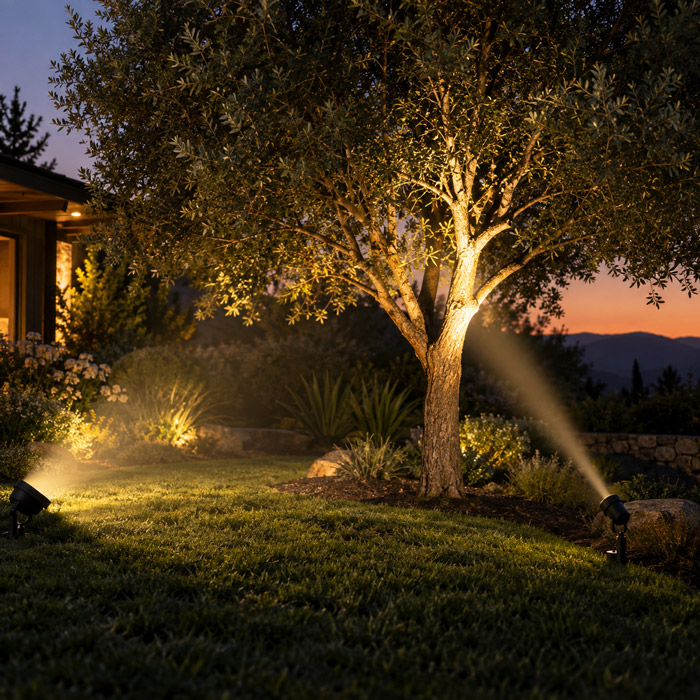
A narrow beam concentrates light on a smaller area. A wide beam distributes it across a larger area.
For example, a 1500-lumen spotlight aimed at a tree can create a concentrated highlight, while a wider floodlight spreads its output across more of the surrounding space. The beam angle of a spotlight helps determine that coverage.
Mounting height and aiming also affect the light reaching the target. This is why a lumen rating alone cannot establish a guaranteed coverage area.

Shades and Diffusers
A shade or diffuser can absorb and redirect some of a bulb’s light. A replacement bulb may therefore deliver a different result in an existing fixture, even when its lumen rating is similar.
For integrated LED fixtures, check whether the specification describes the complete fixture’s delivered output or only the LED source output.

Color Temperature
Color temperature describes the appearance of the light, not its wattage equivalence.
A 2700K–3000K light has a warm appearance, while higher color temperatures look cooler. Choosing a cooler color does not automatically mean you are getting more lumens.
Is 1500 Lumens Suitable for Outdoor Lighting?
A 1500-lumen fixture can be a candidate for entrance lighting, focused landscape lighting, or illuminating part of a patio. Whether it works well depends on the layout, beam pattern, mounting position, and surrounding light.
For a small path, concentrating all 1500 lumens in one exposed light source may create glare and uneven illumination. Several lower-output fixtures can be worth considering when the goal is consistent light along a route.
For a patio or entrance, consider where people sit, walk, and look. Light directed toward the useful surface is generally more helpful than light shining into someone’s eyes or a neighboring window.
Before selecting an outdoor fixture, check:
- Delivered lumens: the output of the complete fixture.
- Beam distribution: whether it concentrates or spreads the light where needed.
- Environmental suitability: the manufacturer’s rating for the installation location.
- Controls: whether dimming, timers, or motion activation suit the application.
There is no universal rule that one 1500-lumen light will illuminate a particular yard size. For more exact planning, use the fixture’s photometric data and the actual installation dimensions.
How Much Electricity Does a 1500-Lumen LED Use?
Electricity use depends on actual watts and operating time.
Suppose your 1500-lumen LED draws 15 watts and runs for 5 hours per day:
Daily energy use = 15 ÷ 1000 × 5 = 0.075 kWh
Over a 30-day month:
Monthly energy use = 0.075 × 30 = 2.25 kWh
At an example electricity rate of $0.15 per kWh, its monthly energy cost would be:
2.25 × $0.15 = approximately $0.34
| Example light | Actual power | Monthly energy use at 5 hours/day | Monthly cost at $0.15/kWh |
|---|---|---|---|
| LED | 15 W | 2.25 kWh | $0.34 |
| Incandescent | 100 W | 15 kWh | $2.25 |
In this example, the LED uses 85% less electricity. The comparison assumes approximately comparable light output; it does not mean every 1500-lumen LED consumes 15 watts.
For multiple lights, multiply the energy use by the number of fixtures. Use your own electricity rate for a relevant cost estimate.
FAQs
Does a 12V 1500-Lumen LED Use Less Electricity Than a 120V Version?
Not necessarily. Voltage does not determine energy consumption by itself. Two lights with the same wattage will use the same amount of energy over the same operating period.
When comparing low-voltage and standard-voltage systems, include transformer or power-supply losses to understand the total energy usage.
Does Dimming a 1500-Lumen LED to 50% Reduce Power Consumption by Half?
Not always. A 50% dimming level does not automatically equal half the brightness or half the electricity usage.
The result depends on the LED driver, dimming method, and control system. Manufacturer power-consumption data provides a more accurate reference.
Can a 1500-Lumen Solar Light Stay at Full Brightness All Night?
It depends on battery capacity, sunlight availability, charging efficiency, and actual power demand.
Check whether the stated runtime refers to continuous maximum brightness, reduced output mode, or motion-activated operation before comparing products.
Will a 1500-Lumen LED Maintain the Same Brightness Throughout Its Lifespan?
No. LED output generally decreases gradually over time through a process known as lumen depreciation.
An L70 rating indicates when light output is expected to reach 70% of the original level. For a 1500-lumen fixture, this equals approximately 1050 lumens and does not mean the light stops working.
Does a 1500-Lumen Smart Bulb Produce 1500 Lumens in Every Color Setting?
Not necessarily. The advertised lumen rating usually applies to a specific white-light setting or color temperature.
Brightness can vary between different colors, and saturated colors may produce significantly lower output than white light. Check specifications for the lighting mode you plan to use.