


Table of Contents
- Does One Bad Bulb Affect the Whole String?
- Seven Reasons a Whole String of Lights Stops Working
- 1. A Blown Fuse or Excessive Connected Load
- 2. A Tripped GFCI, Circuit Breaker, or Interrupted Power Supply
- 3. A Loose Bulb or Broken Connection in a Series Circuit
- 4. Cascading Failure in Incandescent Mini Lights
- 5. Incorrect Bulbs, Wrong Supply Voltage, or Electrical Surges
- 6. Moisture, Corrosion, or Physical Damage
- 7. A Failed LED Adapter, Controller, or Other Shared Component
- How to Find the Cause Safely
- How to Prevent Another Whole-String Failure
- FAQs
A whole string of lights can go dark because of a blown fuse, a loose bulb in a series circuit, damaged wiring, a tripped outlet or breaker, or a failed LED power supply. Actual widespread bulb burnout can result from incorrect voltage, unsuitable replacement bulbs, electrical surges, or cascading failures in an incandescent light string.
The first step is to identify what “burned out” means in your situation. Every bulb going dark at once often points to a problem with the shared power supply or circuit. The bulbs themselves may still work.
Understanding the type of light string you have helps you find the cause without replacing parts unnecessarily.
Does One Bad Bulb Affect the Whole String?
It depends on how the lights are wired.
| Type of light string | What happens when one bulb fails? |
|---|---|
| Traditional incandescent mini lights | A loose bulb, damaged connection, or failed bypass can interrupt an entire series group. |
| Patio lights with independently wired screw-in bulbs | One failed bulb usually leaves the others working. An entire outage suggests a shared power problem or a fault that triggers protection. |
| LED mini lights | The effect depends on the circuit design. One failed component may affect one section or a larger group. |
| LED strings with a shared adapter or controller | A failure in the adapter, controller, or main connection can turn off the whole set. |
Many incandescent mini bulbs contain a shunt, a small bypass that allows current to continue flowing after the filament fails. However, a missing bulb or poor socket connection can still break the circuit. LEDs use different designs, so the same repair method does not apply to every string.
Seven Reasons a Whole String of Lights Stops Working
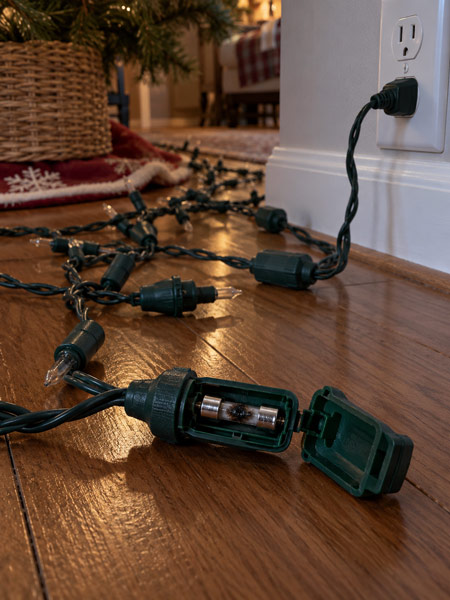
1. A Blown Fuse or Excessive Connected Load
Many light strings have a small fuse inside the plug. When excessive current flows, the fuse opens the circuit to help protect the wiring.
Connecting too many strings end to end can exceed the permitted load. A short circuit can also blow the fuse, even when only one set is connected.
Typical clues include:
- The outlet works, but the entire light string remains dark.
- The lights stopped working after another string was added.
- A replacement fuse blows again.
Follow the connection limit printed on the light set. There is no universal number of strings that every product can safely support. Replace a user-serviceable fuse only with the specified type and rating. A fuse with a higher current rating can allow dangerous overheating.
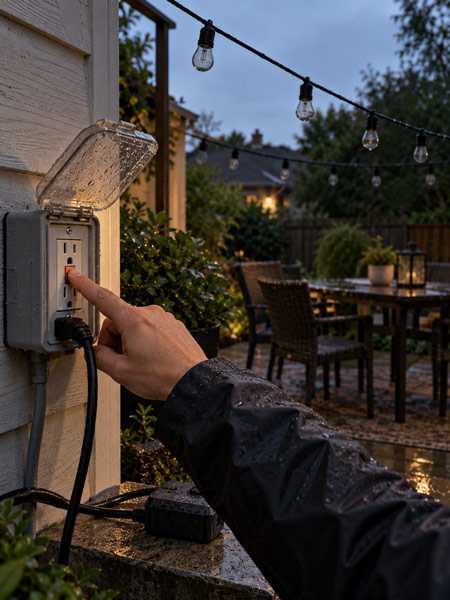
2. A Tripped GFCI, Circuit Breaker, or Interrupted Power Supply
An entire string may stop working because electricity is no longer reaching it.
An outdoor ground-fault circuit interrupter, or GFCI, can disconnect power when it detects leakage current. Moisture entering a connection is one possible cause. A circuit breaker may trip because of an overload or short circuit.
Occupational Safety and Health Administration. (n.d.). Ground-fault circuit interrupters (GFCI).
Other possibilities include a disconnected extension cord, a switched-off outlet, or a timer that is not supplying power.
Check whether another suitable device works from the same dry, undamaged outlet. If it does not, investigate the power source before replacing bulbs. Repeated trips require finding the underlying fault rather than repeatedly resetting the protection.
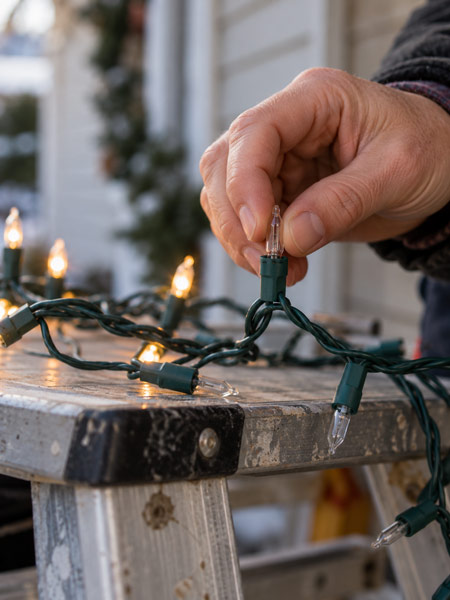
3. A Loose Bulb or Broken Connection in a Series Circuit
In a series circuit, current needs a continuous path through the connected bulbs and sockets. A loose bulb, missing bulb, damaged bulb lead, or poor socket contact can interrupt that path.
This explains why a string may stop working after being unpacked, moved, or hung outdoors. Handling can loosen a bulb even when the glass looks undamaged.
The outage may affect one section or the entire string, depending on how many separate series groups the set contains.
With the lights unplugged, check removable bulbs for secure seating. Follow the instructions for the specific socket design and avoid forcing sealed bulbs out.
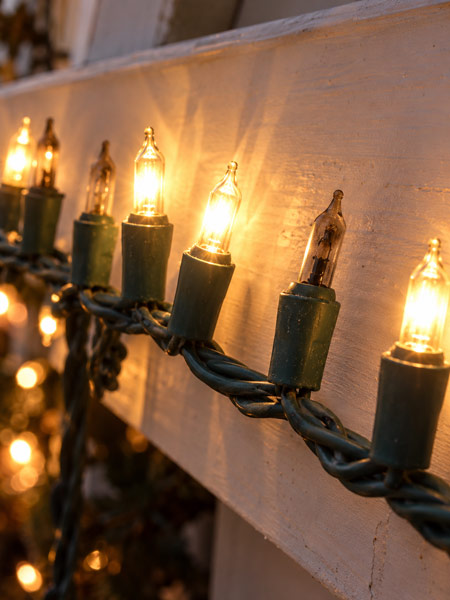
4. Cascading Failure in Incandescent Mini Lights
Incandescent mini lights can suffer a genuine chain reaction of bulb failures.
When a failed bulb’s shunt starts conducting, electricity bypasses its broken filament. The remaining working filaments in that series group then share the supply voltage among fewer bulbs.
As more bulbs fail and are bypassed, the surviving bulbs can run hotter and brighter, increasing their likelihood of failure.
A possible sequence is:
- A few bulbs stop lighting.
- The remaining bulbs appear unusually bright.
- More bulbs fail over a short period.
- Much of the affected group becomes dark or blackened.
Replace failed incandescent mini bulbs promptly with the correct replacements. If many bulbs have already failed, replacing one may leave other weakened bulbs in service. Follow the manufacturer’s guidance for replacing the affected group or the complete set.
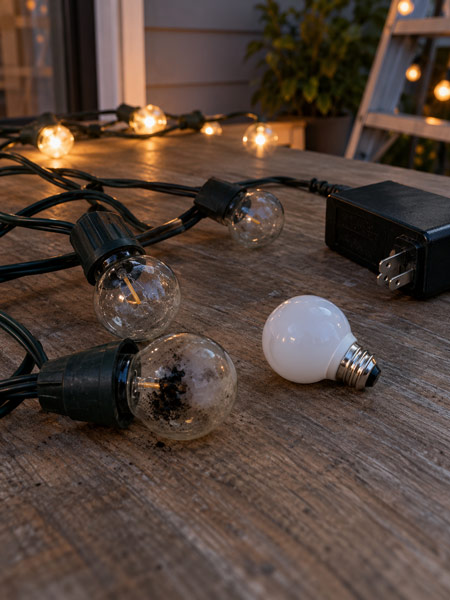
5. Incorrect Bulbs, Wrong Supply Voltage, or Electrical Surges
A replacement bulb can fit a socket and still be electrically unsuitable.
Mini-light replacements must match the specifications for that particular set, including voltage and current or wattage. Bulb count and appearance alone are not reliable guides.
For screw-in patio lights, installing higher-wattage LED bulbs than recommended can increase heat and exceed the socket’s permitted load.
Adapter-powered lights also need the correct power supply. Output voltage, AC or DC output, polarity, connector, and supported load must match the product’s requirements. A physically compatible plug does not establish electrical compatibility.
Electrical surges can damage LED drivers and LED modules as well. If several components fail after an electrical event, the shared electronics may need inspection. A dark string alone does not establish that a surge occurred.
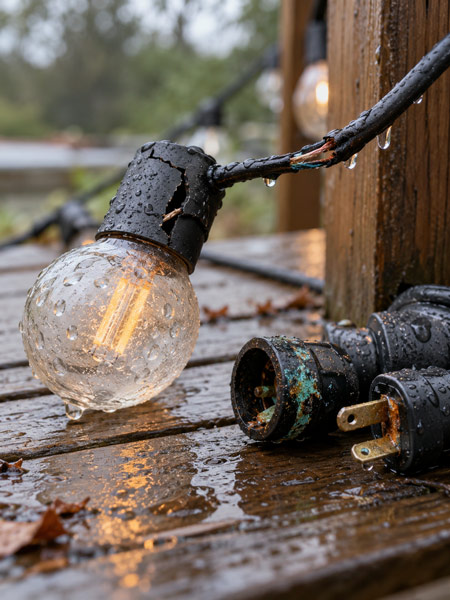
6. Moisture, Corrosion, or Physical Damage
Outdoor string lights face rain, condensation, wind, sunlight, and repeated handling. These conditions can damage seals, corrode contacts, loosen connections, or weaken insulation.
A crushed cable or damaged socket can create an open circuit, a short circuit, or leakage current that trips protective equipment.
Check for:
- Cracked or melted sockets.
- Exposed or frayed wires.
- Corrosion around plugs and connections.
- Damaged seals or water inside components.
Outdoor suitability must cover the complete installation, including the power supply and connectors. A rating such as IP65 water resistance describes specific protection conditions; it does not make equipment suitable for immersion or standing water.
Keep damaged sets disconnected. Exposed wiring or melted sockets call for replacement or manufacturer-approved service.
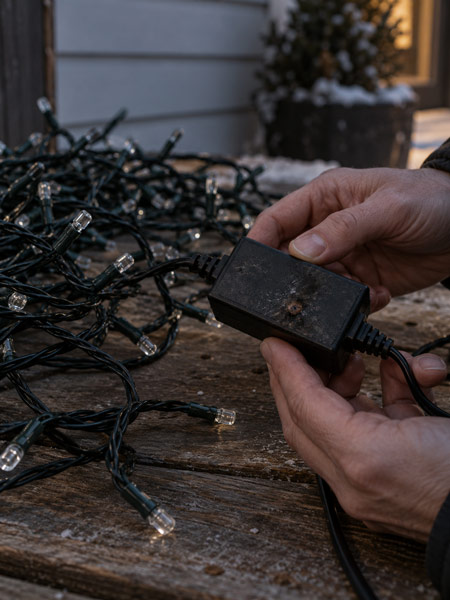
7. A Failed LED Adapter, Controller, or Other Shared Component
LEDs do not use the heated filament found in incandescent bulbs, but their supporting electronics can fail.
Depending on the design, an LED string may rely on a shared power adapter, controller, rectifier, or driver. A fault in one of these components can stop power from reaching otherwise functional LEDs.
Heat, moisture, electrical stress, and unsuitable operating conditions can contribute to electronic failure. Some protected power supplies may also shut down when overloaded or overheated.
Check the original power arrangement, accessible connections, and manufacturer’s troubleshooting instructions. Do not bypass the controller or connect a low-voltage light string directly to mains power.
How to Find the Cause Safely
Work from the shared power source toward individual bulbs. This helps avoid replacing lamps when the fault affects the entire set.
Step 1: Disconnect Power and Inspect the Set
Unplug the lights and allow hot bulbs to cool.
Examine the plug, cable, sockets, and accessible connections. Stop using the set if you find exposed conductors, scorching, melted plastic, or damaged sockets.
Step 2: Confirm That the Outlet Supplies Power
Use a suitable working device to check a dry, undamaged outlet.
Check switches and timers. If a GFCI or breaker has tripped, disconnect the affected lights before following the reset instructions. If protection trips again, leave the faulty equipment disconnected and arrange inspection.
Step 3: Separate Connected Light Sets
If several complete strings are connected end to end, disconnect them from one another while unplugged.
Test each intact set separately using its original power arrangement and within its operating limits. This can identify which set introduces the problem.
Step 4: Check Any User-Replaceable Fuse
Open a fuse compartment only as described in the instructions.
A fuse may fail without obvious discoloration. Use the specified replacement rather than relying entirely on appearance. If the new fuse blows, discontinue use until the fault is resolved.
Step 5: Check Removable Bulbs
With power disconnected, reseat loose bulbs and replace identified failures with the specified type.
Use a tester only if it is suitable for that light technology. A repair tool designed for incandescent mini lights may be unsuitable for LEDs.
Step 6: Follow the LED System’s Troubleshooting Procedure
For adapter-powered or controlled lights, check accessible connectors, power settings, and any documented reset procedure.
If the original supply is working and the string remains dark, contact the manufacturer about approved replacement components or replace the set. Avoid opening sealed electrical components.
How to Prevent Another Whole-String Failure
A few installation and maintenance habits can reduce repeat problems:
- Replace failed incandescent mini bulbs promptly. Accumulating bypassed bulbs increases stress on the remaining lamps.
- Respect every load limit. Check the string’s connection limit as well as the ratings of cords, controllers, and power supplies.
- Support the lights properly. Use suitable clips, hooks, or support wires so cables and sockets do not carry excessive tension.
- Protect outdoor connections as instructed. Keep plugs and supplies out of standing water and use the required outdoor-rated equipment.
- Inspect before storage and reuse. Allow the set to dry, coil it loosely, and store it where moisture and physical damage are unlikely.
The most useful diagnosis starts with the outage pattern. A completely dark string calls for checking shared power and protection first. Several bulbs failing progressively calls for closer attention to bulb compatibility and the electrical stress within the affected group.
FAQs
1. Can I Use a Dimmer With LED String Lights?
Only if the light string is specified as dimmable and the control is compatible with its electronics and load.
An unsuitable dimmer can cause flickering, buzzing, unstable startup, or lights dropping out at low brightness. Some compatible controls allow a minimum-brightness adjustment to reduce dimmer-related flickering. An “LED-compatible” label on the dimmer alone does not confirm compatibility with every LED string.
2. Why Do LED String Lights Glow When Switched Off?
A small amount of current can pass through certain electronic dimmers or switches even in the off position. Sensitive LED electronics may respond with a faint glow or occasional flash, often called ghosting.
The cause of a bulb glowing when switched off depends on the control and circuit. Check compatibility guidance, and have persistent or unexplained wiring issues assessed professionally. Switching a control off does not replace unplugging the set before handling it.
3. Can I Replace Incandescent String-Light Bulbs With LED Bulbs?
For series-wired mini lights, do not substitute individual LEDs for incandescent bulbs unless the manufacturer explicitly supports that conversion. Their electrical requirements differ.
Some parallel-wired strings with replaceable screw-in bulbs can accept suitable LED replacements. Confirm the required supply voltage, base, operating conditions, permitted wattage, and manufacturer’s approval. Replacing a complete mini-light set with an LED set avoids attempting an unsupported bulb-by-bulb conversion.
4. Can I Cut a String of Lights to Make It Shorter?
Do not cut a standard mini-light or preassembled LED string unless its instructions expressly permit shortening.
Cutting can interrupt the circuit, change its electrical characteristics, and leave unsafe cable ends. Some lighting systems are specifically designed for custom lengths, but they require the designated cutting locations and termination components. Choosing a suitable manufactured length is the practical option for sets that cannot be shortened.
5. How Long Should LED String Lights Last?
Check the rated operating hours and warranty for the particular product. Published ratings vary, and an LED’s projected life does not establish an identical service life for every cable, socket, seal, and controller in the set.
When assessing LED Christmas light lifespan, compare complete-product specifications and warranty coverage rather than relying on a general claim about LED longevity. Outdoor exposure and installation conditions also affect how long the assembled system remains usable.
