
What Counts as Permanent Outdoor Lighting?
The Three Parts of Outdoor Lighting ROI
Calculate the Full Cost Before Estimating Returns
How to Calculate Permanent Outdoor Lighting Payback
How Much Does Electricity Affect ROI?
Design Quality Determines How Much Value You Receive
Durability Protects the Investment
When Is Permanent Outdoor Lighting Worth It?
FAQs
Permanent outdoor lighting can make a home more welcoming after sunset and remove the annual routine of hanging and taking down seasonal lights. But does the investment make financial sense?
Permanent outdoor lighting delivers the strongest financial return when it replaces recurring expenses you already pay, remains affordable to operate, and serves your home for enough years to recover its installation cost. For other homeowners, its main value comes from convenience, better nighttime visibility, and more enjoyable outdoor spaces.
Understanding permanent outdoor lighting ROI starts with separating those benefits—and calculating what they are actually worth to your household.
What Counts as Permanent Outdoor Lighting?
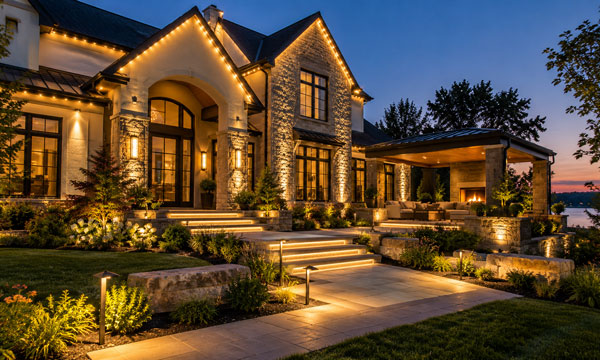
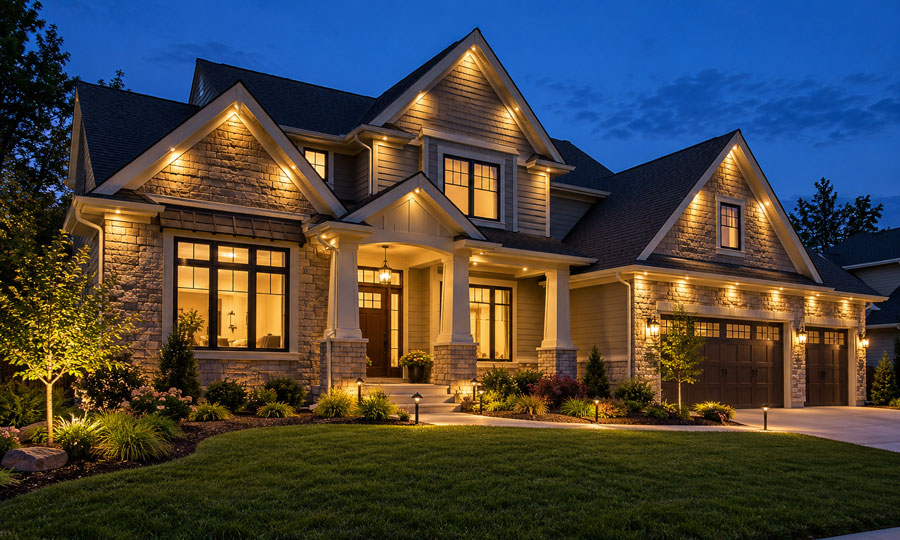
Permanent outdoor lighting is designed to remain installed throughout the year. It can include roofline lighting, architectural accent fixtures, pathway lights, and lighting built into steps or outdoor living areas.
These systems serve different purposes. Roofline lights can replace seasonal decorations, while pathway and patio fixtures address how people move through and use a property after dark.
That distinction matters when calculating ROI. A pathway lighting project should not receive credit for eliminating holiday installation fees unless it genuinely replaces that service. Likewise, decorative roofline lighting should not automatically be treated as a substitute for lighting at ground level.
Start by identifying the job you want the system to perform. Your return depends on how well it fulfills that purpose.
The Three Parts of Outdoor Lighting ROI
1. Measurable Financial Savings
The clearest financial benefits come from expenses you no longer incur, such as:
- Annual professional installation and removal of seasonal lights.
- Replacement strands, clips, and other seasonal supplies.
- Paid storage, if you actually use it.
- Electricity savings when replacing a less efficient system under comparable operating conditions.
Only count costs the new installation will eliminate. If you plan to keep hiring someone to decorate trees and shrubs, that portion of your seasonal bill remains.
2. Potential Resale Value
Thoughtful lighting can improve how a property presents at night. A clearly defined entrance, balanced architectural accents, and an inviting outdoor area can contribute to a favorable impression.
However, improved appearance does not establish a guaranteed increase in sale price. Buyer preferences, local market conditions, installation quality, and the condition of the system all affect the outcome.
For a conservative calculation, assume no resale premium. Treat any eventual increase attributable to lighting as an additional benefit rather than the money required to make the purchase worthwhile.
3. Everyday Use and Convenience
Some benefits are valuable without producing cash savings. These include less time spent decorating, fewer seasonal ladder trips, and easier access to outdoor spaces after sunset.
You can estimate the personal value of time saved, but keep it separate from your financial calculation. Saving eight hours of weekend work is meaningful; it does not automatically reduce your household spending.
This separation helps you decide whether the system is worthwhile even when cash payback is slow.
Calculate the Full Cost Before Estimating Returns
The purchase price is only one part of the investment.
Upfront Costs
Ask for an itemized quote covering fixtures, mounting hardware, controllers, power supplies, wiring, installation, and any necessary electrical work.
Property characteristics can change the total substantially. A simple, accessible roofline requires different labor from a multistory exterior with several peaks. Landscape projects may involve trenching, cable routing, and restoring disturbed surfaces.
For projects that include paths, planting beds, or outdoor living areas, the cost to install landscape lighting should be assessed separately from roofline lighting so each part of the budget remains clear.
Ongoing Costs
Include electricity, cleaning, service visits, replacement components, and any required software fees.
“Permanent” describes an installation intended to stay in place. It does not mean that every component will operate indefinitely without attention.
Read warranty terms closely. Coverage for a failed component may not include the labor, shipping, or access equipment needed to replace it. Those costs matter particularly when fixtures are difficult to reach.
If you finance the project, include interest and fees in the ownership comparison.
How to Calculate Permanent Outdoor Lighting Payback
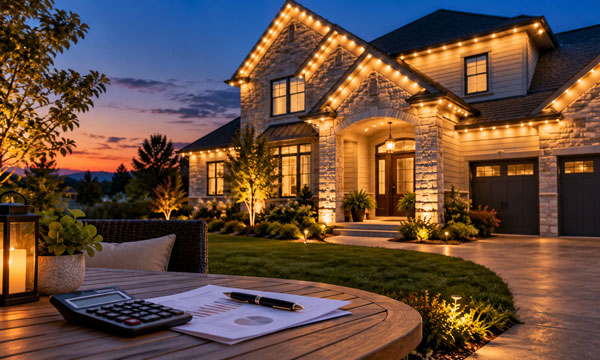
For a straightforward cash comparison, use:
Annual net savings = Annual cost of your existing approach − Annual operating and maintenance cost of the permanent system
Then:
Simple payback period = Upfront installation cost ÷ Annual net savings
This calculation assumes annual costs remain constant. It also assumes the permanent system replaces the expenses included in your baseline.
If annual net savings are zero or negative, the system has no cash payback under those assumptions. It may still be a worthwhile lifestyle improvement.
An Illustrative Homeowner Example
Consider a homeowner who currently pays for seasonal roofline lighting and is considering a permanent replacement.
The figures below are hypothetical planning assumptions in U.S. dollars, not market averages or a quotation.
| Expense | Existing seasonal setup | Permanent lighting |
|---|---|---|
| Upfront installation | $0 additional | $4,500 |
| Annual installation and removal | $900 | $0 |
| Annual materials or maintenance allowance | $100 | $100 |
| Annual electricity | $40 | $60 |
| Total annual ongoing cost | $1,040 | $160 |
Annual net savings would be:
$1,040 − $160 = $880
The simple payback period would be:
$4,500 ÷ $880 = approximately 5.1 years
The longer-term comparison looks like this:
| Ownership period | Continue seasonal setup | Install permanent lighting | Permanent lighting cost advantage |
|---|---|---|---|
| 5 years | $5,200 | $5,300 | −$100 |
| 10 years | $10,400 | $6,100 | $4,300 |
Under these assumptions, the permanent system costs slightly more over five years but costs $4,300 less over ten years.
The ten-year simple net return relative to the upfront investment is:
($8,800 cumulative operating savings − $4,500 upfront cost) ÷ $4,500 × 100 = approximately 95.6%
That is a cumulative ten-year figure, not an annual return. It excludes financing, inflation, the time value of money, resale value, and repairs beyond the assumed allowance. It also assumes the system remains serviceable throughout the comparison period.
Why Your Existing Spending Changes the Answer
Suppose another homeowner spends only $150 per year on a DIY seasonal setup. If the permanent system costs $160 annually to operate and maintain, switching creates no annual cash savings.
That homeowner may still appreciate year-round lighting and simpler decorating, but the purchase should be evaluated as a home improvement rather than a cost-saving measure.
Your actual spending history is more useful than a generic promise that permanent lights “pay for themselves.”
How Much Does Electricity Affect ROI?
Electricity cost depends on total power consumption and operating hours.
Use this formula:
Annual electricity cost = System input watts ÷ 1,000 × Daily operating hours × Days used × Electricity rate
For example, a system drawing 200 watts, operating four hours every night at $0.20 per kilowatt-hour, would cost:
0.2 × 4 × 365 × $0.20 = $58.40 per year
This is an example, not a prediction for every installation. Actual consumption varies with system size, brightness settings, effects, power-supply losses, and standby demand.
Use the system’s actual input power where available. A power supply’s maximum rated capacity is not necessarily its normal consumption.
Also compare realistic schedules. A permanent system running every evening can use more electricity annually than a smaller seasonal setup used for only several weeks, even if its individual lights are efficient.
Appropriate timer controls for landscape lighting systems help limit unnecessary operating hours. Scheduling and dimming are established ways to reduce avoidable lighting energy use.
Design Quality Determines How Much Value You Receive
A lighting installation earns its place when it improves the areas you use and the features you want to see.
Begin with the entrance, circulation routes, and outdoor spaces where your household spends time. Then consider architectural or landscape accents that complement those functional areas.
Well-planned curb appeal lighting should help the exterior feel coherent. Adding more fixtures does not automatically create a better result.
Evaluate the proposed layout from several viewpoints: the street, the front door, seating areas, and inside the home. A fixture that looks attractive from the driveway may shine directly into a bedroom window.
Ask for an evening demonstration or a small mock-up where practical. Reviewing the effect before completing the installation can prevent spending money on a layout you later want to change.
Durability Protects the Investment
A favorable payback calculation depends on the installation remaining useful long enough to deliver the expected savings.
Choose weather-resistant outdoor light fixtures suited to the actual installation environment. Discuss exposure to rain, direct sunlight, temperature extremes, irrigation, and coastal conditions where relevant.
Ask the supplier or installer to document:
- Environmental suitability for fixtures, connectors, controllers, and power supplies.
- Warranty coverage and exclusions.
- Expected servicing requirements.
- Availability and pricing of replacement parts.
- Labor charges for repairs after installation.
An advertised LED operating life is not the same as a warranty for the complete system. Controllers, connections, and power supplies also influence how long the installation remains usable.
A slightly lower purchase price may offer poor value if future repairs are difficult or expensive.
When Is Permanent Outdoor Lighting Worth It?
Permanent lighting makes a stronger financial case when you already pay substantial recurring costs for an equivalent service, expect to remain in the home beyond the estimated payback period, and can budget for upkeep.
It can also be worthwhile when you regularly use outdoor spaces and place a high value on convenience, even if the cash return is modest.
The case is weaker when you spend very little on your current lighting, use decorative lights infrequently, or expect to move before recovering the initial cost.
Before committing, compare three figures: the cost of continuing your current approach, the complete ownership cost of the proposed system, and the number of years you realistically expect to use it.
The best investment is a system whose price, performance, and everyday usefulness fit your home.
FAQs
1. Do permanent outdoor lights work without Wi-Fi?
Some systems support physical controls, local connections, or schedules stored on the controller. Others depend on internet access for particular functions.
Before buying, ask what continues to work during an internet outage and whether everyday operation requires a cloud account. When integrating smart technology into landscape lighting, confirm how control works locally as well as remotely. Dependable basic operation can help preserve the system’s usefulness over time.
2. What happens to permanent outdoor lights when the roof needs replacement?
It depends on where the lights and wiring are mounted and which surfaces the roofing work will affect. Some installations may remain in place; others may require partial removal and reinstallation.
If roof, fascia, or soffit work is approaching, coordinate with both contractors before installing lighting. Ask who will handle removal, storage, reinstallation, and testing, and include those costs in your project timing decision.
3. Can I install permanent outdoor lighting myself to improve ROI?
A DIY installation may reduce labor costs when the system is designed for homeowner installation and the mounting locations are safely accessible.
Compare those savings with equipment purchases, installation time, and potential correction costs. Check the product instructions and warranty conditions before proceeding. High-access work, complex routing, and changes to household wiring can make professional installation the more practical choice.
4. Can I start with part of the house and expand the system later?
Yes, if the system supports expansion and the initial design allows for it. Confirm controller limits, power capacity, supported cable lengths, and compatibility with additional fixtures before purchasing.
A phased project can reduce the initial commitment, but repeated installation visits may increase the total cost. Request both a staged price and a complete-project price so you can compare the trade-off.
5. Can a failed LED be replaced, or does the whole fixture need replacing?
That depends on the construction. Some fixtures accept replaceable lamps, some use serviceable LED modules, and others require replacement of the complete fixture or light segment.
Understanding what integrated LED lighting means helps you ask the right repair questions. Before buying, confirm exactly which part is replaceable, whether matching parts are available, and how much access and labor a replacement requires.
