
Table of Contents
- What Are RoHS Lights?
- Which Substances Does RoHS Restrict in Lighting?
- Where Material Risks Can Appear in LED Lighting
- How to Verify a RoHS Compliance Claim
- Why the Same Model Needs Continuing Material Control
- Evaluate Lighting Performance Alongside RoHS Compliance
- Consider What Happens After the First Component Fails
- FAQs
A lighting product’s material composition is largely invisible. Two lamps can share the same appearance, brightness and power rating while using different solder, cable insulation, plastic additives and surface treatments.
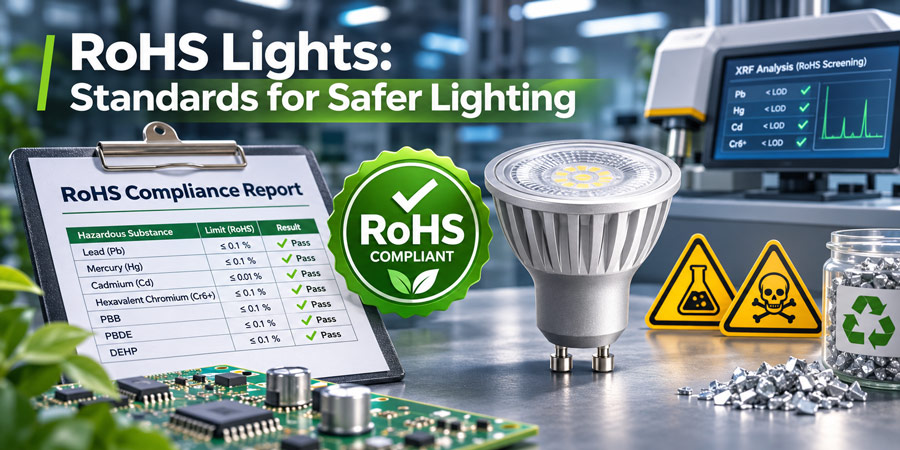
These details matter when evaluating RoHS lights. RoHS compliance addresses specific hazardous substances in electrical and electronic equipment, helping reduce risks associated with manufacturing, use and waste treatment. However, a meaningful purchasing decision requires evidence that connects the compliance claim to the product actually supplied.
For lighting buyers, the useful questions go beyond whether a catalogue displays a RoHS symbol. Which materials were assessed? Does the evidence cover the complete lamp or luminaire? What happens when a supplier changes a cable, driver or coating?
Understanding those questions makes RoHS a practical part of lighting selection.
What Are RoHS Lights?
RoHS stands for Restriction of Hazardous Substances. In the European Union, Directive 2011/65/EU, as amended, restricts specified substances in electrical and electronic equipment. Lighting products generally fall within its scope unless a particular exclusion applies. The current restrictions cover ten substances, including certain heavy metals, flame retardants and plasticisers.
“RoHS lights” therefore describes lamps and luminaires that meet the applicable substance restrictions, including any legally valid, application-specific exemptions.
RoHS addresses material composition. A complete lighting specification also needs to address electrical safety, light quality, environmental protection and reliable operation. Those characteristics require their own evidence.
This distinction helps buyers interpret product claims accurately. A RoHS declaration supports a defined material-compliance claim; broader statements about safety or sustainability need additional support.
Which Substances Does RoHS Restrict in Lighting?
The concentration limits apply by weight within each homogeneous material.
| Restricted substance | Maximum concentration | Equivalent concentration |
|---|---|---|
| Lead (Pb) | 0.1% | 1,000 ppm |
| Mercury (Hg) | 0.1% | 1,000 ppm |
| Cadmium (Cd) | 0.01% | 100 ppm |
| Hexavalent chromium, Cr(VI) | 0.1% | 1,000 ppm |
| Polybrominated biphenyls (PBB) and polybrominated diphenyl ethers (PBDE) | 0.1% each | 1,000 ppm each |
| DEHP, BBP, DBP and DIBP phthalates | 0.1% each | 1,000 ppm each |
The limits apply to each listed substance individually. Specific applications may qualify for exemptions, which must be checked against their current legal conditions.
Environmental Protection Agency. (n.d.). Restriction of the use of certain hazardous substances in electrical and electronic equipment (RoHS) directive.
Why a Small Solder Joint Can Determine Compliance
A homogeneous material has a uniform composition, or consists of materials that cannot be separated into different materials through mechanical actions such as cutting, grinding or unscrewing. Cable insulation, metal conductors and solder can therefore require separate consideration.
Consider a simplified example:
A 1 kg luminaire contains 1 g of solder with 0.5% lead. Averaged across the entire luminaire, that would represent only 5 ppm of lead. Within the solder itself, however, the concentration is 5,000 ppm.
Without an applicable exemption, that solder exceeds the 1,000 ppm lead limit.
A large aluminium housing cannot dilute a non-compliant solder joint into compliance.
For buyers, this changes the meaning of “low hazardous-substance content.” The relevant question is whether each applicable material meets its requirement, rather than whether the complete product contains a small total quantity.
Where Material Risks Can Appear in LED Lighting
LED technology produces light without relying on mercury vapour. Nevertheless, the finished lighting product contains considerably more than the LED emitter.
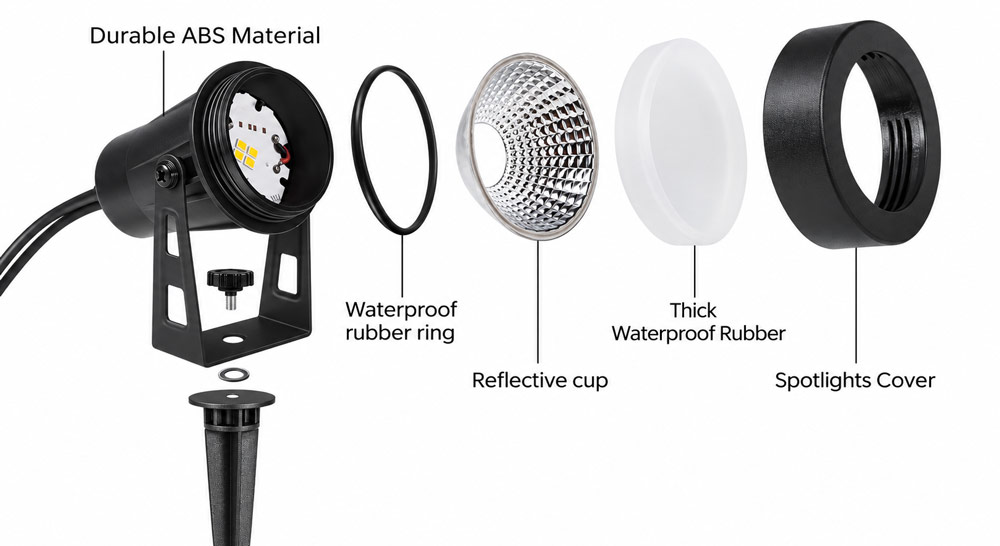
A luminaire may include a driver, circuit board, wiring, connectors, lenses, seals, coatings and mounting hardware. Depending on their composition, these materials can require assessment for different restricted substances.
Examples include:
- Solder and electronic components: potential sources of lead or other restricted metals.
- Flexible cable insulation: materials that may require assessment for restricted phthalates.
- Plastic housings and connectors: materials that may contain restricted flame retardants.
- Certain surface treatments: coatings that may require assessment for hexavalent chromium.
These are areas to investigate, rather than a claim that every lighting product contains these substances.
This is why evidence for an LED chip or driver should be treated as part of the product’s compliance assessment. Other materials in the finished luminaire still need appropriate coverage.
For outdoor lighting, this broader view is especially useful. A change to a cable jacket, gasket or housing material may leave the light’s electrical performance unchanged while altering the evidence needed to support its material-compliance claim.
How to Verify a RoHS Compliance Claim
A useful assessment connects the supplied product to its declaration, technical documentation and supporting material information.
For EU RoHS conformity assessment, manufacturers can use internal production control. Independent laboratory reports can support the assessment, while responsibility for product conformity remains with the manufacturer. EN IEC 63000:2018 provides a recognised framework for the relevant technical documentation, and the IEC 62321 series addresses analytical methods.
Buyers can organise their review around five questions.
1. Does the Documentation Identify the Supplied Product?
Check the model designation, manufacturer and relevant product configuration.
Evidence may legitimately cover a product family, but the manufacturer should be able to explain the relationship between the assessed materials and the models covered. Similar appearance alone provides little assurance about internal construction.
A report for one driver, for example, does not automatically establish that every luminaire using that driver has the same cable, housing or connectors.
2. Is There an Appropriate Declaration of Conformity?
For products placed on the EU market, check for an EU Declaration of Conformity identifying the product and applicable legislation. RoHS forms part of the CE marking framework.
A laboratory report and a manufacturer’s declaration serve different purposes. The report records an assessment of the submitted sample; the declaration states the manufacturer’s responsibility for conformity.
Both can be useful, but buyers should understand what each document establishes.
3. Does the Evidence Cover the Complete Construction?
Ask how the assessment addresses the driver, wiring, housing, connectors and other applicable materials.
Evidence may combine supplier declarations, material specifications and targeted testing. The objective is sufficient, relevant coverage of the supplied product. Requiring a separate laboratory test for every component is not automatically the most useful approach.
A practical question is:
“How do these documents demonstrate compliance for the materials used in this particular product?”
That question is more informative than simply counting reports.
4. Are the Test Methods Suitable for the Substances?
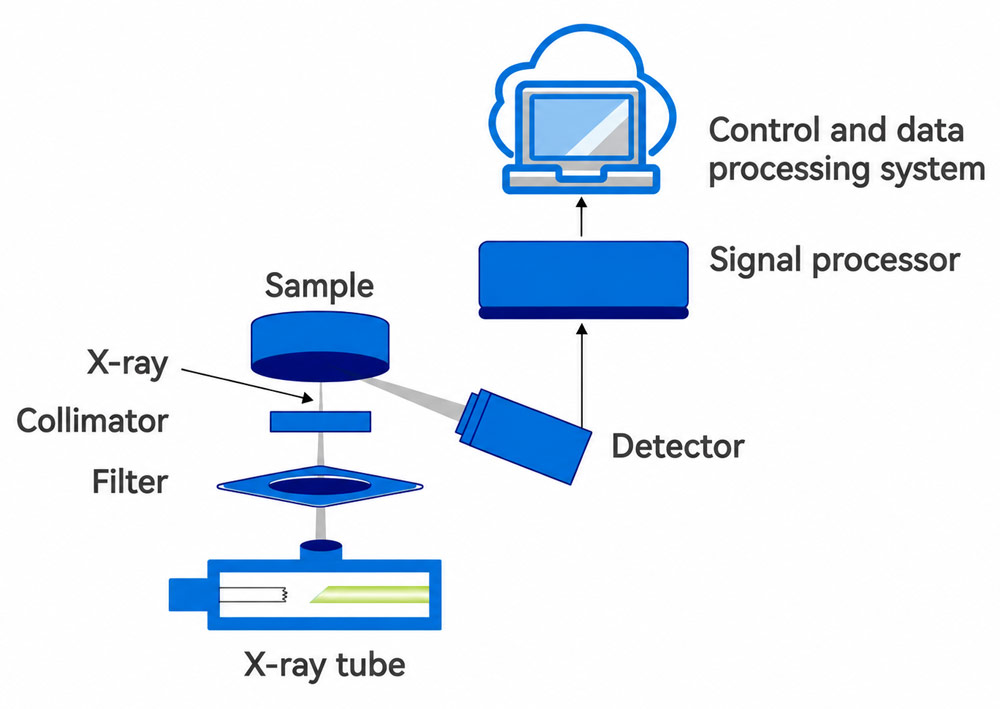
The X-ray tube emits X-rays onto the sample, the detector collects the resulting signals, and the signal processing and data processing systems convert and analyze the signals to obtain useful information.
X-ray fluorescence, or XRF, is useful for elemental screening. Its scope includes elements such as lead, cadmium, total chromium and total bromine. Those results need careful interpretation because total chromium does not identify its chemical form, and total bromine does not identify a particular brominated compound.
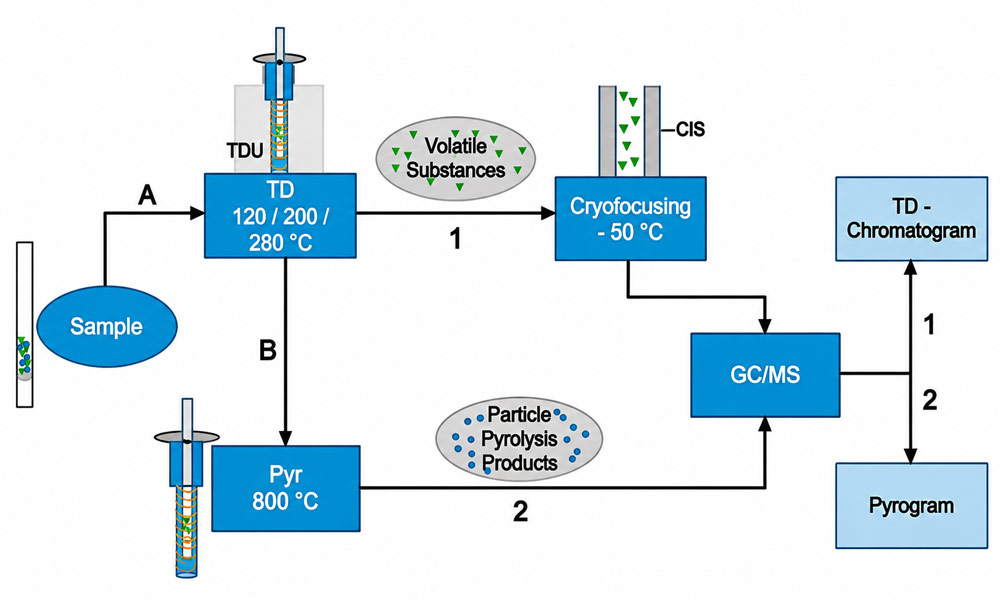
Pyrolysis–thermal desorption GC–MS (Py-TD-GC/MS) combines thermal desorption, cryofocusing, and pyrolysis to identify volatile compounds and particle pyrolysis products.
Phthalates require suitable analytical techniques of their own. IEC 62321-8, for example, addresses their determination in polymers using chromatographic and mass-spectrometric methods.
For a buyer reviewing a report, this means checking the substances assessed, sample descriptions, methods and reporting limits. A broad “pass” heading provides less information than those details.
5. Are Any Exemptions Clearly Explained?
Where compliance relies on an exemption, ask for the relevant entry and an explanation of how it applies.
The assessment should account for the application, equipment category and current legal status, including relevant renewal provisions. A general statement that a material “has an exemption” leaves important questions unanswered.
Why the Same Model Needs Continuing Material Control
Lighting procurement often treats a model number as a stable product description. In production, components can change while that model number remains the same.
A manufacturer might replace a cable supplier, adjust a plastic formulation or introduce an alternative electronic component. These changes can be commercially routine, but their effect on material compliance still needs assessment.
EU RoHS obligations include maintaining conformity in series production and taking relevant product changes into account.
Directive 2011/65/EU of the European Parliament and of the Council of 8 June 2011 on the restriction of the use of certain hazardous substances in electrical and electronic equipment (recast), 2011 O.J. (L 174) 88.
For repeat orders and larger projects, buyers can request a clear process for:
- Recording relevant component and material revisions.
- Reviewing supporting evidence when changes occur.
- Identifying affected production batches.
- Communicating changes that affect agreed compliance requirements.
An older report may remain relevant when the assessed construction is unchanged. A recent report may offer limited reassurance when its sample differs from the goods being supplied.
Document relevance depends on that connection between evidence and production.
Evaluate Lighting Performance Alongside RoHS Compliance
After establishing material compliance, assess whether the light suits its intended location.
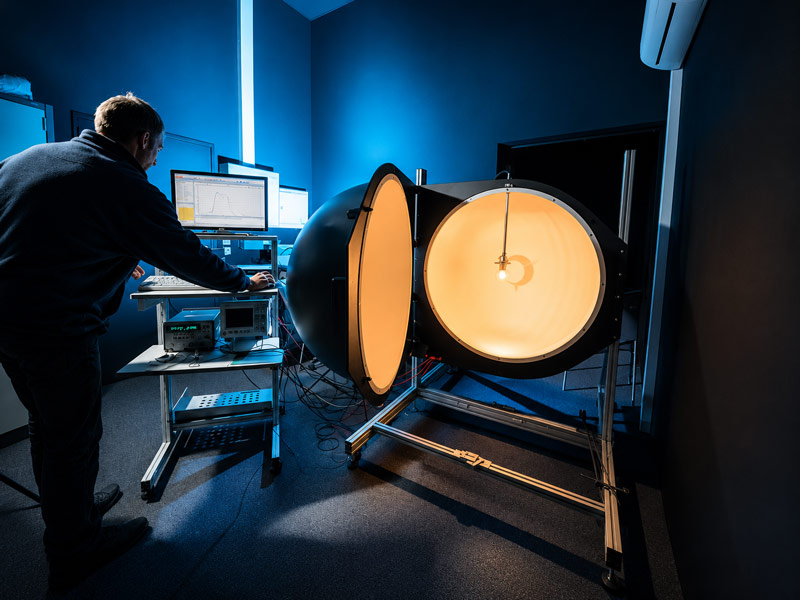
An integrating sphere measures total light output (lumens) from all directions, helping evaluate a light source’s luminous efficacy and overall energy efficiency.
Light Output and Efficiency
Compare delivered lumen output with total input power. Understanding lumens in light bulbs helps separate brightness from electricity consumption.
For luminaires, check whether published figures describe the complete assembled product or only its LED components. Optics and other system losses affect the light ultimately delivered.
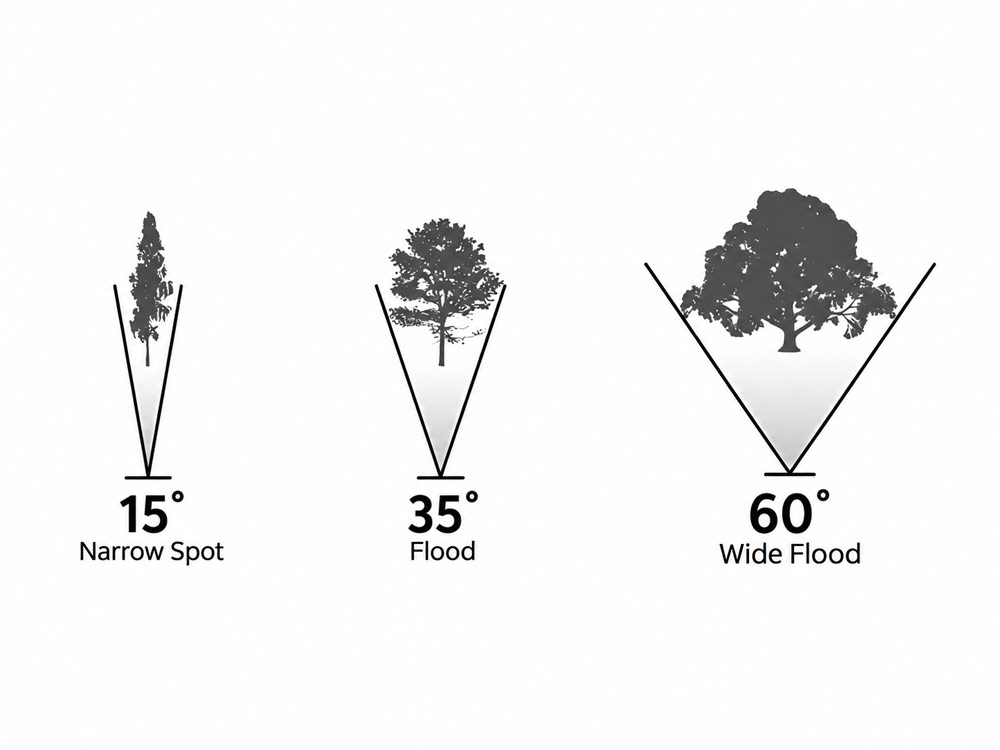
Different beam angles create distinct lighting patterns, from focused spots to broad illumination.
Distribution and Visual Comfort
The beam angle of a spotlight influences where the light falls and how concentrated it appears.
A path, planting bed and entrance may require different distributions. Assess the intended illuminated area, glare and spill light rather than selecting solely by total lumens.
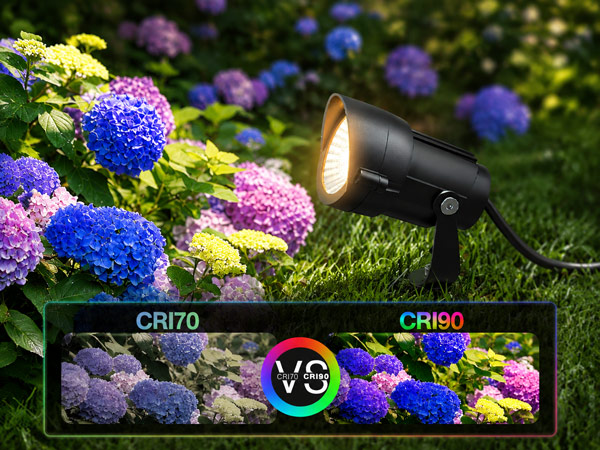
CRI 90 lighting reveals more vivid and natural flower colours compared with CRI 70.
Colour Appearance and Colour Rendering
CCT and CRI in garden lights describe different aspects of lighting quality: the apparent colour of the light and its ability to render object colours.
These characteristics matter when illuminating foliage, paving, timber and architectural finishes. Include them in the specification independently of the RoHS requirement.
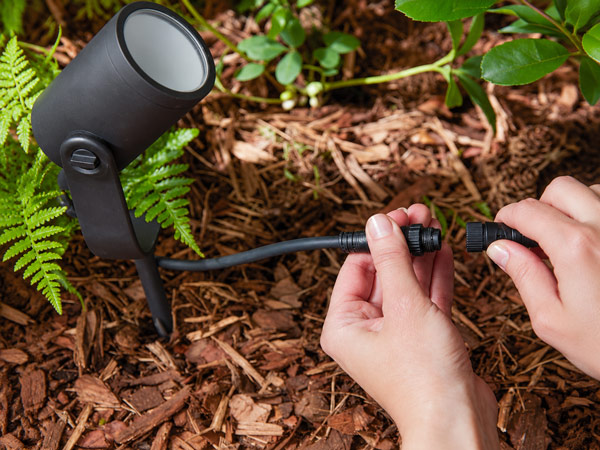
Sealed cable connectors help protect outdoor electrical connections from moisture and dust.
Protection Against Site Conditions
Outdoor products also need appropriate protection against dust and water. Understanding the difference between IP44 and IP65 helps buyers assess ingress protection for different locations.
Additional site conditions may require separate attention, including corrosion, ultraviolet exposure, operating temperature and installation details.
Keeping these checks distinct makes product comparisons more useful: each requirement answers a specific question about suitability.
Consider What Happens After the First Component Fails
RoHS limits hazardous substances in applicable materials. A broader environmental assessment should also examine how much equipment a lighting installation consumes throughout its service life.
Consider two compliant luminaires illuminating the same path. One allows a failed driver to be replaced using a documented compatible part. The other requires replacement of the complete luminaire.
That difference affects maintenance decisions and potential material use, even though both products initially satisfy RoHS requirements.
Useful purchasing questions include:
- Can common failure components be accessed and replaced?
- Are compatible spare parts identifiable and available?
- Can maintenance preserve the original ingress protection?
- Does the replacement part have appropriate material-compliance evidence?
- Are service instructions clear enough to preserve electrical safety?
Repairability needs to work with the product’s protective design. Opening a sealed housing without suitable procedures can compromise its subsequent performance.
The same attention should apply when selecting replacement parts. Matching voltage, wattage and dimensions establishes only part of compatibility; material composition and supporting evidence also deserve review.
For lighting projects, compare products over a common period and operating duty. Consider the luminaires and replacement components needed to maintain the required illumination, alongside energy consumption and maintenance access.
This approach gives RoHS a useful place within a complete specification: controlled materials, traceable evidence, suitable lighting performance and a credible plan for continued service.
FAQs
1. What Is the Difference Between RoHS and REACH?
RoHS restricts specified substances in electrical and electronic equipment. REACH regulates chemicals more broadly and can create additional restrictions and information obligations affecting lighting materials and components.
A RoHS declaration therefore does not establish compliance with every applicable REACH requirement. Buyers should identify the requirements relevant to the product and request evidence addressing each legal framework.
2. Can RoHS-Compliant LED Lights Go in Household Rubbish?
In the EU, electrical lighting waste generally requires separate collection through appropriate electronic-waste channels. RoHS compliance does not remove those disposal obligations.
RoHS controls specified substances in products, while WEEE rules address collection, treatment and recovery after equipment becomes waste. The crossed-out wheeled-bin symbol indicates that the product should enter separate collection rather than unsorted waste.
3. Do Solar Garden Lights and Their Batteries Follow the Same RoHS Rules?
Solar power does not automatically place a lighting product outside RoHS. Products such as solar spike lights still contain electrical and electronic equipment requiring a scope assessment.
The battery is addressed under separate battery legislation. Consequently, buyers should distinguish the luminaire’s RoHS evidence from the battery’s applicable compliance evidence. A single general statement about the complete solar product may leave that distinction unclear.
4. What Is the Difference Between RoHS 2 and RoHS 3?
“RoHS 2” commonly refers to Directive 2011/65/EU. “RoHS 3” is a commercial term often used for the amendment associated with Delegated Directive (EU) 2015/863, which added four restricted phthalates.
For purchasing documents, request the actual applicable legal references rather than relying on numbered marketing labels. The underlying EU framework remains Directive 2011/65/EU as amended.
5. Does RoHS Compliance Mean a Light Is Halogen-Free?
No. RoHS restricts specified substances, including PBB and PBDE flame retardants; it does not impose a blanket restriction on every halogen-containing compound.
Consequently, a RoHS declaration alone cannot substantiate a halogen-free claim. If halogen content matters to a project, define the materials covered, applicable limits and assessment method, then request evidence specifically addressing that requirement.
