

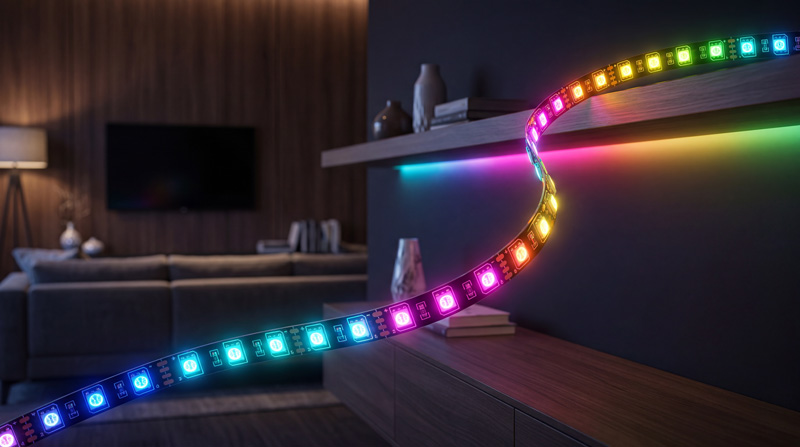
In modern decorative and architectural lighting, few terms have become as visible in product pages and smart-home discussions as RGBIC. Yet many buyers still confuse it with ordinary RGB lighting, assume it is simply a marketing label, or misunderstand what kind of visual difference it actually creates. To understand RGBIC properly, it helps to begin with the basics of digital lighting control.
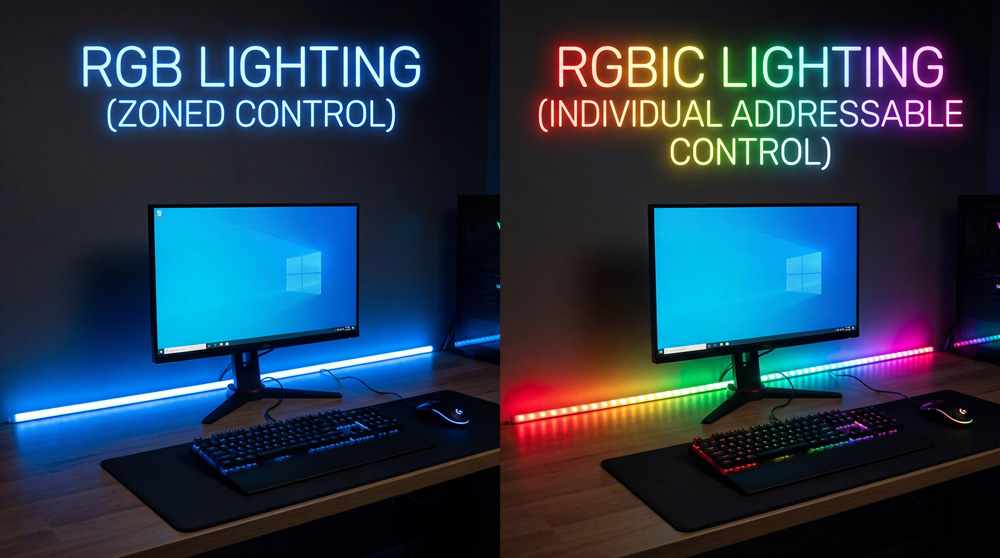
This distinction matters because traditional RGB lighting and RGBIC lighting produce very different visual experiences. A standard RGB strip can generate many colors, but in many products the whole strip acts as one lighting zone: if you set it to blue, the whole strip becomes blue; if you change it to purple, the whole strip becomes purple. RGBIC changes that model by introducing separate control logic across the strip, allowing one section to glow red, another green, and another blue, all at the same time. That is why RGBIC lighting often looks more dynamic, layered, and animated than conventional RGB lighting.
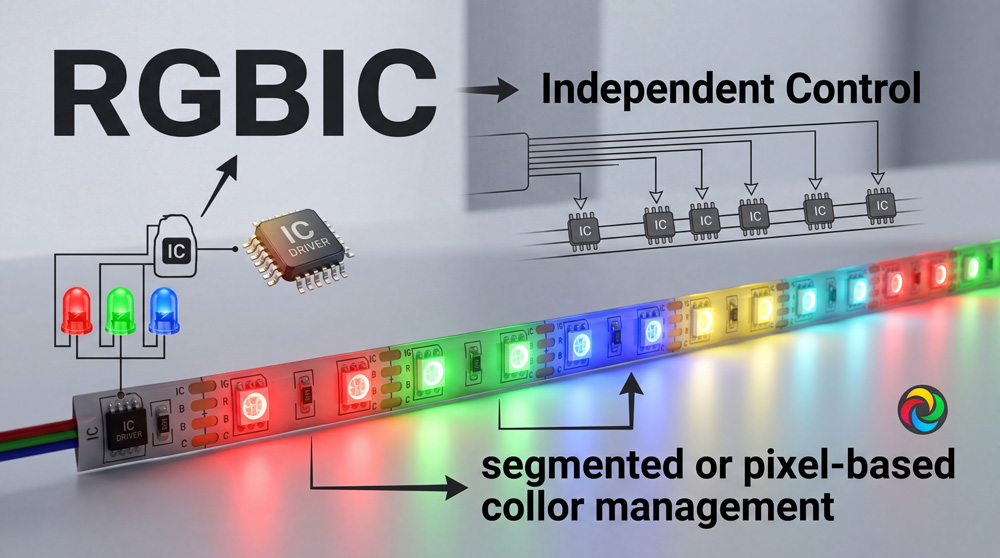
The “IC” in RGBIC is especially important. It stands for Independent Control, referring to the control chip architecture that makes segmented or pixel-based color management possible. In practical terms, the light strip is no longer treated as one continuous, single-color object. Instead, the controller can send different instructions to different parts of the strip. Depending on the product’s design, that control may apply to each LED individually, or to small groups of LEDs that function as independent zones. This is a crucial technical nuance: not every RGBIC product offers full pixel-level control, but the defining feature is that multiple independently managed color regions can coexist on one strip.
From a technology perspective, RGBIC sits within the wider evolution from simple analog lighting toward digitally addressable lighting systems. Older LED strips were comparatively straightforward: power flowed through shared channels for red, green, and blue, and the strip behaved uniformly. Addressable strips, by contrast, include chips that interpret digital data and execute localized lighting commands. Adafruit’s technical materials on addressable strips and products such as NeoPixels and DotStars describe this same broader principle: LEDs or segments can be controlled independently because a chip receives coded instructions and passes data along the chain. RGBIC, then, can be understood as a consumer-friendly label for this more advanced control philosophy in decorative lighting.
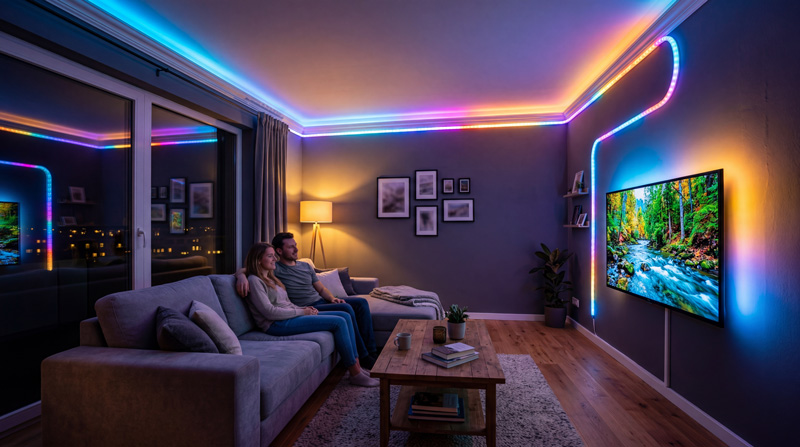
Why does this matter for users? The answer is simple: visual richness. RGBIC enables effects that ordinary RGB cannot reproduce convincingly. Chasing rainbows, flowing gradients, segmented animations, moving color waves, music-reactive effects, and scene-based transitions all become far more effective when separate areas of the strip can behave differently. Instead of a room being washed in one static hue, the lighting can become a layered visual element that contributes motion, mood, and depth. This is one of the reasons RGBIC products are popular in gaming rooms, streaming setups, TV backlighting, bedroom décor, holiday displays, and ambient commercial installations.
Another reason RGBIC matters is that it changes how people think about lighting as part of interior design. Traditional light sources are usually evaluated in terms of brightness, color temperature, and utility. RGBIC products add a more experiential dimension. They do not merely illuminate a space; they can shape atmosphere, define edges, emphasize geometry, and synchronize with music or media. In contemporary smart homes, lighting is no longer only functional infrastructure. It is increasingly part of entertainment, branding, self-expression, and environmental storytelling. RGBIC is well suited to this shift because it combines programmability with relatively accessible consumer hardware.
Still, a professional understanding of RGBIC requires moving beyond the marketing language. Buyers often assume RGBIC is always “better” than RGB, but that depends on the application. If the goal is simple mood lighting in one solid color, standard RGB may be entirely sufficient. It can also be less expensive and easier to configure. RGBIC becomes valuable when the user wants multi-zone color expression, animated effects, or a more premium visual presentation. In other words, RGBIC is not universally necessary, but it offers a stronger toolkit for advanced decorative lighting design.
From a buying standpoint, one of the most common misconceptions is that all RGBIC strips have the same control granularity. They do not. Some products divide a strip into relatively large segments, while others offer much finer addressability. This difference has a direct impact on the smoothness of gradients, the detail of animations, and the sophistication of scene effects. A strip with coarse segmentation may still display multiple colors at once, but transitions can appear blocky. A strip with finer control can create more fluid and premium-looking motion. Professionals evaluating lighting products should therefore look beyond the RGBIC label and examine the number of controllable segments, software ecosystem, app design, effect library, and integration options.
Software is another major part of the RGBIC experience. The hardware may enable independent control, but the app or control platform determines how usable that capability becomes. High-quality RGBIC systems usually provide scene presets, DIY pattern creation, segmented editing, brightness control, timers, music synchronization, and smart-home integration. In practice, consumers often judge RGBIC products less by the raw chip architecture than by whether the software makes the effects easy to customize. This is why two RGBIC products with similar hardware can feel very different in real-world use. A professional evaluation should therefore consider both the electrical design and the control interface.
There are, of course, limitations. RGBIC strips are generally more complex than basic RGB strips, and that complexity can affect cost, installation, power planning, and troubleshooting. Because they rely on digital control, they can be less straightforward to cut, extend, or integrate than simple analog strips. Some products have strict cutting points, connector requirements, or controller dependencies. In addition, certain RGBIC consumer products cannot be easily synchronized with third-party ecosystems at the same level as professional DMX or architectural lighting systems. For casual users, these limitations are usually acceptable. For advanced installations, however, they are important considerations.
In a broader market sense, RGBIC reflects the convergence of three trends: the falling cost of LEDs, the rise of smart-home ecosystems, and the growing demand for personalized environments. Consumers now expect lighting to respond not only to switches but also to apps, schedules, voice assistants, games, music, and video content. RGBIC fits naturally into this landscape because it turns light into a programmable medium. It is no longer just about seeing better; it is about feeling, expressing, and controlling space in a more nuanced way. That is why RGBIC has become especially visible in lifestyle-oriented technology categories rather than purely utilitarian lighting segments.
For consumers, the practical takeaway is clear. Choose RGB when you want affordable, simple, single-color-at-a-time lighting. Choose RGBIC when you want layered color, motion, visual complexity, and a more immersive smart-lighting experience. For designers and technology professionals, RGBIC is best understood not as a vague buzzword, but as a consumer-facing expression of addressable LED control principles adapted for home and lifestyle markets. Seen in that light, RGBIC is not merely a trend. It is part of the larger transformation of lighting from static illumination into interactive digital ambience.
FAQs
Can RGBIC light strips be cut or extended?
That depends entirely on the product design.
Some RGBIC lights include marked cutting points, while others—especially many outdoor or permanent-installation models—cannot be cut at all.
Extension support is also model-specific, so installation planning should always begin with the exact product specifications and FAQ.
Does RGBIC require a hub to work?
Not always.
Many consumer RGBIC products can be controlled directly through the manufacturer’s app without requiring Alexa, Google Assistant, or a separate hub.
However, devices with Matter support may offer broader ecosystem integration and more flexible cross-platform control.
Is RGBIC compatible with Matter, Alexa, Google Home, or Apple Home?
Compatibility varies by model rather than by the RGBIC label alone.
Matter-enabled RGBIC devices can connect with major platforms such as Apple Home, Amazon Alexa, Google Home, and Samsung SmartThings.
Buyers should verify support at the individual product level before purchase.
Can RGBIC lights sync with music, TV content, or other smart lights?
Yes, many RGBIC systems support music-reactive lighting through a phone microphone, built-in microphone, or a dedicated sync accessory.
Some TV-oriented products also use a camera or HDMI sync box to match on-screen colors in real time.
Within compatible ecosystems, multiple lights may also be synchronized in one setup.
What should professionals check before specifying RGBIC for long runs or outdoor projects?
The most important factors are weather resistance, maximum supported length, extension rules, and power planning.
For long addressable-light runs, voltage drop and power distribution can affect brightness consistency.
Installers should confirm the IP rating, controller limits, and whether additional power injection is needed.
