
Table of Contents
- U.S. solar and outdoor lighting compliance dates
- Maine’s requirements for public outdoor lighting
- Illinois has two separate lighting schedules
- California and New York apply energy codes to covered building work
- What to check in other states
- How to specify and verify a compliant solar lighting installation
- References
- FAQs
Maine began applying its new outdoor lighting requirements to covered public installations and replacements on October 1, 2026. California’s 2025 Energy Code applies to covered building permit applications filed from January 1, 2026. In Illinois, two laws taking effect on January 1, 2027 address different projects. One amends the requirements for certain state-funded and state-managed outdoor lighting. The other sets a deadline for adopting new standards in the commercial stretch energy code.
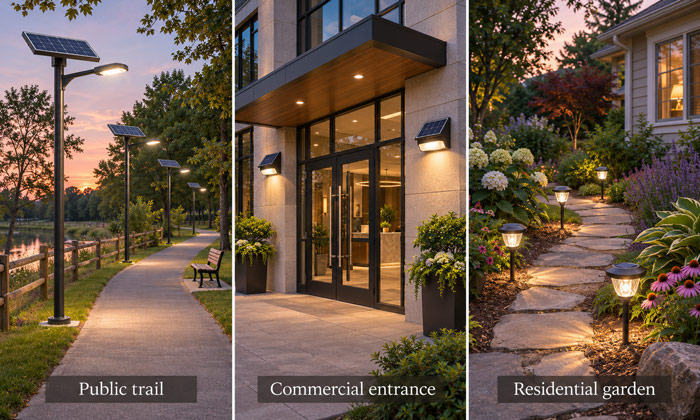
Outdoor solar lighting includes pole lights on public trails, wall lights at commercial entrances, and stake lights in residential gardens, with compliance deadlines depending on the project type and location.
For solar lighting, the relevant date depends on the property, the work, and the rule that governs it. A battery-powered pathway light can fall within an outdoor lighting ordinance because of where it is used and where its beam goes. A permanently installed commercial system may also be subject to building energy or electrical requirements. A public contract can add its own equipment and acceptance criteria. Identify those obligations before selecting a fixture or setting an installation date.
U.S. solar and outdoor lighting compliance dates
| Jurisdiction | Key date | What triggers compliance |
|---|---|---|
| New York State | December 31, 2025 | The 2025 state energy code took effect. Covered commercial exterior lighting is subject to the applicable power and control provisions. |
| California | January 1, 2026 | Covered buildings with permit applications filed on or after this date must follow the 2025 Energy Code. |
| Palo Alto, California | February 20, 2026, with an existing-lighting deadline of February 20, 2027 | The city ordinance took effect in 2026. Existing fixtures with adjustable features have one year to meet the applicable requirements other than shielding. |
| New York City | March 30, 2026 | The city’s 2025 energy code applies to new job filings and specified other filings, including those with incomplete energy analyses. |
| Maine | October 1, 2026 | Covered public outdoor lighting installed or replaced from this date must meet the new standards. |
| Illinois | January 1, 2027, with a code adoption deadline of December 31, 2029 | Public Act 104-0813 takes effect in 2027. The 2029 date is the deadline for the Capital Development Board to adopt a commercial stretch energy code containing the specified lighting standards. |
Maine’s requirements for public outdoor lighting
Maine’s Title 5, §481 applies to installations and replacements that qualify as public improvements. That scope can include a municipal project or work performed under a contract or grant agreement with a public entity. A town replacing solar fixtures along a public trail should evaluate the lighting as part of the public improvement. Municipalities can also adopt ordinances that extend the standards beyond the public projects covered by state law.
For covered projects, check four separate requirements when preparing the fixture schedule:
- Maintained light level. For uses subject to the general cap, the design may reach up to 125% of the applicable ANSI/IES recommended level, subject to a stricter rule or ordinance. Outdoor sports lighting has separate provisions.
- Spill into protected areas. Light trespass into specified state- or federally designated natural areas, habitats, reserves, or wilderness is capped at 0.1 lux. Check where the measurement must be taken and how the meter must be oriented.
- Shielding and high-angle output. A fixture emitting more than 1,000 lumens must be fully shielded and may emit up to 5% of its total output at angles greater than 80 degrees from straight down.
- Color and hours. The general cap is 3,000 K, with exceptions for specified uses. Nonessential lighting must switch off during the statutory nighttime period. That period generally begins at 10 p.m., with a later start for facilities or activities operating past that hour.
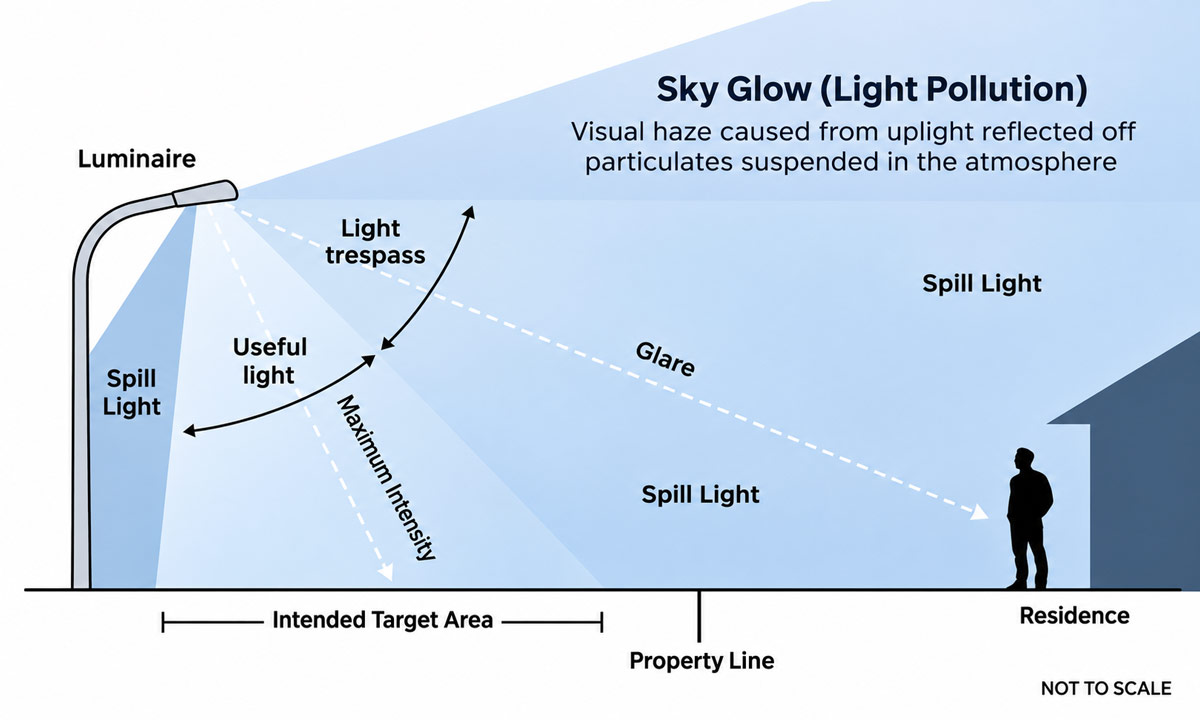
Proper beam control, mounting height, and aiming keep outdoor solar lighting focused on the intended area and help reduce glare, light trespass across property lines, and sky glow.
On a public trail next to a designated reserve, the designer has two distinct jobs. The trail needs enough light for its intended use, and the edge facing the reserve needs to meet the spill limit. If the applicable recommendation is 4 lux and the general 125% cap applies, the trail’s maximum under that calculation is 5 lux before any stricter rule. Fixture spacing helps achieve the trail target. Beam control, mounting height, and aiming help keep light within the site.
Illinois has two separate lighting schedules
State-funded purchases and specified state-managed sites
Public Act 104-0800 amends the Responsible Outdoor Lighting Control Act. It covers specified new luminaires purchased with state funds and installations on land or structures owned and managed by the Illinois Department of Natural Resources. For covered permanent fixtures, the statute calls for full shielding, a backlight, uplight, and glare rating, and less than 1% of output at angles greater than 80 degrees from straight down. It also specifies a 1-lux property-boundary limit, measured horizontally and vertically at ground level.
The amended law sets a 2,700 K cap through June 30, 2032, followed by a 2,200 K cap for covered new luminaires purchased or installed after that date. A park or agency planning a multiyear rollout should put purchase and installation dates on its fixture schedule. A model selected for an early phase may need a different color configuration for a later phase.
Commercial stretch energy code
Public Act 104-0800
Lighting requirements
Act Takes Effect
2,200 K Maximum
Public Act 104-0813
Commercial stretch code
CDB Adoption Deadline
Project Applicability
Depends on local adoption and the governing code edition.
Public Act 104-0813 directs the Capital Development Board to adopt a commercial stretch energy code containing specified lighting standards by December 31, 2029. The enacted provisions call for a 3,000 K maximum, a 1.0-lux light-trespass ceiling, and outdoor light levels up to 25% above the applicable ANSI/IES standards. They also specify a 5% high-angle output limit for fixtures emitting more than 1,000 lumens. The bill’s original December 2026 proposal was replaced during the legislative process.
For a privately funded commercial site, check whether the municipality has adopted the commercial stretch code and which edition governs the work. Record the board’s adoption deadline separately from the date the project must comply with the applicable local edition.
California and New York apply energy codes to covered building work
California
For nonresidential projects subject to California’s 2025 Energy Code, Title 24, Part 6, §130.2 addresses outdoor lighting equipment and controls, while §140.7 covers outdoor lighting power allowances. Start a parking lot or commercial entrance design by identifying the lighting zone, the area served, and the controls required for that use. Those details determine what the designer needs to show on the plans.
Covered residential luminaires permanently mounted to a building follow a different provision. §150.0(k)3 calls for manual switching that works with an automatic control arrangement. Listed options include a photocell paired with a motion sensor or time switch, or an astronomical time clock. When proposing an integrated solar wall light, document the controller’s actual functions and confirm which requirements apply to the installation.
Palo Alto shows how a city can establish a separate timeline. Its ordinance generally sets a 2,700 K ceiling and regulates shielding, light trespass, and operating hours, with exceptions for specified uses. The city says existing fixtures with adjustable features must meet the applicable provisions other than shielding by February 20, 2027. For an existing property, identify which lights can be re-aimed, dimmed, or rescheduled and which fixtures are part of a new installation or replacement.
New York
New York’s 2025 state energy code addresses commercial exterior lighting controls in §C405.2.7 and exterior lighting power in §C405.5. For covered façade and landscape lighting, the controls must switch the lights off by one hour after closing and keep them off until at least one hour before opening. Other exterior lighting can be subject to automatic power reductions under the applicable setback provisions.
A site with both grid-connected fixtures and standalone solar units should identify the power source and responsible owner for each lighting group. The reviewer can then determine which loads belong in the connected exterior lighting calculation and which control provisions apply. New York City has its own filing guidance, with a March 30, 2026 transition for new job filings and specified other applications.
What to check in other states
Arizona and New Mexico illustrate how existing state laws can affect solar fixtures. Arizona defines outdoor lighting broadly enough to include permanent and portable fixtures used for landscape lighting. Its shielding law has wattage and use exceptions, and qualifying local ordinances can govern where they are equally or more stringent. New Mexico’s Night Sky Protection Act applies its shielding provision to outdoor fixtures installed after January 1, 2000, subject to statutory exemptions. Start with the city or county that governs the address before applying a state threshold to a specific light.
Colorado and Connecticut illustrate why funding and road ownership matter. Colorado’s statute includes a full-cutoff requirement for qualifying new fixtures above 3,200 lumens installed by or for the state using state funds. Connecticut regulates state- or municipally funded installations and replacements of permanent roadway luminaires, with cutoff provisions that depend on the road category and statutory conditions. A roadway bid should identify the funding source and road classification before assigning a fixture standard.
For a project elsewhere in the United States, use the federal building energy codes portal to identify the adopted commercial or residential edition. Then check the state’s lighting statutes and the local zoning code for exterior lighting, glare, light trespass, and lighting plan requirements. Record the provision, effective date, and event that brings the work within its scope.
How to specify and verify a compliant solar lighting installation
Match the beam to the area that needs light
A specification for dark sky compliant outdoor lighting should identify the task, the allowable light distribution, and the areas that need protection from spill. For a path, show the walking surface, changes in level, nearby windows, and the property boundary. A low-mounted fixture with a controlled beam may illuminate the path more effectively than a higher-output fixture aimed across the site. Verify the installed height and tilt against the approved layout.
Check light output, boundary illuminance, and color separately
A fixture’s lumens describe its total light output. Lux and foot-candles describe light arriving at a surface. Use the photometric chart to review the distribution, then use the corresponding digital photometric data to model the proposed fixture, optics, mounting height, and tilt. Compare the results at the points and measurement planes required by the governing rule. An acceptable average across a parking lot can coexist with a bright spot at its boundary.
Record the actual correlated color temperature on the fixture schedule. Where both 2700K and 3000K landscape lighting are permitted, a nighttime mockup can show how each looks against paving, steps, or a façade. For selectable-color fixtures, specify the approved setting so the installer can verify it during commissioning.
Size the solar system for the permitted operating schedule
A photocell can detect daylight, a timer can enforce a shutoff or dimming schedule, and a motion sensor can raise output when people arrive. Check which functions the site requires and whether the controller can perform them in sequence. Where different rules apply to façade, pathway, and parking lights, put each group on the schedule appropriate to its use.
Base the energy budget on the allowed operating modes. For example, a fixture drawing 20 watts for four hours and 5 watts for eight hours uses 120 watt-hours per night at the light, before system losses. For standalone equipment, ask the supplier to show how usable battery capacity and local solar exposure support that schedule, including periods of reduced charging. On a pole-mounted system, account for the panel when reviewing wind loads and the foundation design.
Request evidence for the exact equipment and installed settings
For a bid or permit submittal, identify the offered fixture model, optics, shield, output setting, color temperature, and controller. Ask for photometric data for that configuration and any equipment documentation required by the adopted code or project specification. Where the contract references ANSI/NEMA C136.40-2023 for DC solar-powered roadway and area lighting systems, verify the edition and evidence requested in the bid.
At acceptance, check the mounting and aim after dark, test the scheduled shutoff or dimming, and verify the motion response where applicable. Keep the approved fixture schedule, control settings, and any required field measurements with the project records. That record gives maintenance teams the information they need when replacing a fixture or resetting its controller.
References
1. Maine Legislature. (n.d.). Title 5, § 481: Responsible outdoor lighting.
2. Illinois General Assembly. (2025–2026). SB 3037: Dark Sky Act.
3. Illinois General Assembly. (n.d.). Energy Efficient Building Act (20 ILCS 3125).
4. Illinois General Assembly. (2026). Public Act 104-0813 (SB 3037).
5. Arizona Legislature. (n.d.). Arizona Revised Statutes § 49-1101: Definitions.
6. Arizona Legislature. (n.d.). Arizona Revised Statutes § 49-1102: Shielding of outdoor light fixtures; exemptions.
7. Arizona Legislature. (n.d.). Arizona Revised Statutes § 49-1106: Exemption of cities, towns and counties.
8. New Mexico Statutes. (2025). Section 74-12-4: Shielding of outdoor light fixtures.
9. Colorado Revised Statutes. (2025). Section 24-82-902: Outdoor lighting fixtures funded by the state—Standards.
10. Connecticut General Assembly. (2025). Chapter 238: Highway construction and maintenance.
11. California Energy Commission. (2025). 2025 Building Energy Efficiency Standards.
12. California Energy Commission. (2025). 2025 Nonresidential Compliance Manual, Chapter 6: Outdoor Lighting.
13. New York State Department of State. (2025). 2025 Energy Conservation Construction Code of New York State.
14. International Code Council. (2021). 2021 International Building Code with Massachusetts Amendments: Chapter 10—Means of Egress.
15. Maricopa County. (n.d.). Maricopa County Zoning Ordinance.
16. Yavapai County Development Services. (n.d.). Residential outdoor lighting report form.
17. Florida Fish and Wildlife Conservation Commission. (n.d.). Sea turtle protection ordinances.
18. Schultz, J. (2022, March 25). States shut out light pollution. National Conference of State Legislatures.
19. California Department of Real Estate. (n.d.). Real Estate Law: Pertinent excerpts from the California codes.
20. U.S. Department of Energy, Better Buildings & Better Plants Initiative. (2017, February 7). Solar-powered street and area lighting considerations fact sheet.
21. National Association of Counties. (n.d.). Solar energy for county facilities.
FAQs
1. Do I need a permit to install solar landscape lights?
Permit requirements depend on the local jurisdiction and the work. Tell the building department whether the fixtures are freestanding and self-contained, will be mounted to a structure, or require a new circuit. For example, South Pasadena, California, lists landscape lighting below 50 volts as permit-exempt and requires a permit for new 110-volt exterior lighting. Local lighting ordinances can still apply to permit-exempt installations.
2. Can an HOA restrict solar landscape lighting?
An HOA can review exterior changes where its governing documents and state law authorize that review. Check the declaration of covenants, conditions, and restrictions and the architectural standards for provisions on fixture placement, appearance, or mounting. California Civil Code §4765, for example, governs the review process when association documents require approval for a physical change to an owner’s property or a common area.
3. Can solar lights serve as required emergency exit lighting?
A solar-powered system can serve that function if the building official approves it under the adopted egress and emergency-power provisions. The design must demonstrate the required illumination, uniformity, and duration. The building code with Massachusetts amendments, for example, calls for at least 90 minutes of emergency power for covered egress lighting. Submit the system design and illumination calculations before relying on solar fixtures for this purpose.
4. Are solar lights allowed near sea turtle nesting beaches?
Check the beachfront lighting ordinance for the property. Florida provides a framework for local sea turtle protection rules, and its wildlife agency recommends mounting necessary lights low, shielding the source from the beach, and using long-wavelength light. Its wildlife lighting criteria call for wavelengths above 560 nanometers with shorter wavelengths absent. Use the fixture’s spectral data and the local visibility rules to evaluate the installation.
5. Is IP65 sufficient for outdoor solar lights?
An IP65 rating indicates a dust-tight enclosure tested for protection against water jets. For a location where a fixture may sit in standing water, check the manufacturer’s immersion rating and installation instructions. Where the adopted electrical code requires a wet-location marking, verify that marking for the exact luminaire as part of equipment selection.
