

Table of Contents
- 12V vs. 24V LED Strips: How Their Power Requirements Differ
- How to Calculate LED Strip Power Requirements
- LED Strip Power Requirement Chart
- Choose the Correct Power Supply Type
- Check RGB, RGBW, and Controller Current Limits
- Account for Voltage Drop on Longer Runs
- Consider Temperature and Outdoor Exposure
- FAQs
Choosing the right power supply starts with three specifications: the LED strip’s voltage, its maximum power consumption per meter, and the length you plan to install.
For example, a 5-meter strip rated at 14.4 watts per meter requires 72 watts of DC power. Using an 80% power supply loading target, that strip alone calls for at least 90 watts of supply capacity, before accounting for controller consumption and wiring losses.
Both 12V and 24V systems follow the same calculation method. The main difference is how much current they carry—and how that affects wiring, voltage drop, and power distribution.
12V vs. 24V LED Strips: How Their Power Requirements Differ
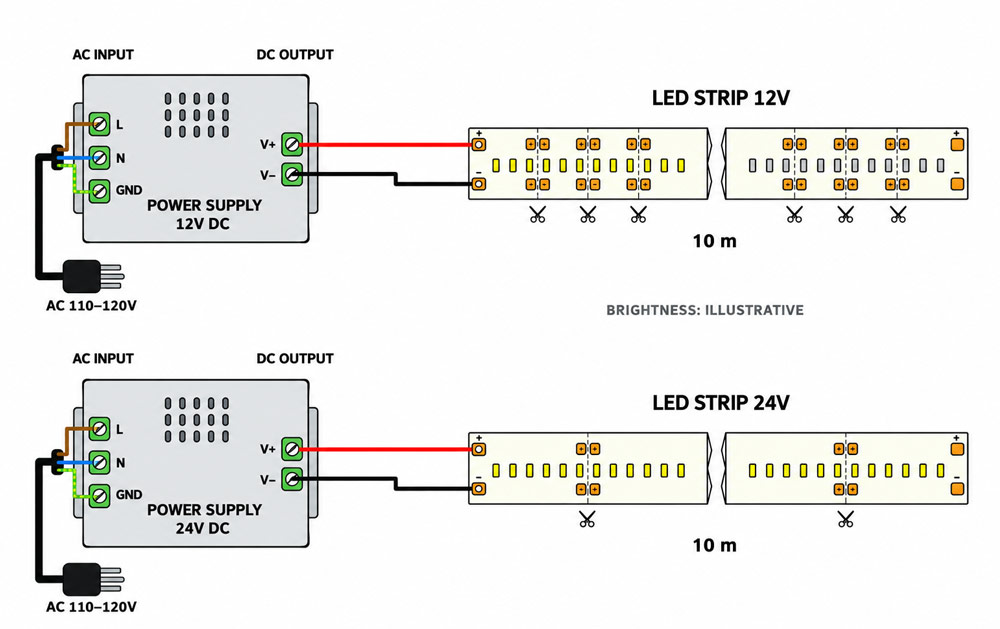
Voltage does not tell you how many watts an LED strip consumes. Two strips designed for different voltages can have the same power rating.
The difference becomes clear when you calculate current:
Current (A) = Power (W) ÷ Voltage (V)
| Comparison | 12V LED Strip | 24V LED Strip |
|---|---|---|
| Required supply output | Matching 12V DC | Matching 24V DC |
| Current for a 60W load | 5A | 2.5A |
| Current for a 120W load | 10A | 5A |
| Cable voltage drop at equal power and cable resistance | Higher | Lower |
| Common reason to choose it | Compatibility with an existing 12V installation | Lower current for longer or more demanding installations |
A 24V strip draws half the current of a 12V strip consuming the same wattage. This reduces losses in the supply cables and makes power distribution easier.
However, switching to 24V does not automatically halve electricity consumption or double brightness. Compare the products’ watts per meter, lumens per meter, and efficiency rather than assuming voltage determines their performance.
How to Calculate LED Strip Power Requirements
1. Confirm the Strip Specifications
Before choosing a power supply, identify:
- Rated voltage: Usually 12V DC or 24V DC for the strips covered here.
- Maximum power consumption: Expressed in watts per meter or watts per foot.
- Installed length: The total illuminated length connected to the supply.
Calculate the actual installed length after any trimming. Cut only at the manufacturer’s marked cut lines, since the available cutting intervals determine the final usable length.
Keep your measurement units consistent. Multiply watts per meter by meters, or watts per foot by feet.
Also check whether the listed wattage applies to one meter or the entire reel. A 5-meter reel labeled “72W total” already includes its full length; multiplying that figure by five would overestimate the load.
2. Calculate the Total Strip Wattage
Use this formula:
Strip power (W) = Installed length × Power per unit length
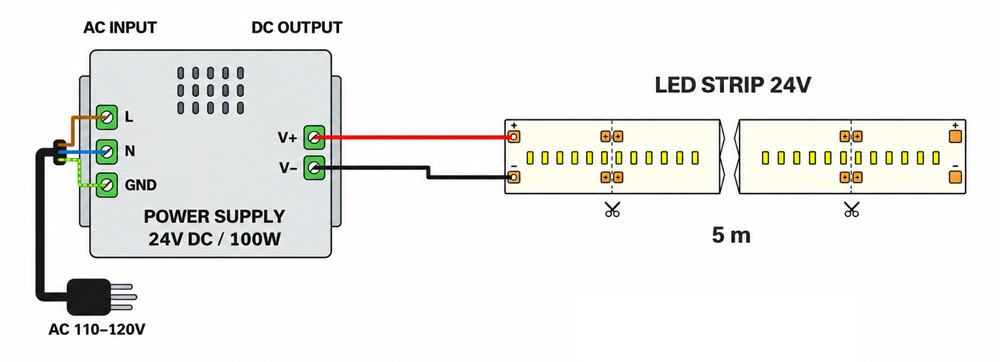
For a 5-meter strip rated at 14.4W/m:
5 × 14.4 = 72W
For multiple sections connected to one supply, calculate each section and add the results.
For example:
- Section A: 3 meters × 9.6W/m = 28.8W
- Section B: 2 meters × 14.4W/m = 28.8W
- Combined strip load: 57.6W
Use the product’s electrical power specification rather than estimating consumption from LED count alone.
3. Calculate the Required Current
Divide the strip wattage by its rated voltage.
For a 72W strip load:
At 12V: 72 ÷ 12 = 6A
At 24V: 72 ÷ 24 = 3A
These figures help you check the controller, connectors, and supply cables. A power supply may have sufficient wattage while a connector or controller remains unable to carry the required current.
4. Allow Appropriate Power Supply Capacity
A common design approach is to select a supply that operates at no more than approximately 80% of its available continuous output:
Required supply capacity = Total DC load ÷ 0.80
For a 72W load:
72 ÷ 0.80 = 90W
This calculation adds 25% capacity above the load. Adding only 20% produces 86.4W, which would operate at approximately 83.3% load.
The 80% target is a planning allowance. The final selection must follow the power supply manufacturer’s continuous output rating, temperature derating, mounting requirements, and permitted operating conditions.
LED Strip Power Requirement Chart
The following examples show how strip wattage translates into current and supply capacity.
| Installed Length | Strip Rating | Strip Load | Current at 12V | Current at 24V | Supply Capacity at an 80% Loading Target |
|---|---|---|---|---|---|
| 5m | 4.8W/m | 24W | 2A | 1A | 30W |
| 5m | 9.6W/m | 48W | 4A | 2A | 60W |
| 5m | 14.4W/m | 72W | 6A | 3A | 90W |
| 5m | 19.2W/m | 96W | 8A | 4A | 120W |
| 10m | 14.4W/m | 144W | 12A | 6A | 180W |
These are illustrative strip ratings, not universal specifications. The 12V and 24V columns assume separate products with the same rated wattage per meter.
The supply capacity column covers the strip load only. Add other loads and wiring losses before applying your chosen allowance. The table also does not establish how much strip can be powered from one feed point.
A Complete Power Supply Sizing Example
Suppose an installation contains:
- 5 meters of 24V strip rated at 14.4W/m.
- A calculated 4W allowance for controller consumption and DC wiring losses.
The calculation becomes:
Strip load: 5 × 14.4 = 72W
Total DC load: 72 + 4 = 76W
Supply capacity at an 80% loading target: 76 ÷ 0.80 = 95W
A suitable 24V, 100W supply could support this installation if it provides its rated continuous output under the actual installation conditions.
The 4W allowance is an assumption for this example. Use the documented or calculated values for your own equipment.
Choose the Correct Power Supply Type
Standard constant-voltage LED strips require a regulated constant-voltage DC supply with the correct output voltage.
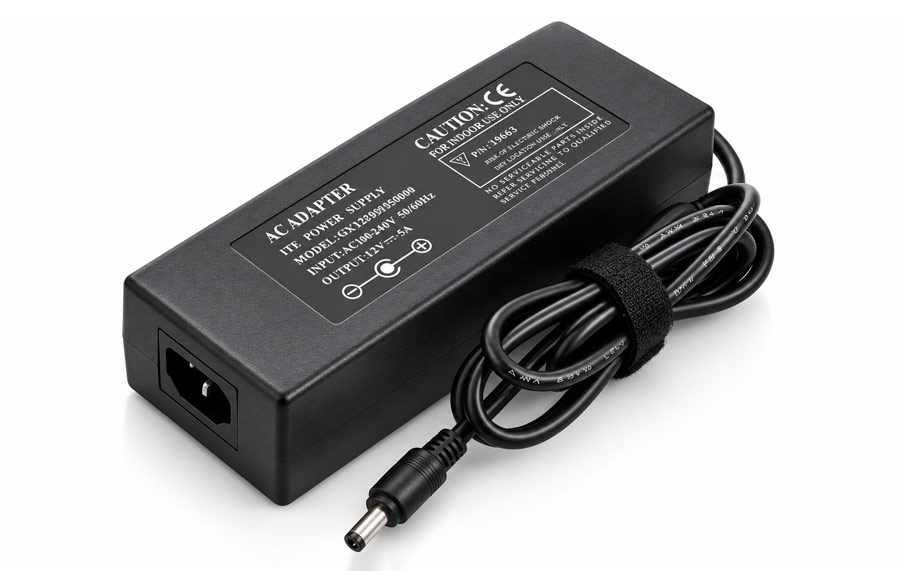
A 12V strip requires a compatible 12V DC supply. A 24V strip requires a compatible 24V DC supply. A constant-current driver is not an interchangeable substitute unless the strip manufacturer specifically requires one.
Extra wattage provides available capacity; it does not force that additional power into a correctly matched strip. Extra voltage changes the electrical operating conditions and can damage the strip. Increasing supply voltage is therefore not an appropriate way to increase brightness.
Check RGB, RGBW, and Controller Current Limits
Color-changing strips need a maximum-load check because power consumption varies with the active channels.
For RGB strips, operating red, green, and blue together can draw substantially more current than displaying one color. Size the system for the most demanding mode it can reach rather than a low-power effect used during testing.
For RGBW and tunable-white strips, check which channels the controller allows to operate simultaneously. If the published maximum W/m rating already includes those channels, do not multiply it again.
Controllers can also have separate per-channel and total-current limits. For example, a controller rated at 4A per channel and 8A total cannot deliver 4A through four channels simultaneously.
A larger power supply does not increase the controller’s limits. Check the entire current path, including shared conductors and terminals.
Account for Voltage Drop on Longer Runs
Enough supply wattage does not guarantee uniform brightness. Voltage can fall along both the cable feeding the strip and the copper tracks within the strip itself.
For a supply cable:
Voltage drop (V) = Current (A) × Total circuit resistance (Ω)
Total circuit resistance includes both the outgoing and returning conductors.
At the same power and cable resistance, a 24V system carries half the current, producing half the cable voltage drop in volts. Its cable heating losses are approximately one-quarter because resistive losses follow I²R.
The strip’s internal voltage drop still needs separate consideration. A larger power supply cannot remove resistance from a long strip or undersized cable.
To maintain consistent output:
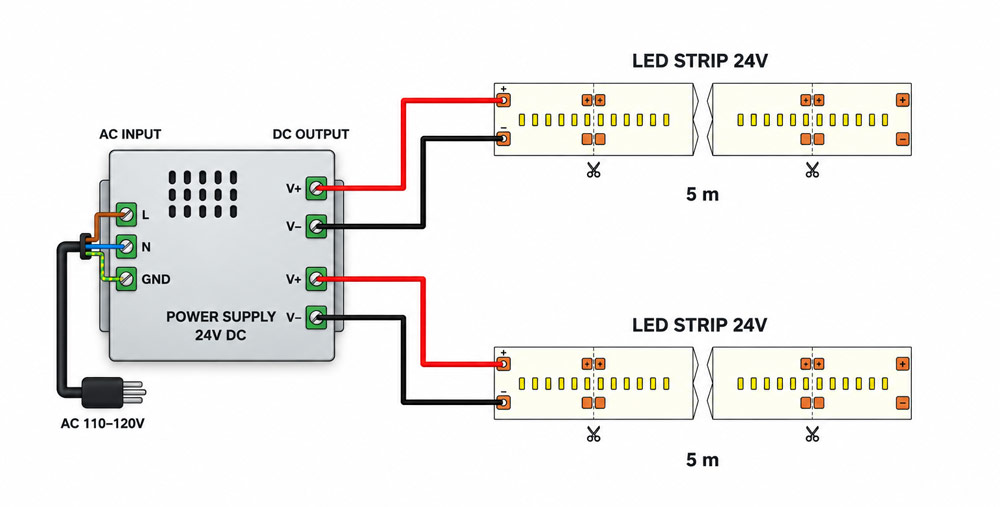
Keep power supply leads reasonably short and select conductors that can carry the required current while maintaining acceptable voltage drop. Divide longer installations into shorter sections supplied in parallel, and add feed points according to the strip and controller wiring instructions.
For outdoor installations, appropriate landscape lighting wire sizing depends on the load and cable distance together.
Always check the strip’s specified maximum run length for the intended feeding arrangement. Voltage alone cannot establish a universal maximum length.
Consider Temperature and Outdoor Exposure
A power supply’s nameplate wattage may not be available at every ambient temperature. Some models require reduced loading as temperature rises, so check the derating curve before placing a supply in a hot cabinet or restricted enclosure.
The strip also needs the mounting and heat dissipation specified by its manufacturer. Follow those requirements for any aluminum profile or mounting surface, and maintain the supply’s required ventilation.
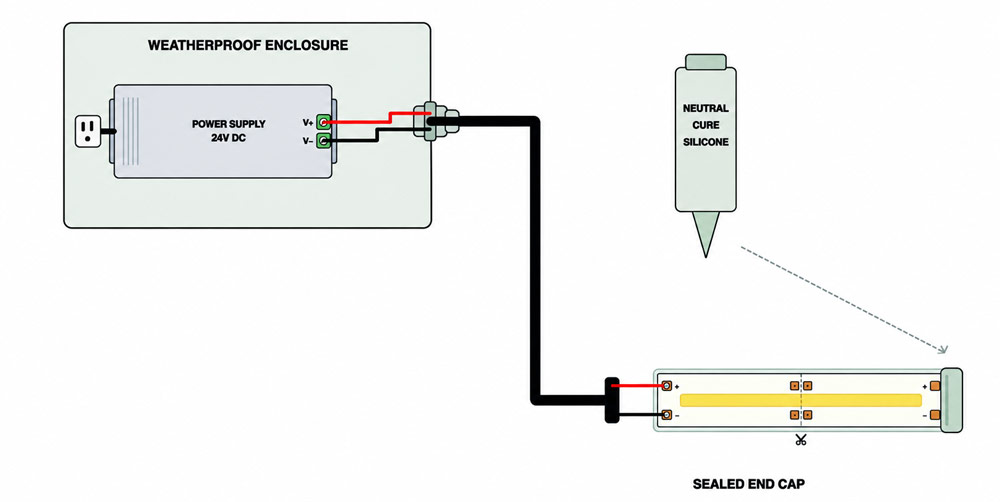
Weatherproof enclosures, sealed cable entries, and silicone-sealed end caps help keep outdoor LED strip connections dry.
For exterior installations, evaluate the strip, power supply, connectors, and cable entries individually. An outdoor-rated strip does not protect an indoor adapter or an exposed splice.
IP65 protection covers dust ingress and water jets under specified test conditions; it does not establish suitability for submersion.
Before completing the installation, test the system at its maximum permitted output. Measure voltage at the supply and distant strip sections under load, then check connections and temperatures against the equipment specifications.
FAQs
1. Can I Use a 12V AC Landscape Transformer for a 12V LED Strip?
Generally, no. A standard strip marked 12V DC requires a suitable DC source. A landscape transformer marked 12V AC supplies a different type of output, even though the voltage number looks the same.
Check the output label rather than relying on the word “transformer.” Use AC only when the strip is explicitly designed for it. A basic rectifier alone does not provide regulated 12V DC.
2. Can 12V or 24V LED Strips Run From a Battery?
Yes, provided the battery system’s output stays within the strip’s permitted voltage range and can supply the required current.
A battery’s nominal voltage does not describe its entire charging and discharging range. Use suitable voltage regulation when necessary.
For runtime estimates:
Runtime (hours) ≈ Usable battery capacity (Wh) × Conversion efficiency ÷ Load (W)
Use usable capacity rather than assuming the battery’s full nameplate energy is available.
3. How Much Electricity Do LED Strip Lights Use per Month?
Calculate electricity consumption from actual wall-input power:
Monthly energy (kWh) = Input watts × Daily operating hours × Days ÷ 1,000
For example, a 60W DC load supplied through a power supply operating at an assumed 90% efficiency draws approximately 66.7W from the wall.
Used six hours daily for 30 days, it consumes approximately 12kWh. Multiply that figure by your electricity tariff to estimate cost. Controller consumption and standby operation can add to the total.
4. Why Do LED Strips Flicker When Dimmed Even With Enough Supply Capacity?
Adequate wattage does not guarantee dimming compatibility. Flickering can result from an incompatible dimmer or an unstable low-end setting.
A mains wall dimmer requires a driver that supports its specific dimming method. Alternatively, a compatible low-voltage PWM controller can regulate a suitable strip on the DC side.
Check the supported dimming range and minimum-load requirements before assuming a larger supply will solve the problem.
5. Can Two Power Supplies Be Connected to the Same LED Strip?
Do not connect ordinary power supply outputs in parallel unless their manufacturers explicitly approve that operating arrangement. Matching voltage labels alone do not ensure that the supplies will share current correctly.
Use one adequately rated supply, or divide the installation into separately powered sections. Keep each section’s power connections within its intended supply zone, and follow the controller’s instructions for any shared signal reference or grounding connections.
