
Table of Contents
- Start With the Activity Below the Pendant
- Choose the Weave According to the Light You Want
- Size the Pendant by Its Visual Weight
- Calculate the Complete Hanging Drop
- Check the Bulb From Your Actual Eye Level
- Match the Bulb to the Shade
- Assess Craftsmanship Where It Affects Performance
- Verify Suitability for the Installation Environment
- Let the Room’s Existing Detail Guide the Final Choice
- FAQs
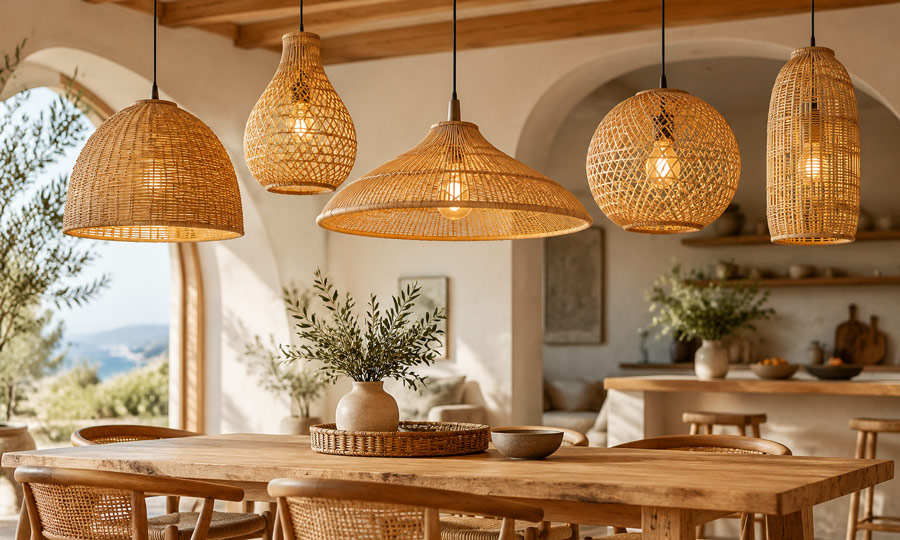
Choosing rattan pendant lights starts with understanding what happens after you switch them on. The weave, shade opening, bulb position, and hanging height all influence how the fixture lights a room.
A pendant that looks light and airy in a photograph may expose a distracting bulb when viewed from a dining chair. A densely woven shade may still illuminate a table effectively through its open base. Appearance alone tells only part of the story.
The most useful approach is to evaluate three things together: the shade in daylight, the visible light source after dark, and the surfaces receiving the light. This helps you choose a pendant that feels right throughout the day.
Start With the Activity Below the Pendant
Before comparing shapes, decide what the light needs to accomplish.
Above a dining table, comfortable faces, visible food, and an inviting atmosphere matter. Over a kitchen island, you may also need clear illumination for preparation and cleanup. In a bedroom, the pendant might provide atmosphere while a separate reading light handles close work.
Write a simple brief before shopping:
“This pendant should make dinner feel comfortable, while other fixtures provide general room lighting.”
That sentence makes selection easier. It tells you how much responsibility the pendant carries and whether a decorative shade with limited output will suit the space.
For a working island, examine where light reaches the countertop. A beautiful illuminated shade can coexist with poorly lit preparation areas. Consider the lighting across the entire surface, including the ends.
Choose the Weave According to the Light You Want
Weave density matters, but it works together with the shade’s openings, lining, and bulb position.
Use the following comparison to narrow your options.
| Shade construction | What to examine when illuminated | Where it may work well |
|---|---|---|
| Open weave without a lining | Visibility of the bulb, sideways light, and projected patterns | Spaces where decorative shadows are welcome |
| Dense weave with an open base | Downward illumination and how deeply the bulb sits inside | Dining areas where light should concentrate around the table |
| Rattan with an inner diffuser | Brightness of the diffuser and the amount of light reaching nearby surfaces | Spaces where a quieter, more even appearance is preferred |
| Layered or overlapping forms | Light escaping between layers and coverage beneath the fixture | Rooms where the pendant serves as a prominent decorative feature |
Treat these as inspection points. Two shades with similar-looking weaves can perform differently because their bulbs sit at different depths.
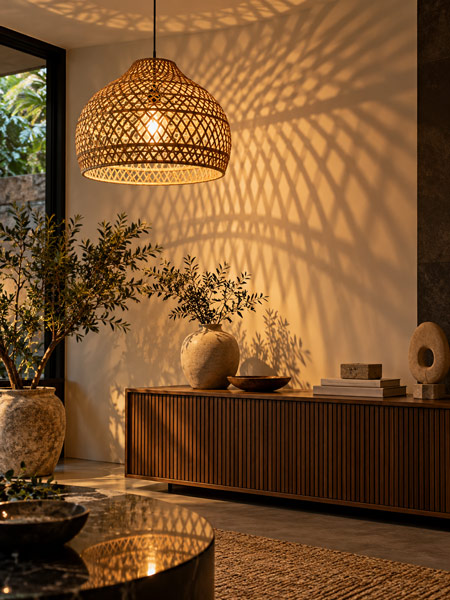
Treat the Projected Shadow as Part of the Decor
A useful design principle is to count the pendant’s shadow as another pattern in the room.
An open weave casting a geometric pattern across a plain wall can add interest. The same pattern projected over patterned wallpaper, open shelving, and decorative tiles may make the space feel crowded.
Look beyond the lampshade itself. Consider the surfaces around it:
- Plain walls can provide space for a noticeable shadow pattern.
- Strongly patterned walls often suit a more restrained lighting effect.
- Glossy surfaces deserve a reflection check because they may reveal the light source.
- Dark finishes make it especially useful to assess whether enough light reaches the intended surfaces.
This approach connects the pendant to the room’s existing visual detail.
Size the Pendant by Its Visual Weight
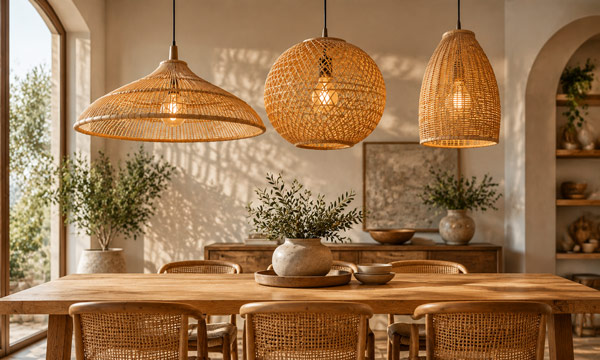
Diameter is a useful measurement, but it does not fully describe how large a rattan pendant will feel.
A broad, shallow shade with generous openings may appear lighter than a smaller, deep basket with tightly woven sides. Shade height, color, layering, and transparency all contribute to its visual weight.
For a single pendant above a dining table, a common starting point is a diameter around one-half to two-thirds of the table’s width. A 100 cm wide table would therefore suggest an initial shortlist around 50–67 cm. Use that range to begin comparing options, then assess the actual fixture and surrounding space.
For dense or dark shades, consider the smaller end of the range first. With a more transparent design, a wider shade may still feel balanced.
Check the Shape From More Than One Direction
Product photographs often show the most flattering angle. In your room, the pendant will also be seen from doorways, adjacent seating, and the side of the table.
Make a paper or cardboard outline showing both the proposed width and height. Have someone hold it safely at the intended position while you view it from several places.
This simple exercise can reveal that a pendant fits the table but blocks an important view across an open-plan room.
For a long table, also consider the end seats. The fixture’s outline may look balanced while its light remains concentrated in the center. Compare one larger pendant with a pair of smaller fixtures according to coverage, clear spacing, and sightlines.
Calculate the Complete Hanging Drop
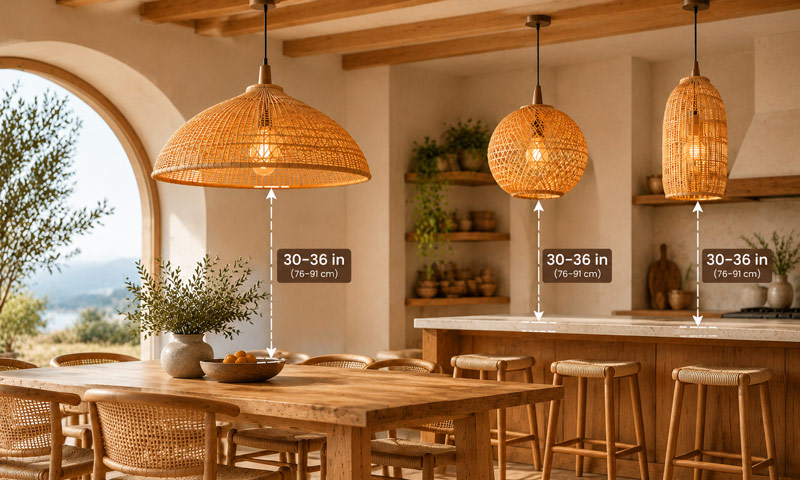
Hanging height should account for the whole assembly: canopy, suspension, and shade.
A common planning range above a dining table or kitchen counter is approximately 30–36 inches, or 76–91 cm, measured from the surface to the bottom of the fixture. The final position depends on the shade’s scale, light distribution, and the people using the space.
When assessing pendant light height above an island, check the view from both seated stools and the standing preparation area.
Work Backward From the Desired Position
Use this calculation:
Space for canopy and suspension = ceiling height − surface height − desired clearance − shade height
For example:
- Ceiling height: 240 cm
- Table height: 75 cm
- Clearance above the table: 80 cm
- Shade height: 35 cm
That leaves:
240 − 75 − 80 − 35 = 50 cm
In this example, the canopy and suspension must fit within approximately 50 cm. The complete ceiling-to-bottom drop would be 85 cm.
Compare that required drop with the product’s stated minimum and maximum overall hanging heights. A long supplied cable does not tell you how short the complete fixture can become.
This calculation is particularly helpful for deep basket shades and lower ceilings.
Check the Bulb From Your Actual Eye Level
The shade’s weave may be attractive while the bulb remains uncomfortable to look at.
For a dining pendant, assess the fixture from a seated position. For a bedside pendant, consider the view while reclining. For an island, check both standing and seated positions.
Look for direct views of the bright source through the sides or bottom opening. A deeper shade, a different bulb position, or a manufacturer-designed diffuser may improve the result.
A frosted bulb is a practical option to compare with a clear bulb in an open-weave shade. Evaluate both the visible source and the shadow pattern; the effect depends on the complete arrangement.
When shopping online, request three useful images:
- The pendant switched off in daylight.
- The pendant switched on in a dim room.
- The underside, showing the bulb position and lower opening.
Use photographs to judge appearance, source visibility, and pattern. Published specifications and an in-room assessment are more useful for comparing brightness because camera exposure can make very different light levels look similar.
Match the Bulb to the Shade
The bulb has a substantial influence on the finished result. Compare brightness, color appearance, color rendering, and control compatibility separately.
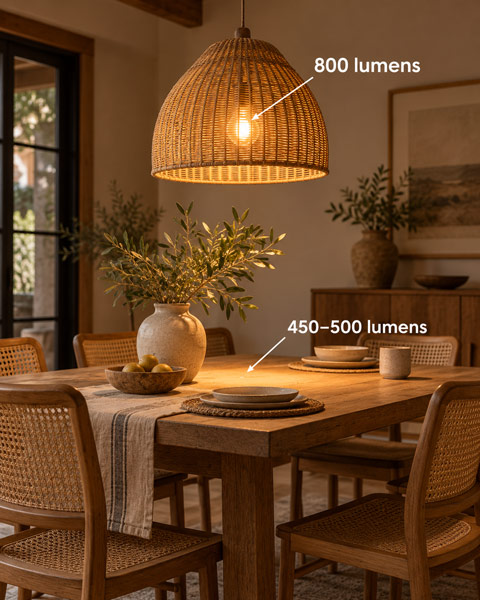
Compare Brightness in Lumens
Light bulb lumens describe the amount of visible light produced. Watts describe electrical power consumption. Comparing lumen output is therefore more useful when choosing between bulbs with different efficiencies.
For a rattan pendant, distinguish the bulb’s output from the light reaching the table. The shade intercepts and redirects some of that light.
A larger shade also does not automatically provide more illumination. Check the number of light sources, their specifications, and the openings through which light can escape.
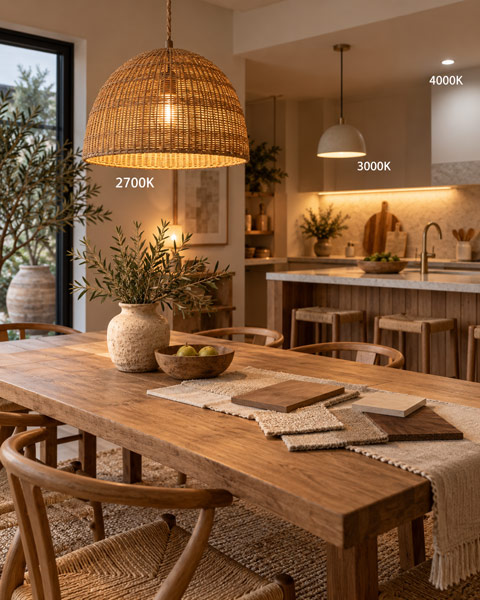
Choose Color Temperature in Context
Warm white light around 2700K–3000K is a useful starting range for residential spaces.
Within that range, compare the pendant with nearby lighting. A 2700K pendant surrounded by cooler ceiling lights may create a more noticeable difference than expected.
Bring actual material samples into the comparison where possible. The combination of light color and the shade’s finish can change how wood, upholstery, and wall colors appear.
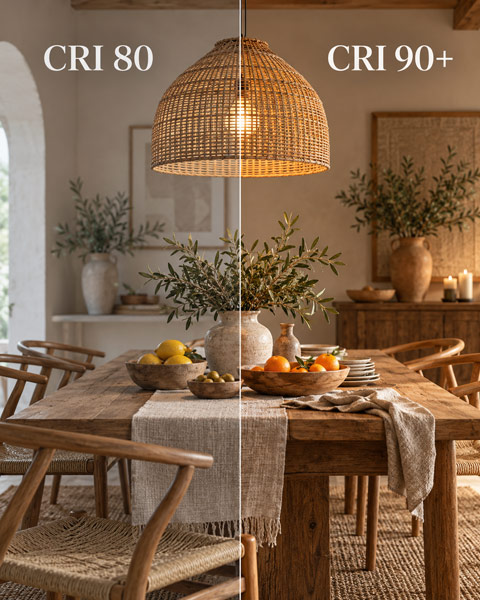
Give Color Rendering Its Own Check
The color rendering index describes how faithfully a source renders colors relative to a reference. A CRI of 90 or higher is a useful selection target when the appearance of food, timber, fabrics, and finishes matters.
A warm color temperature alone does not establish good color rendering.
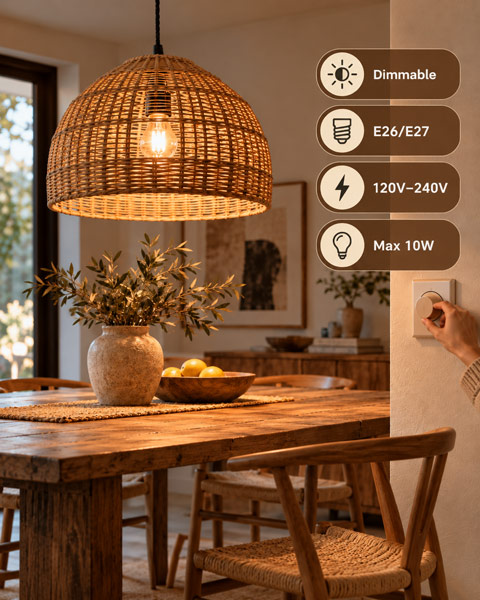
Confirm Dimming and Operating Requirements
If you want adjustable brightness, select suitable dimmable LED bulbs and confirm compatibility with the intended control. Integrated LED pendants require compatible drivers and controls.
Also check the specified bulb type, base, operating voltage, and permitted wattage. Where a fixture encloses the bulb, confirm that the bulb is approved for that application; heat buildup can affect LED performance and life.
Assess Craftsmanship Where It Affects Performance
Handwoven materials can show variations in tone and strand spacing. Assess these alongside the intended design.
Focus your inspection on the areas that affect how the pendant hangs and functions:
- Does the shade hold its advertised shape?
- Are attachment points secure and free from splits?
- Does the bulb sit in the intended position?
- Are the mounting components clearly specified?
- Can the bulb or other serviceable components be reached?
- Is the product supplied as a shade only or as a complete fixture?
Request close-up photographs of the top mounting area and underside. These views often reveal details that a styled room photograph conceals.
If you are buying a pair, ask about expected variation between pieces. Small differences can become more noticeable when two pendants hang beside each other at the same height.
For higher-priced fixtures, include serviceability in the comparison. Available replacement shades, diffusers, or electrical components can make future maintenance more straightforward.
Verify Suitability for the Installation Environment
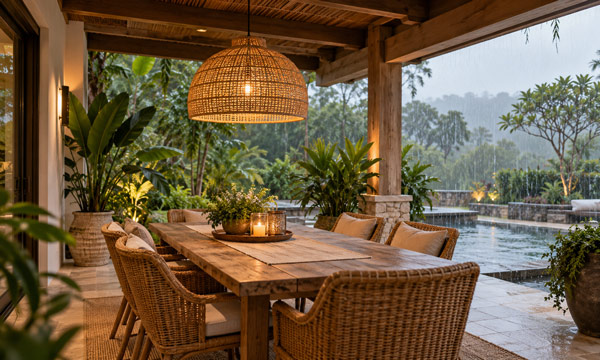
A rattan appearance does not establish outdoor suitability.
For a covered patio, assess both the complete fixture’s environmental rating and the manufacturer’s instructions for the woven material and finish.
Location ratings distinguish between conditions involving moisture or condensation and conditions involving direct water exposure. A damp-location rating does not provide the same permission as a wet-location rating.
There are two separate questions to resolve:
Is the complete electrical assembly suitable for the location?
Is the shade material and finish intended to remain in those conditions?
Check both before selecting a pendant for a porch, veranda, or outdoor dining area. A roof overhead still leaves the fixture exposed to local environmental conditions.
Let the Room’s Existing Detail Guide the Final Choice
Consider two dining areas with identical tables and ceiling heights.
The first has plain walls, simple chairs, and a restrained color palette. An open-weave pendant could introduce both a sculptural shape and a noticeable projected pattern.
The second already contains woven chair backs, patterned tiles, open shelves, and decorative textiles. A simpler shade with a controlled lighting effect may give those existing details more space.
The dimensions are the same, but the design priorities differ.
This is where selecting rattan pendant lights becomes more personal. Decide where you want attention to settle: on the shade, across the table, or on the surrounding walls. Then choose the construction that supports that intention.
FAQs
1. What Is the Difference Between Rattan and Wicker Pendant Lights?
Rattan describes a plant material derived from palm stems. Wicker describes a weaving technique. A wicker pendant may therefore be made from rattan or another material. Read the construction details to identify what the shade actually contains; the words are often used loosely in product descriptions.
2. How Do You Clean a Rattan Pendant Light Without Damaging It?
Switch off the light and allow the bulb to cool. Follow the fixture’s care instructions, starting with gentle dusting using a soft, dry cloth. Avoid pressing hard on delicate strands. Use moisture or cleaning products only when the manufacturer permits them for that specific finish; some rattan pendant instructions expressly specify dry dusting and prohibit household cleaners.
3. Can Rattan Pendant Lights Be Installed on a Sloped Ceiling?
Some can, depending on the suspension and canopy design. Check the exact model’s stated compatibility, permitted ceiling angle, and required accessories. One fixture may require a separate pivot, while another may be unsuitable for sloped installation. An adjustable hanging length alone does not confirm compatibility.
4. Can You Replace an Existing Pendant Shade With a Rattan Shade?
You may be able to if the existing pendant assembly is designed to accept a replacement shade. Confirm the shade’s fitter opening, retaining mechanism, weight, and required clearances with the cord-set or fixture manufacturer. A matching bulb-base designation does not establish that the shade attachment fits. Use the approved mounting arrangement and obtain qualified help if electrical alterations are required.
5. Are Rattan Pendant Lights Sustainable?
Sustainability depends on sourcing and the complete product. Rattan is harvested from both cultivated and wild sources, and complex supply chains can make species identification and responsible harvesting difficult to verify. Ask for traceable sourcing information, evidence supporting environmental claims, and details about repairable or replaceable components. The material’s natural origin alone is insufficient evidence of sustainable production.