

Pendant Light Height by Ceiling Height
How to Measure Pendant Height Correctly
How to Choose the Right Height Within the Range
Make Sure the Counter Still Receives Enough Light
How Far Apart Should Island Pendant Lights Be?
Check the Position Before Installation
FAQs
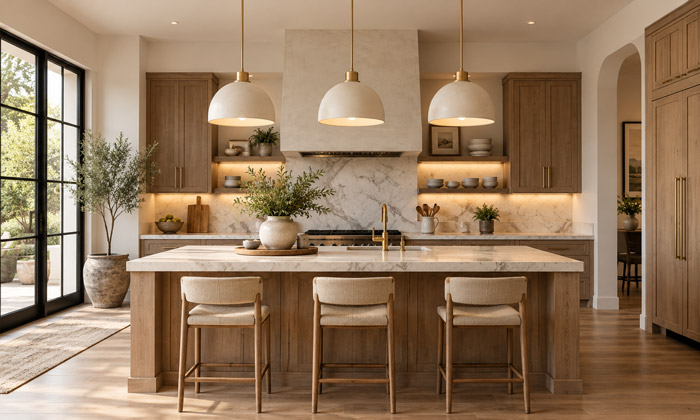
Pendant lights should generally hang 30–36 inches (76–91 cm) above a kitchen island, measured from the finished countertop to the lowest point of the fixture. Start within this range, then adjust for the pendant’s size, the people using the island, and the view across the kitchen. This is a common design guideline rather than a guarantee that every fixture will work at the same height.
The best position gives you useful light on the counter without putting a shade in front of someone’s face. Before settling on a measurement, check the arrangement from both sides of the island and from the seating area.
Pendant Light Height by Ceiling Height
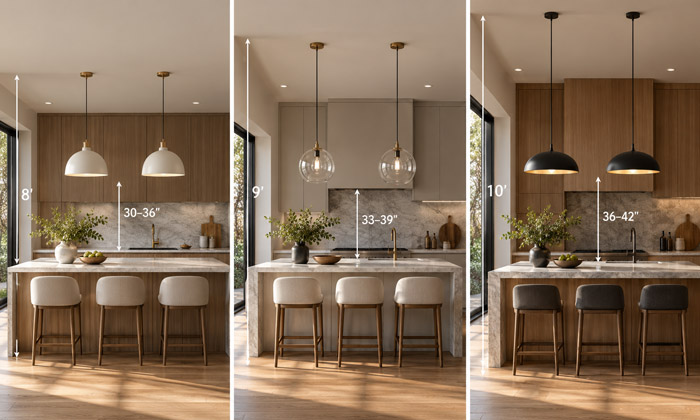
Ceiling height affects the proportions of a pendant installation. One common approach is to raise the fixture approximately 3 inches for each additional foot of ceiling height above 8 feet.
| Ceiling height | Suggested starting clearance above countertop |
|---|---|
| 8 feet | 30–36 inches (76–91 cm) |
| 9 feet | 33–39 inches (84–99 cm) |
| 10 feet | 36–42 inches (91–107 cm) |
These ranges provide a practical starting point. Adjust the final hanging height to suit your fixture’s size, the lighting needs of your island, and the sightlines across your kitchen.
A higher ceiling does not automatically require a larger gap above the countertop. If a pendant already provides comfortable illumination and clear sightlines at 35 inches, moving it higher simply to follow a table may offer little benefit.
For vaulted or very tall ceilings, use sufficient cord or rod length to bring the fixture into a useful position above the island. Check that the pendant’s mounting hardware is compatible with the ceiling slope. A taller ceiling usually requires more suspension length; it does not mean the light should stay close to the ceiling.
How to Measure Pendant Height Correctly
Measure vertically from the finished countertop surface to the lowest part of the assembled pendant. Include any glass, diffuser, or decorative element extending below the main shade. Check the finished counter height rather than assuming it is standard.
Three measurements help prevent ordering or installation mistakes:
- Countertop clearance: The space between the counter and the pendant’s bottom.
- Overall drop: The distance from the ceiling to the pendant’s bottom.
- Suspension length: The cord, chain, or rod between the mounting assembly and fixture body.
These measurements are related, but they are not interchangeable.
Calculate the overall drop
Use this formula:
Overall drop = ceiling height − countertop height − desired clearance
For example, suppose your kitchen has:
- A 9-foot ceiling: 108 inches
- A countertop height of 36 inches
- A desired clearance of 35 inches
The calculation is:
108 − 36 − 35 = 37 inches
The pendant’s lowest point should therefore sit 37 inches below the ceiling.
That does not mean you need 37 inches of cord. The fixture body and mounting assembly occupy part of that distance. If those components account for 13 inches vertically, approximately 24 inches remain for the suspension, subject to the manufacturer’s measurement conventions.
Check the product’s minimum and maximum overall hanging height before ordering, especially with a low ceiling or a tall pendant body.
How to Choose the Right Height Within the Range

Check the view across the island
Start by testing a position around the middle of the recommended range. Stand where you normally prepare food, then move to the opposite side.
Can you see the person across from you? Does the shade interrupt a view into the living room? Can the tallest household member lean toward the middle of the island comfortably?
If the fixture obstructs normal use, raise it slightly and repeat the check. A number that looks correct on a plan may feel different when a full-size shade occupies the space.

Account for the size and shape of the shade
A broad, opaque pendant can feel more intrusive than a slim fixture at the same bottom height. Larger shades may need a higher position to preserve the view across the counter. Clear glass looks less solid, but an exposed bulb can introduce glare.
The fixture’s width matters as well as its height. Raising an oversized shade will not always solve an arrangement that feels crowded. Sometimes a smaller fixture is the better adjustment.
Test the seated view
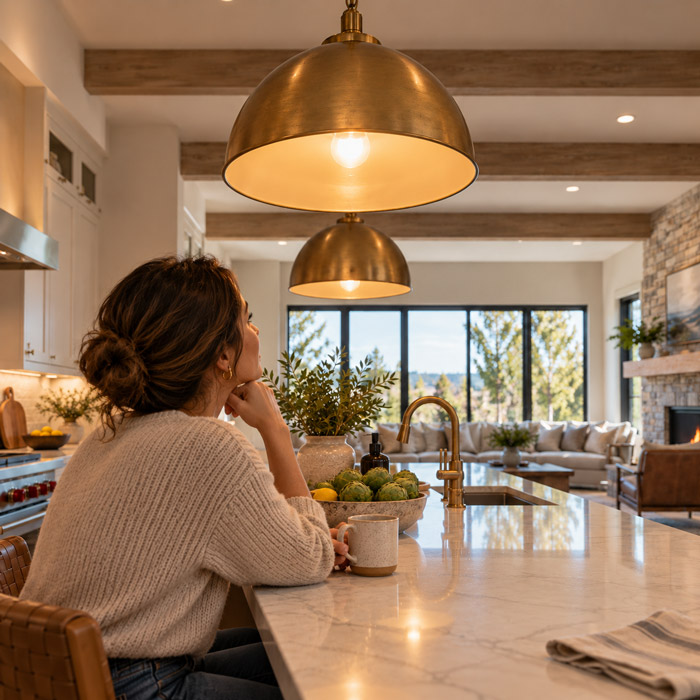
If your island includes stools, check the pendants while seated. Look toward the opposite side of the kitchen and toward the light itself.
An open-bottom shade may expose the bulb from below. Simply raising it can sometimes make that bulb more visible, so test the actual viewing angle. A diffuser or better-shielded light source may improve comfort more than another height adjustment.
Make Sure the Counter Still Receives Enough Light
The correct hanging height should support the way you use the island. A pendant that looks balanced from the doorway may still leave the food preparation area poorly lit.
When checking brightness, compare light output in lumens, rather than relying on wattage alone. Lumens describe the amount of light a source produces; watts describe its power consumption. Shade design and light distribution also affect how much useful light reaches the counter.
After installation, check the island after dark with the lighting combinations you normally use. Look for dark areas between fixtures, distracting reflections, and shadows where you work.
If the counter remains dim at a comfortable hanging height, reconsider the light output or distribution. Lowering the fixture is only one possible adjustment.
How Far Apart Should Island Pendant Lights Be?
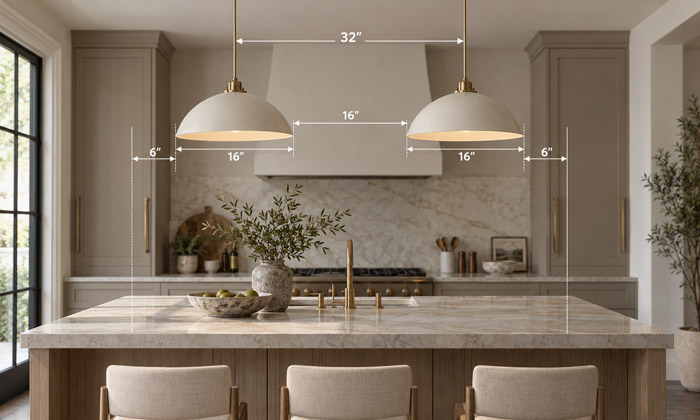
Height and spacing need to work together. A practical starting point is 30–32 inches between pendant centers, with the outer edges of the shades at least 6 inches inward from the island’s edges. Adjust these distances to suit the shade diameter and island dimensions.
For example, two 16-inch-wide shades placed 32 inches apart, center to center, leave 16 inches between their nearest edges. That distinction matters: measuring the same distance between shade edges would produce a much wider arrangement.
Mark the proposed centers on the countertop with painter’s tape. Use paper circles matching the shade diameters to check how much space the fixtures occupy.
Choose the number of pendants after checking their size and placement. Two substantial fixtures can suit an island better than three crowded ones. For a matching row, keep the pendant bottoms level unless the fixture is specifically designed as a staggered arrangement.
Check the Position Before Installation
Create a lightweight cardboard mockup showing the shade’s approximate width and height. Position it at the proposed location and check it from the kitchen entrance, the working side, and the stools.
Before installing the pendants, confirm that:
- The countertop-to-fixture clearance matches your intended measurement.
- The shade does not interfere with normal reaching or conversation.
- The fixture’s adjustment range supports the required overall drop.
- Matching pendants align consistently.
- The installer has the manufacturer’s mounting instructions.
Use a qualified electrician for electrical installation and any changes to the electrical box, wiring, or ceiling support.
FAQs
What Color Temperature Is Best for Kitchen Island Pendant Lights?
A color temperature of 2700K–3000K suits kitchens where the island serves as both a workspace and a dining area.
Choose 2700K for a softer, warmer appearance or 3000K for a slightly crisper look. Keep nearby lighting similar in color temperature for a consistent appearance.
Should Kitchen Island Pendant Lights Be Dimmable?
Dimmable pendants let you adjust the lighting for food preparation, casual meals, and evening entertaining.
Check that the LED bulb or integrated LED driver supports dimming and is compatible with the selected dimmer switch. A dimmer cannot make a non-dimmable light source dimmable.
Can Pendant Lights Be Installed Above a Kitchen Island Sink?
Yes, provided the fixture is suitable for the location and installed according to its instructions.
Consider exposure to splashes and moisture, and position the pendant so it does not interfere with the faucet or sink use. Have the installer confirm whether the location requires a moisture-rated fixture.
Are Replaceable Bulbs or Integrated LEDs Better for Island Pendants?
Replaceable bulbs make it easier to change brightness, color temperature, or a failed light source.
Integrated LEDs allow slimmer fixture designs, but servicing depends on whether the LED module and driver are replaceable. Compare maintenance options and replacement-part availability before choosing.
Which Pendant Light Materials Are Easiest to Clean in a Kitchen?
Smooth glass and sealed metal shades are generally easier to wipe clean than fabric, woven materials, or intricate perforated designs.
Glass can show fingerprints and grease more readily, while detailed surfaces take longer to clean. Follow the manufacturer’s care instructions to protect coatings and finishes.