
Outdoor Lighting Classification by Landscape Space
1. Garden Path Lighting
2. Step and Stair Lighting
3. Driveway Lighting
4. Patio and Terrace Lighting
5. Planting Bed Lighting
6. Tree Lighting
7. Lawn Lighting
8. Garden Wall Lighting
9. Water Feature Lighting
10. Entrance and Gate Lighting
11. Pergola and Gazebo Lighting
12. Sculpture and Focal-Point Lighting
FAQs
Outdoor lighting should not be treated as a single system applied uniformly across an entire landscape. A garden path, patio, planting bed, mature tree, pond, and entrance all have different functions, viewing conditions, mounting opportunities, and lighting requirements.
For landscape design, the most practical way to classify outdoor lighting installation is by the type of space being illuminated and the role that lighting needs to perform in that space. This approach makes it easier to select suitable fixture types, installation positions, beam angles, and lighting levels without over-lighting the garden.
Outdoor Lighting Classification by Landscape Space
| Landscape Space | Main Lighting Purpose | Typical Fixture Type | Common Installation Position | Recommended Lighting Approach |
|---|---|---|---|---|
| Garden paths | Safe movement and guidance | Path lights, bollards, low-level lights | Along path edges | Soft, downward, evenly spaced lighting |
| Steps and stairs | Visibility and safety | Step lights, recessed lights | Risers, side walls, adjacent surfaces | Low-level glare-free illumination |
| Driveways | Navigation and boundary definition | Bollards, in-ground lights, post lights | Driveway edges or entrance points | Controlled lighting with clear visual guidance |
| Patios and terraces | Ambient and activity lighting | Wall lights, downlights, portable landscape lights | Walls, pergolas, surrounding planting | Layered warm lighting |
| Planting beds | Highlight plants and textures | Spike lights, spotlights | Inside planting areas | Directional accent lighting |
| Trees | Architectural and natural emphasis | Spotlights, uplights, downlights | Ground, branches, nearby structures | Uplighting, moonlighting, or cross-lighting |
| Lawn areas | Spatial definition and visual depth | Bollards, floodlights, in-ground fixtures | Lawn perimeter or adjacent beds | Selective rather than uniform illumination |
| Garden walls | Texture and boundary lighting | Wall washers, grazing lights | Ground or wall-mounted | Washing or grazing techniques |
| Water features | Reflection and focal-point lighting | Submersible lights, spotlights | Underwater or around water edges | Low-glare directional lighting |
| Entrances and gates | Orientation and welcome lighting | Wall lights, pillar lights, bollards | Gate posts, walls, entrance paths | Clear but comfortable illumination |
| Pergolas and gazebos | Functional and decorative lighting | Downlights, pendant lights, integrated lights | Roof beams, posts, overhead structures | Layered ambient and task lighting |
| Sculptures and focal points | Visual emphasis | Narrow-beam spotlights | Ground or concealed positions | Precise accent lighting |
1. Garden Path Lighting
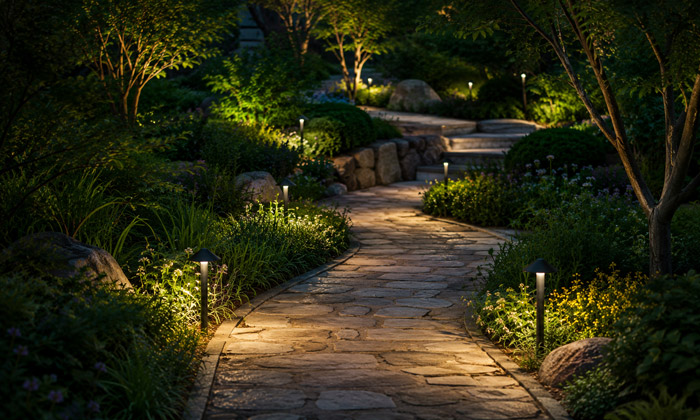
Garden paths need lighting primarily for orientation and safe movement. The objective is not to make the path as bright as an indoor corridor. Instead, lighting should reveal changes in direction, paving edges, nearby planting, and potential obstacles.
Low-level path lights are commonly installed along one or both sides of the walkway. Fixtures should direct most of their light toward the ground rather than toward people's eyes.
Spacing also matters. Installing a fixture at every short interval can make a garden look overly engineered. In many landscapes, alternating fixtures or placing lights near curves, intersections, and changes in level creates a more natural visual rhythm.
The best path lighting should:
- Define the walking surface clearly.
- Avoid excessive glare.
- Complement nearby planting.
- Maintain comfortable contrast with surrounding areas.
- Keep fixtures visually unobtrusive during the day.
2. Step and Stair Lighting
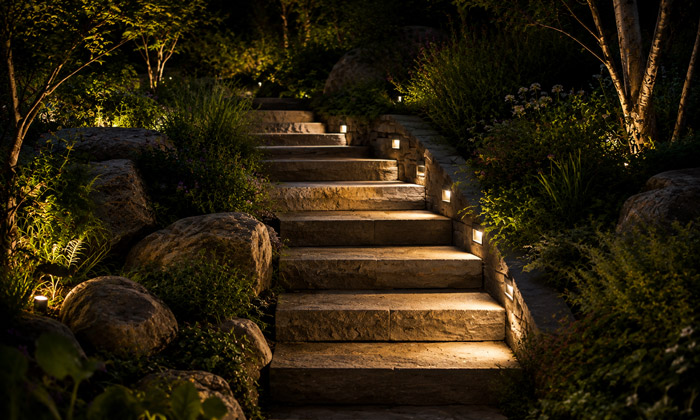
Steps require a more safety-focused installation because changes in elevation need to remain immediately visible after dark.
Fixtures can be recessed into stair risers, incorporated into side walls, or positioned beside the staircase. The light should reveal both the edge and horizontal surface of each important step.
A successful installation keeps the light source concealed wherever possible. Bright fixtures facing upward toward users can create glare and actually make changes in level more difficult to see.
In landscape stairs, low-mounted lighting usually integrates better with stone, timber, concrete, and surrounding vegetation.
3. Driveway Lighting
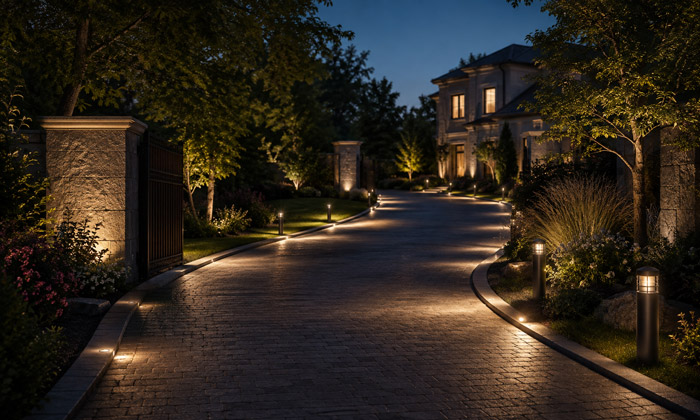
Driveway lighting should define the route without making a residential landscape resemble a commercial parking area.
Bollards, low post lights, and carefully positioned in-ground fixtures can indicate driveway edges, turning points, gates, and the transition between vehicle and pedestrian areas.
From a landscape perspective, lighting should concentrate on important locations rather than illuminating every square meter equally. Key positions include:
- Driveway entrances.
- Curves and narrow sections.
- Parking transitions.
- Pedestrian crossing points.
- Changes in surface or elevation.
Where planting borders the driveway, lighting can also illuminate selected shrubs or trees. This combines navigation lighting with landscape lighting and produces a more integrated appearance.
4. Patio and Terrace Lighting
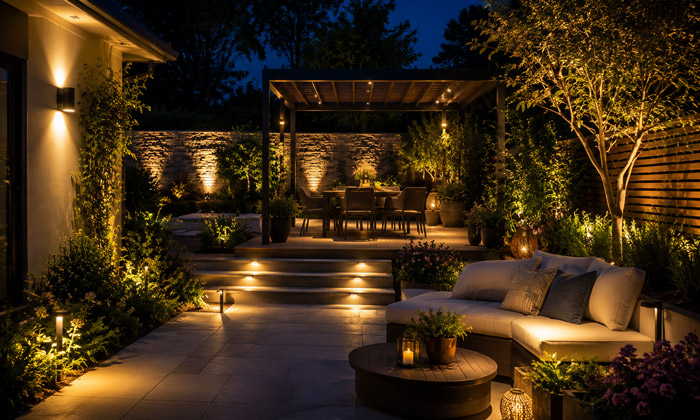
Patios and terraces normally require several types of lighting because they function as outdoor living spaces.
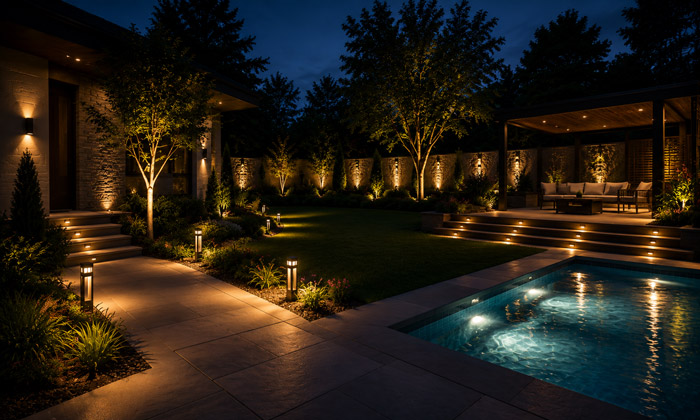
General illumination may come from wall-mounted lights, pergola downlights, or carefully positioned landscape fixtures. Additional accent lighting can illuminate nearby planting, walls, or trees.
Instead of using one powerful fixture to illuminate the entire terrace, a better landscape approach is to create several layers of softer light.
For example, a terrace can combine low-level perimeter lighting with illuminated planting and subtle overhead light. This makes the space comfortable for dining and conversation while preserving views into the surrounding garden.
5. Planting Bed Lighting
Lighting installation inside planting beds is mainly used to reveal plant structure, foliage texture, seasonal character, and depth.
Adjustable spike lights are particularly useful because their position and direction can be changed as plants grow. Narrower beams may suit specimen plants, while wider beams can illuminate groups of shrubs or ornamental grasses.
Fixture placement should respond to the shape of the planting rather than following a rigid grid.
Front lighting shows a plant clearly but can appear flat. Side lighting emphasizes texture, while backlighting can create attractive silhouettes around grasses, translucent leaves, and strongly shaped shrubs.
Because gardens constantly change, planting-bed lighting should remain relatively flexible.
6. Tree Lighting
Trees are among the most important vertical elements in a landscape, so their lighting often has a major influence on the nighttime character of the garden.
Uplighting
Ground-mounted spotlights are aimed upward into the trunk and canopy. This technique emphasizes height, bark texture, branching structure, and foliage.
It works particularly well for mature specimen trees.
Downlighting
A fixture positioned within a tree directs light toward the landscape below. When carefully installed, it can create a soft effect similar to moonlight.
This method can illuminate paths, lawns, seating areas, and planting without filling the landscape with visible fixtures.
Cross-Lighting
Two or more fixtures illuminate the tree from different directions. Cross-lighting is useful when a tree is viewed from several important locations or when a more three-dimensional appearance is required.
Tree lighting should generally focus on selected specimens. Lighting every tree equally reduces contrast and weakens the visual hierarchy of the landscape.
7. Lawn Lighting
Large lawns usually do not need uniform illumination.
A completely illuminated lawn can appear visually flat and may require unnecessary numbers of fixtures. Landscape lighting is generally more effective when the lawn remains relatively dark while surrounding features establish its boundaries.
Trees, planting beds, sculptures, walls, or distant focal points can be illuminated around the lawn. The darker open surface then becomes part of the composition and creates valuable visual depth.
Where functional lighting is required, low bollards or carefully shielded fixtures can be installed around circulation routes and activity areas.
8. Garden Wall Lighting
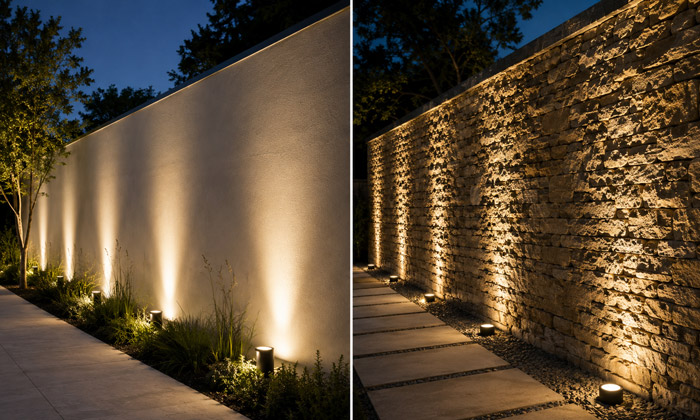
Walls provide excellent surfaces for outdoor lighting because reflected light can contribute significantly to the overall atmosphere of a garden.
Two major techniques are commonly used.
Wall washing places the fixture some distance from the wall and produces relatively even illumination across the surface. It is useful for clean architectural walls and broad background lighting.
Wall grazing positions the fixture close to the surface. The light travels almost parallel to the wall, emphasizing stone, brick, rough concrete, and other textured materials.
The choice depends on whether the landscape designer wants the wall to function as a quiet illuminated background or as a strong textural feature.
9. Water Feature Lighting
Ponds, fountains, streams, and waterfalls require particularly careful fixture positioning because water reflects and refracts light.
Lighting can be installed underwater or outside the feature.
Submersible fixtures can illuminate moving water, fountain jets, rocks, or the interior of a pond. External spotlights are useful when the objective is to highlight surrounding vegetation or create reflections across the water surface.
The position of the viewer should always be considered. A submerged light aimed toward a seating area can produce uncomfortable glare.
Good water-feature lighting emphasizes:
- Water movement.
- Surface reflections.
- Underwater texture.
- Rocks and planting.
- The relationship between water and the surrounding garden.
Often, less light produces a stronger effect than excessive brightness.
10. Entrance and Gate Lighting
Entrances need to communicate orientation immediately. Visitors should be able to identify the gate, pathway, house entrance, and any changes in level without searching for them.
Lighting can be integrated into gate pillars, walls, bollards, planting areas, or nearby trees.
From a landscape perspective, the entrance should not be treated only as a security zone. It is also the first nighttime view of the garden.
A balanced installation therefore combines practical visibility with selected illumination of entrance planting, specimen trees, walls, or architectural materials.
11. Pergola and Gazebo Lighting
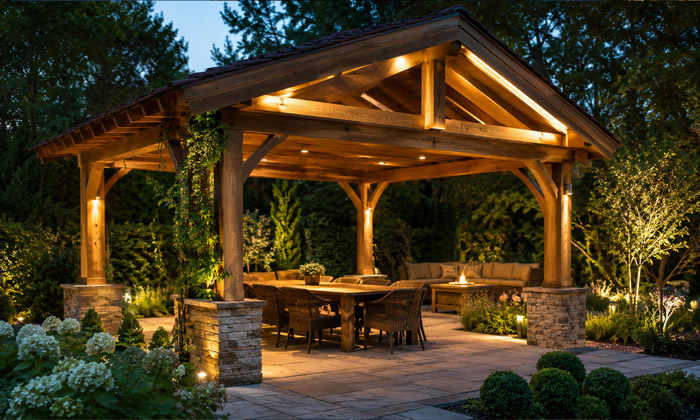
Pergolas, gazebos, and other garden structures offer more mounting possibilities than open landscape areas.
Fixtures can be integrated into:
- Beams.
- Rafters.
- Posts.
- Roof structures.
- Adjacent walls.
- Planting around the structure.
Downlights provide functional illumination for tables and seating, while concealed or indirect lighting can emphasize the structure itself.
The key is to avoid excessive overhead brightness. Outdoor structures usually feel more comfortable when functional lighting is balanced with softer illumination from the surrounding landscape.
12. Sculpture and Focal-Point Lighting
Sculptures, feature stones, decorative pots, fountains, and other focal elements usually require precise accent lighting.
Narrow-beam spotlights provide better control than broad floodlighting. Fixture position determines how much texture, shadow, and three-dimensional form becomes visible.
A fixture positioned directly in front of an object gives clear visibility but limited depth. Moving it toward one side produces stronger shadows and often makes the feature more dramatic.
For important focal points, the lighting direction should also relate to the main viewing position—for example, a terrace, garden entrance, or interior window.
FAQs
What IP Rating Is Best for Outdoor Landscape Lighting?
For most garden and landscape installations, IP65 or higher is recommended for fixtures exposed to rain, dust, and irrigation.
In-ground or underwater fixtures typically require higher protection levels, such as IP67 or IP68, depending on installation conditions.
See also: What Is IP65? The Waterproof Rating of Garden Lights
What Color Temperature Is Best for Garden Lighting?
Warm white light between 2700K and 3000K is widely used in residential landscapes because it complements plants, stone, timber, and outdoor living areas.
Cooler color temperatures may suit contemporary architectural landscapes but can make natural planting appear less inviting.
Is 12V or 120V Better for Landscape Lighting?
12V low-voltage systems are commonly preferred for residential gardens because they are safer around planting areas, easier to install, and flexible for future changes.
120V systems may be appropriate for larger properties, high-output fixtures, or locations requiring longer cable runs and greater electrical capacity.
How Do You Choose the Right Transformer Size for Landscape Lighting?
Add the total wattage of all connected fixtures and select a transformer with additional capacity rather than operating it at its maximum rating.
Allowing roughly 20–30% spare capacity can support stable performance and make future fixture additions easier.
How Can Outdoor Lighting Reduce Energy Consumption?
Energy use can be reduced by combining LED fixtures, timers, photocells, motion sensors, zoning, and smart lighting controls.
Dividing the landscape into separate lighting zones also allows decorative, functional, and security lighting to operate only when required.
