
Start With the Outdoor Area You Want to Illuminate
Choose a Fixture Designed for Outdoor Conditions
Match the Scale to the Garden Architecture
Consider How the Finish Works With the Landscape
Pay Attention to the Glass and Light Diffusion
Use Warm Light to Complement the Garden
Let the Fixture Highlight Garden Features
Keep the Art Deco Details Focused
FAQs
Choosing the right Art Deco light fixture for an outdoor space is about more than finding an attractive design. In a garden, patio, courtyard, entrance, or outdoor dining area, the fixture needs to balance decorative character with practical lighting, weather resistance, scale, and placement.
Art Deco lighting is especially effective outdoors because its geometric shapes, strong symmetry, metallic finishes, and structured lines can create a striking contrast with plants, stone, wood, and other natural materials. The key is choosing a fixture that enhances the landscape rather than competing with it.
Start With the Outdoor Area You Want to Illuminate
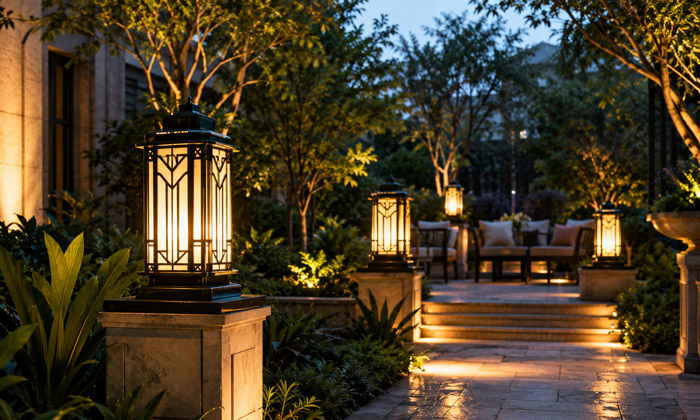
The right fixture depends first on where it will be installed. A covered patio has very different lighting needs from an exposed garden wall or pathway.
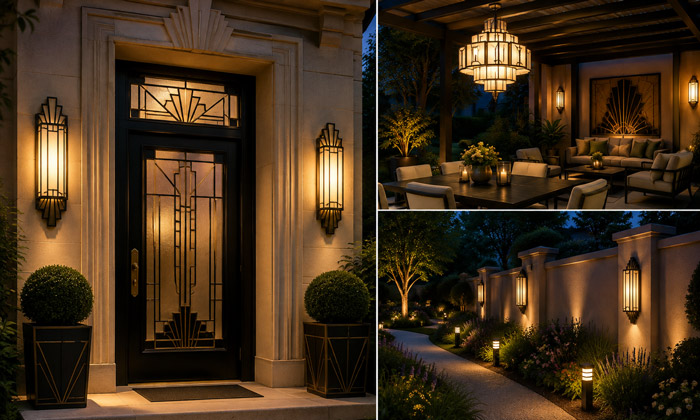
For a garden entrance or front gate, Art Deco wall lights can create a strong architectural focal point while providing useful illumination. Fixtures with symmetrical frames, stepped patterns, frosted glass, or vertical geometric details work particularly well beside doors and gates.
For a covered patio or pergola, pendant lights or compact chandeliers can help define a dining or seating area. Because these spaces often function like outdoor rooms, a decorative Art Deco fixture can become the visual centerpiece.
Along garden walls and pathways, smaller wall sconces or low-level fixtures are usually more effective. They provide enough light for safe movement without overwhelming planting beds or landscape features.
| Outdoor Area | Recommended Art Deco Fixture | Main Consideration |
|---|---|---|
| Garden entrance | Wall sconces | Visibility and architectural impact |
| Covered patio | Pendant or chandelier | Scale and ambient lighting |
| Outdoor dining area | Pendant light | Comfortable downward illumination |
| Garden wall | Compact wall light | Controlled light distribution |
| Pathway | Low-level geometric fixture | Safety without excessive brightness |
| Pergola | Hanging fixture | Weather protection and proportion |
Choose a Fixture Designed for Outdoor Conditions
Appearance should never be the only consideration for garden lighting. Outdoor fixtures must cope with moisture, temperature changes, dust, and, depending on their location, direct rain.
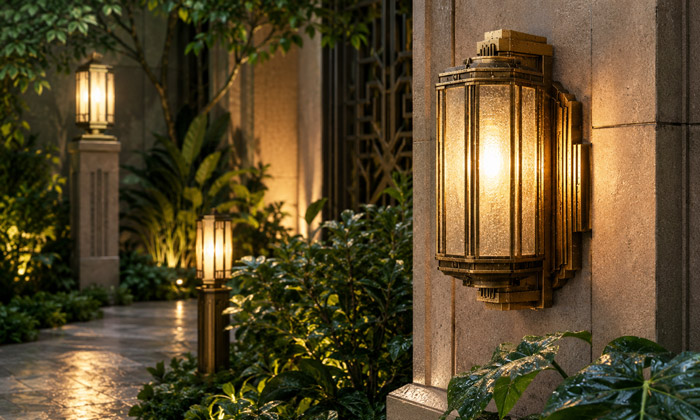
Always choose a fixture with an appropriate outdoor rating for its installation area. A light positioned beneath a deep covered roof may require less weather protection than one mounted on an exposed garden wall.
Material quality is equally important. Powder-coated metals, properly finished brass, stainless steel, and corrosion-resistant aluminum are practical choices for outdoor environments. Decorative glass should also be securely enclosed and suitable for exterior use.
This is particularly important with Art Deco lighting because metallic finishes are a major part of the style. A beautiful brass or bronze appearance will quickly lose its appeal if the surface is not designed to withstand outdoor conditions.
Match the Scale to the Garden Architecture
Art Deco fixtures often have bold proportions and clearly defined geometry, so choosing the correct size matters.
A small fixture may disappear beside a large entrance, stone wall, or tall garden gate. On the other hand, an oversized pendant can make a compact patio feel crowded.
Look at the surrounding architecture before selecting a fixture. Consider the width of the wall, height of the doorway, dimensions of the pergola, and size of nearby furniture.
For larger outdoor spaces, a pair of matching sconces can often look more balanced than a single light. Symmetry is strongly associated with Art Deco design, making paired fixtures especially suitable for entrances, garden doors, and gateways.
In smaller gardens, choose simpler fixtures with clean geometric lines rather than highly elaborate designs. This keeps the Art Deco character while preventing the lighting from visually dominating the landscape.
Consider How the Finish Works With the Landscape
Traditional Art Deco lighting frequently features black, brass, bronze, chrome, and gold-toned finishes. Outdoors, the best finish is one that connects the fixture to both the architecture and the garden.
Black fixtures work well against pale stone, stucco, brick, and greenery. Their strong outlines emphasize the geometric quality of Art Deco design.
Warm brass and bronze finishes can complement timber decking, natural stone, terracotta, and gardens with warm-toned planting schemes. They can also create a softer transition between decorative lighting and natural surroundings.
Highly reflective finishes may be better suited to protected patios and covered spaces, where they are less exposed to weather and easier to maintain.
The goal is not necessarily to match every outdoor material. Instead, choose a finish that creates deliberate contrast or visual continuity.
Pay Attention to the Glass and Light Diffusion
Art Deco fixtures often use frosted, etched, ribbed, or patterned glass. Outdoors, these materials are not only decorative—they also influence how comfortable the lighting feels.
Clear glass exposes the bulb and can create stronger, sharper illumination. This may work near entrances where visibility is important, but it can produce uncomfortable glare in seating areas.
Frosted or textured glass softens the light and is usually more suitable for patios, garden lounges, and outdoor dining spaces. It allows the fixture itself to glow without producing excessive brightness.
For a relaxing garden atmosphere, choose fixtures that distribute light gently rather than projecting intense light directly into the surrounding space.
Use Warm Light to Complement the Garden
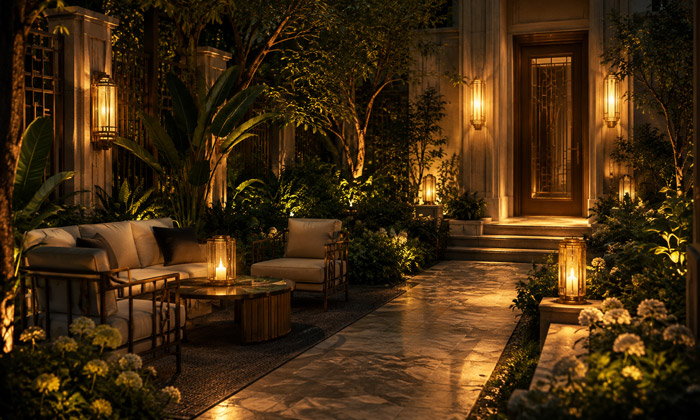
Color temperature has a major influence on outdoor atmosphere. In most residential gardens, warm white light works particularly well with Art Deco fixtures.
Warm illumination enhances bronze and brass finishes while complementing timber, stone, foliage, and flowers. It also creates a more welcoming environment around patios and seating areas.
Very cool white lighting can make an outdoor area appear overly harsh and may reduce the visual warmth associated with decorative Art Deco fixtures.
Brightness also matters. Garden lighting does not need to illuminate every surface equally. A combination of brighter functional lighting near entrances and softer decorative lighting around planting and seating areas usually produces a more attractive result.
Let the Fixture Highlight Garden Features
A well-positioned Art Deco light can do more than illuminate a wall. It can help frame important features in the garden.
For example, wall lights can emphasize a symmetrical entrance, while pendant fixtures can visually anchor an outdoor dining table beneath a pergola. Decorative sconces positioned near climbing plants or textured stone can create attractive patterns of light and shadow after dark.
Avoid placing decorative lights where dense foliage will completely cover them as plants mature. Consider both the current landscape and future plant growth when determining fixture locations.
Lighting should also avoid producing unnecessary glare toward neighboring properties or directly into outdoor seating areas.
Keep the Art Deco Details Focused
Art Deco design is recognizable through geometry, symmetry, stepped forms, streamlined shapes, and elegant metallic accents. You do not need every fixture in the garden to feature all of these elements.
A single strong design characteristic is often enough.
A black rectangular wall lantern with frosted glass can introduce Art Deco character without making the garden feel themed. Similarly, a geometric brass pendant above an outdoor dining table can become a focal point while the surrounding landscape remains simple.
When several outdoor lights are required, choose fixtures from the same design family or repeat one or two elements, such as the finish, glass texture, or geometric shape. This creates consistency without making the space overly decorative.
FAQs
Can Art Deco outdoor light fixtures use LED bulbs?
Yes. Most modern Art Deco outdoor fixtures can use LED bulbs, which offer lower energy consumption, longer service life, reduced heat output, and a wide range of brightness levels.
Are Art Deco outdoor lights compatible with smart lighting systems?
Many fixtures can work with smart bulbs, smart switches, timers, motion sensors, or app-controlled systems, provided the electrical setup and bulb type are compatible.
Can Art Deco garden lighting be dimmable?
Yes, when the fixture, bulb, and dimmer are compatible.
Dimmable lighting is particularly useful for adjusting brightness between functional evening use and softer decorative illumination.
How can Art Deco outdoor lighting reduce light pollution?
Choose shielded fixtures that direct light downward, use moderate lumen levels, and avoid unnecessary upward illumination.
Dark-sky-friendly placement can reduce glare and limit unwanted light spill.
How often should outdoor Art Deco light fixtures be maintained?
Fixtures should be checked periodically for dirt, water buildup, loose fittings, corrosion, damaged seals, and bulb performance.
Regular cleaning and inspection can help preserve both appearance and lighting efficiency.
