

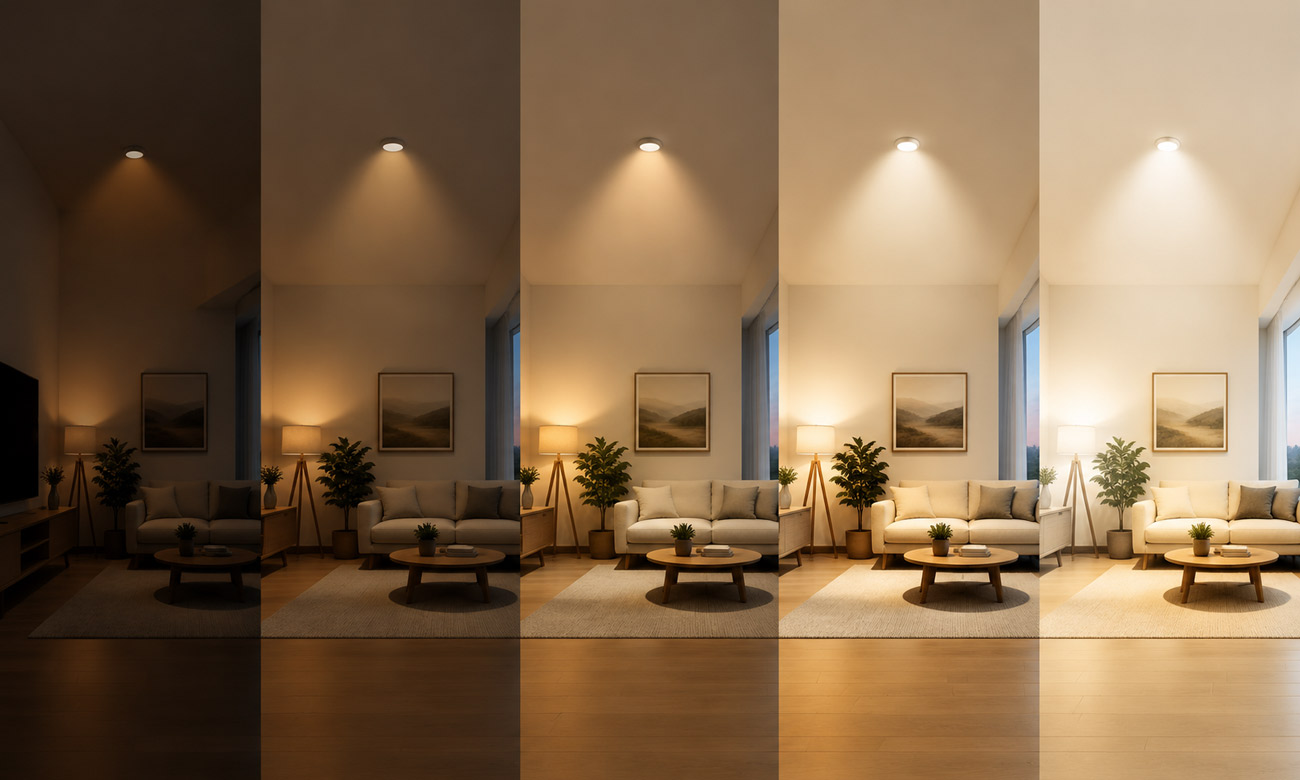
What Are Lumens, and What Do They Measure?
What Do Different Lumen Levels Look Like in Everyday Use?
Why Lumens Alone Don’t Tell the Whole Story
How Many Lumens Do You Need for Different Tasks?
How Room Size and Layout Affect Your Lighting Needs
What to Check Before Choosing a Light
FAQs
A 500-lumen lamp can provide useful light beside a reading chair, while a 2000-lumen fixture delivers four times as much light overall. But that higher number does not tell you exactly how bright a room will look—or how comfortably you will be able to read.
For a familiar reference, 800 lumens is roughly the light output of a traditional 60-watt incandescent bulb. Moving up to 1000 lumens gives you 25% more light output; moving to 2000 lumens gives you 2.5 times as much. How effectively that light works depends on where it goes.
Understanding those differences makes it easier to choose lighting that suits your space without relying on wattage or vague descriptions such as “super bright.”
What Are Lumens, and What Do They Measure?
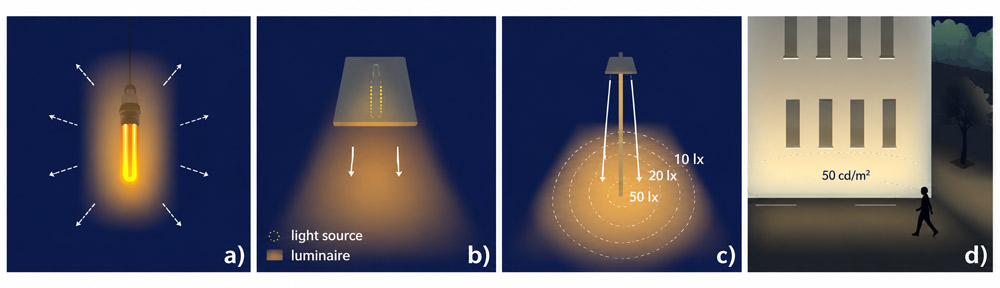
Figure 1. Luminous flux, illuminance, and luminance: (a) light emitted in all directions; (b) light directed toward a specific area; (c) illuminance on a receiving surface, measured in lux (lx); and (d) luminance of a surface in the observer’s direction, measured in candelas per square metre (cd/m²).
Lumens, abbreviated as lm, measure luminous flux: the total visible light output of a source, weighted to the sensitivity of human daytime vision. A higher lumen rating means more light output.
Three measurements help explain what happens between switching on a lamp and seeing your surroundings:
| Measurement | What it describes | What it helps you assess |
|---|---|---|
| Lumens (lm) | Total visible light output | How much light a bulb or fixture produces |
| Watts (W) | Electrical power consumption | How much power the light uses |
| Lux (lx) | Light arriving per unit of surface area | How much illumination reaches a desk, floor, or other surface |
Watts once served as a convenient shorthand for brightness when incandescent bulbs dominated household lighting. With LEDs, they are a poor substitute for a lumen rating: different products can produce similar light output while consuming different amounts of power.
Lux describes the receiving surface. One lux equals one lumen per square metre. If 1000 lumens actually reach a surface and spread evenly across 10 square metres, the average illuminance is 100 lux. This is an illustrative calculation, not a prediction for a room with a 1000-lumen bulb: some light reaches walls, furniture, and other surfaces instead.
What Do Different Lumen Levels Look Like in Everyday Use?
The following comparisons use common household lighting as a reference. The suggested applications are starting points, not guaranteed lighting levels.
| Light output | Familiar comparison | Possible household application |
|---|---|---|
| 500 lumens | Slightly above the roughly 450 lumens associated with a traditional 40W incandescent bulb | A shaded bedside lamp or a close-range task light |
| 800 lumens | About the output of a traditional 60W incandescent bulb | A table lamp or one light source within a room |
| 1000 lumens | 25% more output than 800 lumens; slightly below the roughly 1100-lumen reference for a 75W incandescent bulb | A higher-output reading or work lamp |
| 2000 lumens | Four times the output of 500 lumens; above the roughly 1600-lumen reference for a 100W incandescent bulb | A ceiling fixture or broader area light, depending on its distribution |
The incandescent comparisons refer to approximate light output, not the electrical consumption of an LED replacement.
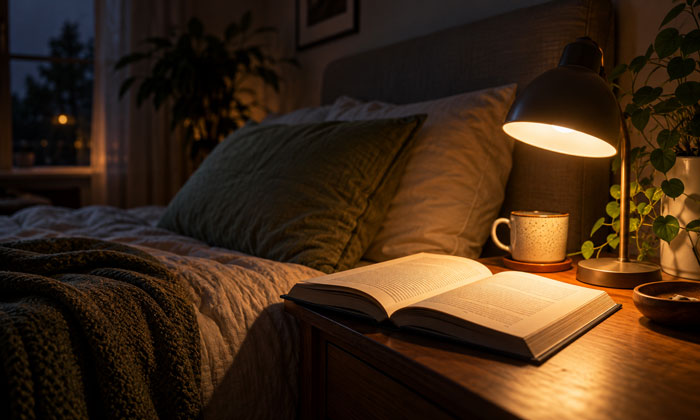
500 Lumens
At 500 lumens, placement matters especially. A lamp positioned near a book can provide useful local illumination, even while the rest of the room remains relatively dim. The same output behind a dense shade or high above a work surface may feel insufficient.

800 Lumens
At 800 lumens, you are in familiar household-bulb territory. This can work well in a table lamp or as part of a room with several light sources. It does not automatically mean that one bulb will illuminate an entire bedroom evenly.
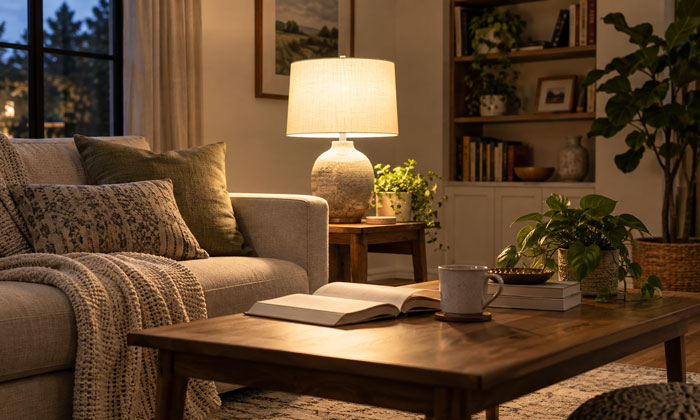
1000 Lumens
At 1000 lumens, the increase over 800 lumens is moderate. If both lights use comparable optics and occupy the same position, the higher-output version provides more illumination.
However, a 25% increase in output should not be interpreted as a guaranteed 25% increase in perceived brightness.
2000 Lumens
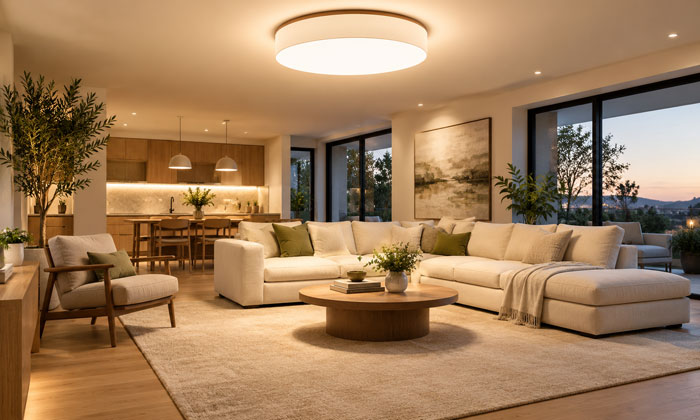
At 2000 lumens, there is substantially more light available to distribute. A broad diffuser can spread it across a larger area, while a narrow beam can concentrate it into a bright patch.
The first may suit general illumination; the second may leave the surrounding space comparatively dark.
Why Lumens Alone Don’t Tell the Whole Story
Two lights with identical lumen ratings can create very different results because their light distribution differs.
Beam angle controls how concentrated the light is. A narrow spotlight puts more of its output into a limited area; a wide floodlight spreads its output more broadly. A lower-lumen spotlight can therefore illuminate a small target more strongly than a higher-lumen light aimed across a large area.
Distance changes how much light reaches a surface. Under an ideal point-source model, with the receiving angle unchanged, doubling the distance reduces direct illuminance to one-quarter. Real fixtures, nearby extended light sources, and reflected light make indoor conditions more complicated, but the practical lesson remains useful: moving a task lamp closer can make a substantial difference.
Shades and diffusers redirect light and can absorb some of it. Check whether a specification refers to the bare bulb or the complete fixture. A bulb’s lumen rating does not necessarily describe the light that emerges after it is installed behind a shade.
Background lighting and glare also shape the experience. An exposed light source may seem harsh in an otherwise dark room. Shielding it from direct view and adding gentle background illumination can improve comfort without simply increasing output. Glare depends on factors including source size, position, and the surrounding visual field.
How Many Lumens Do You Need for Different Tasks?
Start by identifying what you need to see. Lighting a book, illuminating a kitchen counter, and creating a relaxed living room place different demands on a light source.

Bedside Reading
For bedside reading, a directional lamp in the 500–800-lumen range can be a reasonable starting point if it sits close to the page. Adjust its position so the light reaches the book without shining directly into your eyes. Small print and individual visual needs may call for more illumination.

Desk Work
For desk work, consider an adjustable lamp around 800–1000 lumens as a starting point. Place it to limit hand shadows and screen reflections. If the desk remains dim, check the beam coverage and distance before assuming that a more powerful bulb is the only solution.

Food Preparation or Detailed Work
For food preparation or detailed work, the priority is sufficient light on the working surface. A ceiling fixture can leave the counter in shadow when you stand between them.
Lighting positioned over or beneath cabinets may solve that problem more effectively than increasing ceiling-light output.

General Room Lighting
For general room lighting, evaluate several light sources together. A 2000-lumen fixture may contribute useful overall illumination, but whether it is sufficient depends on the room and the activities taking place there.
These are household starting points, not lighting standards. Where a specific task requires a defined illumination level, assess lux at the work surface rather than relying solely on the bulb’s lumens.
How Room Size and Layout Affect Your Lighting Needs
A larger room usually needs more total light to achieve a similar average illumination level, assuming comparable fixtures and finishes. However, floor area alone cannot determine the right bulb.
Ceiling height changes the distance between overhead fixtures and the surfaces below. Dark walls and furnishings absorb more light than light-coloured finishes. Alcoves, shelves, and furniture can block light, creating shadows that additional output from the same position may not eliminate.
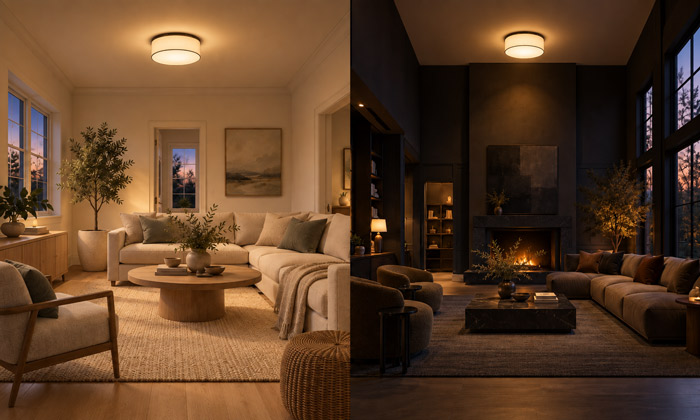
For example, a 2000-lumen fixture in a compact room with light walls may produce a very different result from the same fixture in a larger room with a high ceiling and dark finishes. Assigning one universal room size to that lumen rating would overlook these differences.
Distribution matters alongside the total. Four 500-lumen sources add up to 2000 lumens of rated output, but their placement can produce a different pattern from one central 2000-lumen fixture. Several well-positioned lamps can illuminate separate areas, while one central source may leave corners or work surfaces shadowed.
A useful approach is to combine general lighting for movement around the room with task lighting where you read, cook, or work. This lets you adjust each area to its purpose.
What to Check Before Choosing a Light
Once you have a likely lumen range, check the specifications that determine whether the light will be useful and comfortable.
Light distribution and shielding. Choose a beam or diffuser suited to the area you want to illuminate. Consider whether the bulb or LED elements will be directly visible from your normal sitting or standing position.
Colour temperature. Measured in kelvins, this describes the colour appearance of white light. Around 2700–3000K looks warmer, while 4000–5000K looks more neutral to cool. A higher colour temperature does not automatically mean higher light output.
Colour rendering. CRI describes how faithfully a light renders object colours compared with a reference source. As a practical starting point, look for CRI 80 or higher for everyday household use and consider 90 or higher where colour judgement matters. CRI is separate from brightness.
Dimming compatibility. Check that both the LED product and the dimmer support each other. Dimming provides flexibility when the same room serves different purposes, such as reading during the evening and relaxing later.
Power use and fixture suitability. Compare watts after establishing the light output you need. Also check the bulb’s base, dimensions, and suitability for enclosed or damp locations when relevant.
Choose the lumen rating together with the fixture and its position. A well-placed 500-lumen task light can be useful for close work, while 2000 lumens can supply more light across a broader area. The right choice is the one that delivers comfortable illumination where you actually need it.
FAQs
How Can I Verify If a Light Actually Produces 1000 Lumens?
A standard light-meter reading cannot directly confirm the total lumen output of a light source. A lux meter measures brightness at a specific point, while professional equipment such as an integrating sphere measures total emitted light.
For accurate verification, check an independent photometric report or test data for the exact product model.
Do LED Lights Become Dimmer as They Age?
Yes. LED lights gradually lose output over time through a process known as lumen depreciation rather than suddenly failing.
The L70 rating indicates when an LED is expected to maintain approximately 70% of its original light output under specified operating conditions.
Does a Higher-Lumen Flashlight Always Shine Farther?
No. Lumens measure total light output, but beam distance also depends on factors such as beam intensity, reflector design, and candela rating.
A flashlight with a focused beam can project light farther than a wide-angle model with the same lumen output.
Can a 2000-Lumen Flashlight Keep Its Maximum Brightness Continuously?
Not always. Many high-output flashlights reduce brightness after a short period to control heat and protect battery performance.
Review sustained output charts, thermal management information, and runtime specifications to understand actual performance.
Are ANSI Lumens the Same as Regular Light Bulb Lumens?
No. Both describe light output, but they are used for different applications.
ANSI lumens are commonly associated with projector brightness testing, while bulb lumen ratings describe the total visible light produced by a lamp or LED source. Comparing products requires checking that the measurement methods are consistent.
