
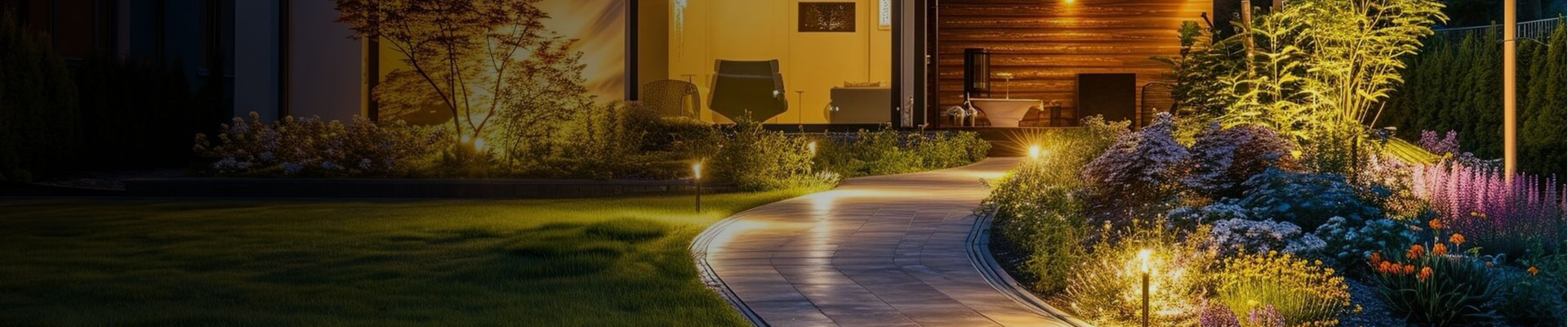
1. Give a Winding Garden Path a Gentle Glow
2. Make One Tree the Garden’s Focal Point
3. Create a Moonlit Corner Beneath the Branches
4. Turn a Patio into an Outdoor Dining Room
5. Hide Lighting Beneath Steps and Wall Caps
6. Frame Flower Beds with Small Pools of Light
7. Use a Fence as a Backdrop for Plant Silhouettes
8. Give a Fountain or Garden Sculpture Its Own Lighting
9. Create a Flexible Lantern Nook
10. Design Different Lighting Scenes for Different Evenings
Bring Your West Alexandria Garden Lighting Plan Together
FAQs
A garden can feel completely different after sunset. A softly illuminated walkway invites you outside, a favorite tree becomes a focal point, and a quiet seating corner turns into somewhere you want to spend the evening.
When planning West Alexandria landscape lighting, start with the way you use your garden. Where do you walk? Where do you sit? Which features would you like to see from your windows? Those answers create a more useful starting point than buying a matching set of lights and spreading them evenly across the yard.
These ten ideas combine practical illumination with decorative effects, helping you shape an outdoor space that feels comfortable, balanced, and personal.
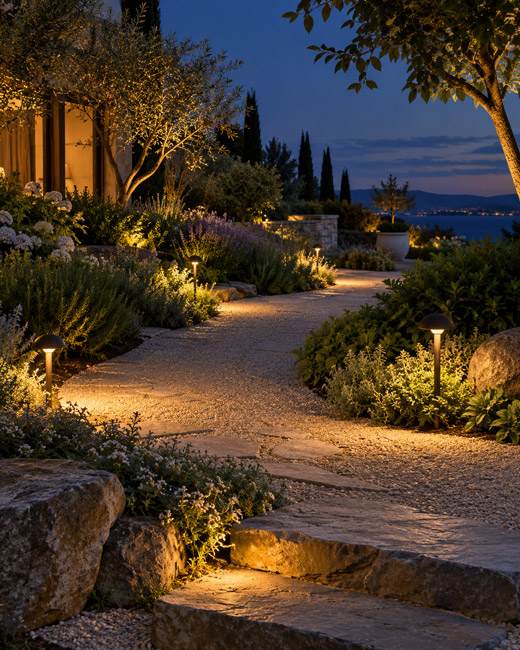
1. Give a Winding Garden Path a Gentle Glow
Let lighting follow the route through your garden. Place shielded path lights near changes in direction, entrances, and transitions between paving materials, then fill in any stretches where the walking surface remains difficult to see.
For an informal path, try alternating fixtures between planting pockets. This creates a relaxed rhythm while keeping the light directed toward the ground. Leave enough clearance for plants to grow without covering the fixtures.
The right pathway light spacing depends on the fixture’s light distribution, path width, and existing illumination. Test the arrangement after dark instead of relying on one fixed distance for every garden. Shielded fixtures help keep the light useful without exposing a bright bulb at eye level.
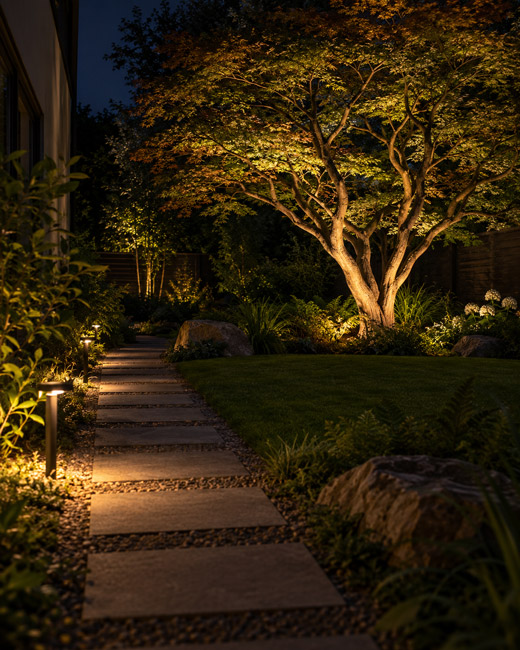
2. Make One Tree the Garden’s Focal Point
Choose a tree with a distinctive trunk, branching pattern, or canopy, and make it the main feature of your nighttime view.
An adjustable spotlight near its base can bring out the trunk and lower branches. Aim carefully so the beam lands on the tree rather than passing through gaps into the sky. Uplighting works particularly well when you want to emphasize a feature that otherwise disappears after sunset.
For a simple composition, imagine a garden with a path along one side and a specimen tree at the far end. Keep the path lighting restrained and let the tree provide the visual destination.
Check the result from the patio and from inside the house. A beam that looks attractive from one angle may point toward someone’s eyes from another.
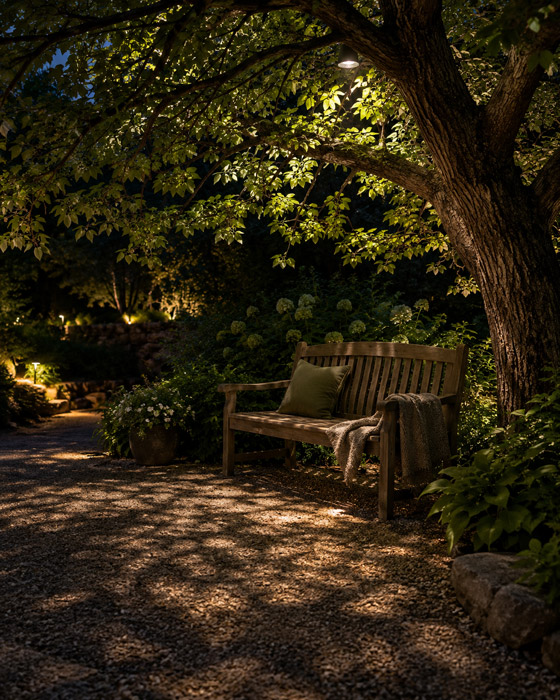
3. Create a Moonlit Corner Beneath the Branches
A bench beneath a tree offers an opportunity for a quieter lighting effect.
Moonlighting uses a shielded fixture mounted above the area, aimed downward through branches. The foliage interrupts the beam and creates patterns of light and shadow across the ground.
Use this effect around a reading bench, a small seating circle, or a garden path beneath an open canopy. Keep nearby decorative lights subdued so the shadows remain visible.
Tree-mounted fixtures need suitable mounting methods and room for growth. Have a qualified installer handle elevated installation and plan for later adjustment. The light should remain accessible for maintenance without placing unnecessary stress on the tree.
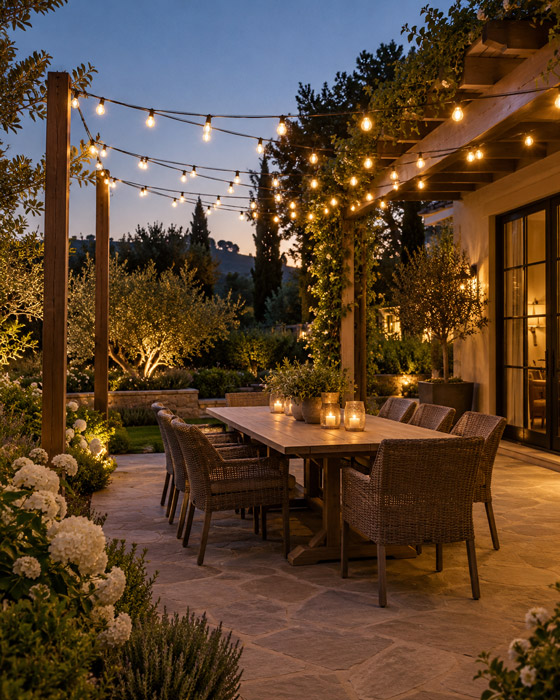
4. Turn a Patio into an Outdoor Dining Room
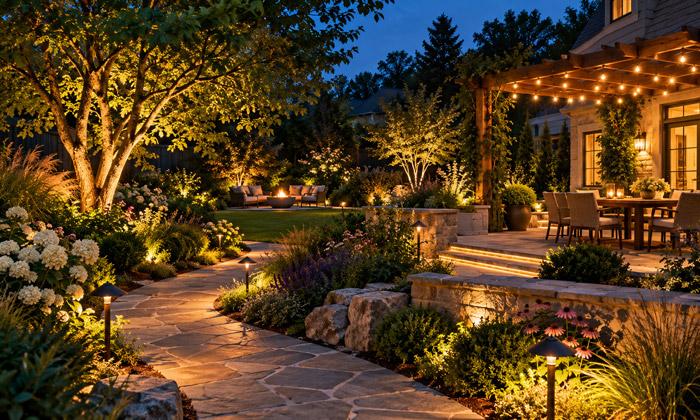
A modest canopy of string lights can give a patio a defined ceiling and make a dining table feel connected to the surrounding garden.
Try a simple arrangement between a pergola and purpose-built posts, or follow the perimeter of a seating area. Keep the pattern proportional to the space: a small courtyard may need only a few carefully placed runs.
For a welcoming appearance, consider warm white lighting around 2700K; 3000K offers a slightly crisper look. Keep adjacent fixtures visually consistent unless a different color temperature serves a deliberate purpose.
Choose outdoor-rated string lights and follow their support and connection instructions. Position the lights where they illuminate the table comfortably without hanging across access routes or competing with the view into the garden.
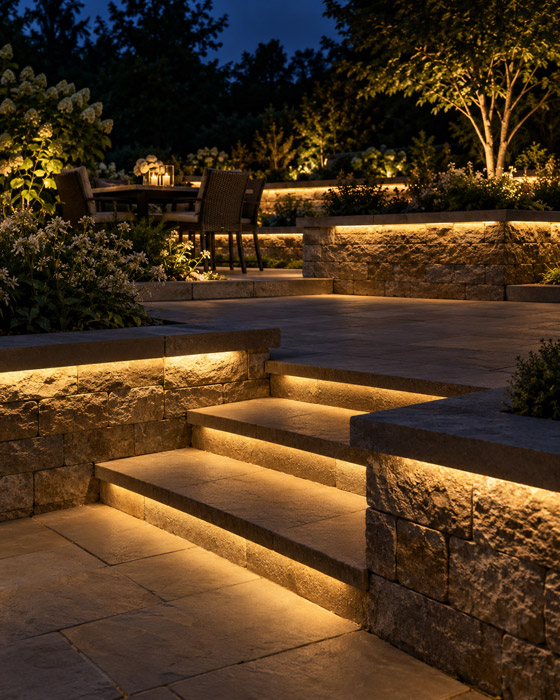
5. Hide Lighting Beneath Steps and Wall Caps
If your garden includes a raised patio or terraced planting beds, integrate light into the hardscape.
Compact fixtures tucked beneath a wall cap can reveal the surface below while concealing the source. On steps, shielded lighting can help make the tread and changes in level easier to distinguish.
Use hardscape lighting for retaining walls to connect different garden levels visually. For example, a low illuminated wall beside a dining area can continue the composition established by nearby path lights.
Avoid choosing brightness solely for the dramatic effect in photographs. View the installation while walking toward the steps and while sitting nearby. The fixtures should reveal the surfaces without sending light directly into your eyes.
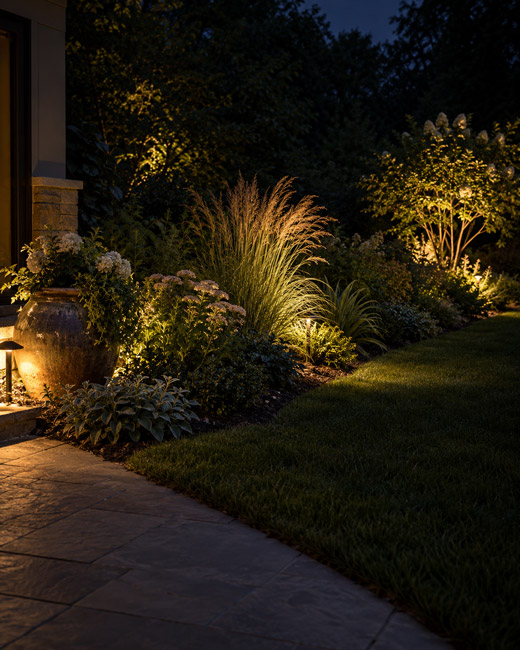
6. Frame Flower Beds with Small Pools of Light
Give a planting bed a few points of interest instead of lighting every flower.
Imagine three features along a border: a ceramic pot near the patio, ornamental grasses in the middle, and a shrub at the far end. A restrained arrangement can guide the eye between them while leaving quieter spaces in between.
Place fixtures where you can adjust them as plants grow. A position that works in early spring may be hidden by summer foliage, so leave access for small seasonal changes.
Keep equipment out of the way of edging and routine gardening. Before settling on a fixture height, consider the mature height of the surrounding plants, not just their size on installation day.
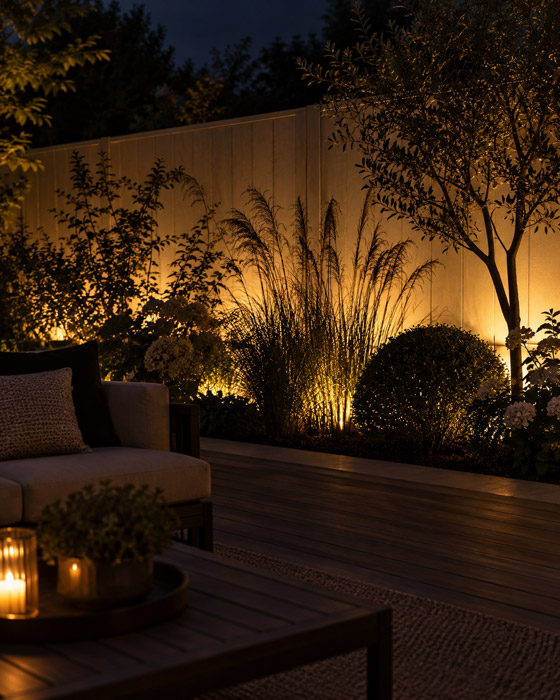
7. Use a Fence as a Backdrop for Plant Silhouettes
A plain fence can become part of the nighttime garden when you illuminate it behind a plant with an interesting outline.
Place a light between the plant and the background, directing it toward the fence. The illuminated surface creates contrast with the darker plant in front. This technique, known as silhouetting, suits sculptural shrubs, ornamental grasses, and garden ornaments.
Try the effect on one section of the boundary behind a seating area. It gives the view a deliberate endpoint without requiring the entire fence to be illuminated.
Adjust the beam so it stays on your chosen surface. Check the effect from neighboring sightlines as well as your own patio, especially where gardens sit close together.
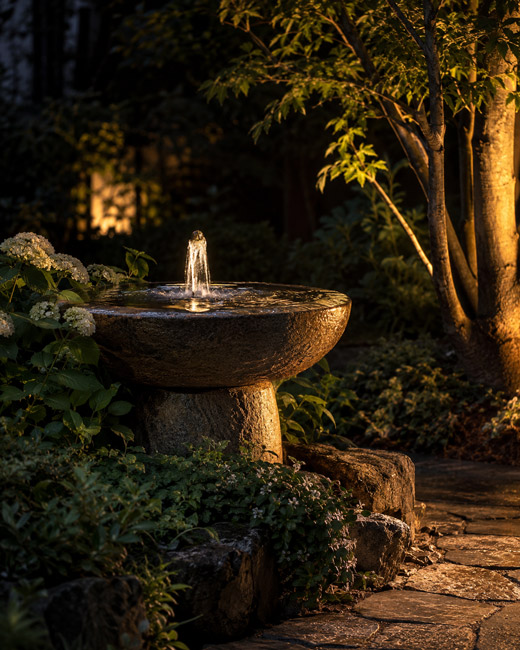
8. Give a Fountain or Garden Sculpture Its Own Lighting
A fountain, birdbath, or sculpture can serve as a small, intimate focal point.
Begin with a light positioned to one side. Experiment with the angle until the object’s shape reads clearly from your main viewing position. A slightly off-center arrangement is worth testing before committing to symmetrical fixtures.
For a water feature, decide whether you want to emphasize the surrounding stone, the moving water, or the object as a whole. Lighting all three equally may make the scene feel busy.
Keep ordinary landscape fixtures outside the water. Any submerged installation needs equipment specifically rated for that purpose and installation appropriate to the feature. Leave access for cleaning and servicing rather than burying the equipment behind permanent landscaping.
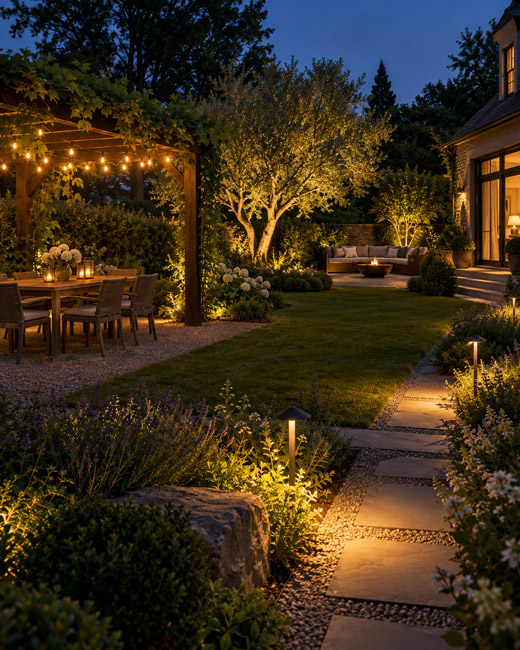
9. Create a Flexible Lantern Nook
A pair of outdoor lanterns can make an unused garden corner feel intentional.
Place them beside a bench, near a cluster of planters, or on a stable surface beside a small table. Vary their height slightly and keep the arrangement outside the walking route.
Solar lanterns suit decorative spots where suitable sunlight reaches the panel. Their runtime depends on charging conditions, so assess the location before relying on them through the evening. When comparing solar and low-voltage outdoor lighting, consider whether the light is an optional accent or something you need to operate consistently.
This idea is useful if you like rearranging your garden furniture. Start with one seating nook and move the lanterns as your preferred evening spot changes.
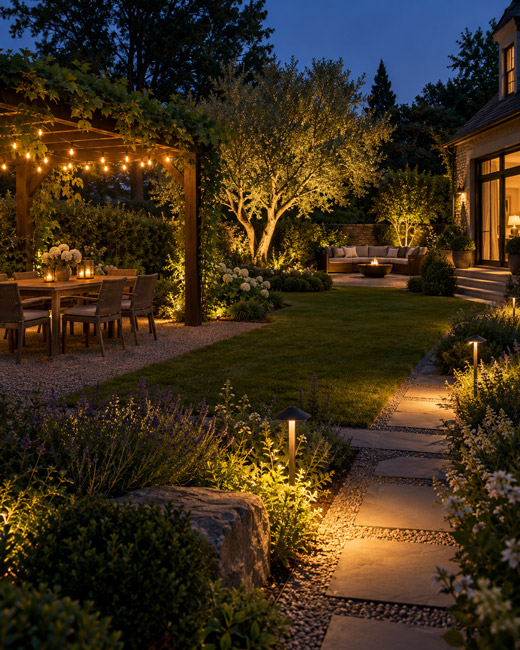
10. Design Different Lighting Scenes for Different Evenings
Your garden does not need the same lighting arrangement for dinner, a quiet evening, and late-night access.
Plan separately controlled areas around those activities. An entertaining scene might include the dining lights, a softly lit tree, and the route back to the house. A quieter setting might use only the seating area and essential pathway lights.
Keep controls simple enough that everyone in the household can use them. If you add dimming, confirm that the lamps, drivers, and controls work together.
A landscape lighting timer can provide a regular operating schedule. Choose settings that suit the controller’s capabilities and check them as sunset times change. Decorative lighting can switch off when the garden is no longer in use.
Bring Your West Alexandria Garden Lighting Plan Together
You do not need to use all ten ideas. Begin with the route you walk most often, one place to sit, and one feature you enjoy looking at. For a small garden, that might mean shielded path lights, a softly illuminated patio, and a single accent tree.
Walk through the proposed layout after dark before finalizing fixture positions. Look from the entrance, the seating area, and your indoor windows. Notice where the light feels comfortable, where important surfaces remain difficult to see, and where a visible lamp distracts from the scene.
Choose fixtures rated for their actual outdoor exposure, keep them accessible for maintenance, and plan the power supply before expanding the system. As planting changes, revisit the aiming and clear foliage from the light paths.
A thoughtful West Alexandria landscape lighting design should make your garden easier to use and more enjoyable to look at. Start with a few purposeful choices, adjust them after dark, and let the garden’s best features guide the result.
FAQs
What Affects the Cost of Landscape Lighting in West Alexandria?
The total cost depends on fixture quantity and quality, cable lengths, installation access, and electrical work.
Installing lights across an existing paved area may require more labor than placing them in accessible planting beds. Request an itemized quote separating fixtures, wiring, transformers, controls, and labor so you can compare proposals accurately.
How Many Lumens Do Landscape Lights Need?
There is no single lumen rating suitable for every landscape lighting application.
Lumens measure total light output, while beam angle and distance determine how that light reaches a surface. A narrow spotlight can concentrate light on a distant feature, whereas a wider beam spreads the same output over a larger area. Compare fixture specifications rather than choosing brightness by wattage alone.
What Size Transformer Do I Need for Landscape Lighting?
Add the wattage of all fixtures, then follow the transformer manufacturer’s loading requirements.
For example, if the manufacturer recommends a maximum load of 80%, a 100-watt transformer should serve no more than 80 watts of lighting. Allow capacity for planned additions, and have cable length and voltage drop checked separately because extra transformer capacity does not automatically solve wiring losses.
Why Are Landscape Lights Dimmer at the End of a Cable Run?
Voltage drop can leave distant fixtures receiving less voltage than they require, particularly on long runs with unsuitable cable sizing or excessive loads.
Poor connections can also contribute to performance problems. Have an installer check the voltage at affected fixtures and inspect the cable layout before replacing lights or increasing transformer output.
Can I Upgrade Existing Landscape Lights With Smart Bulbs?
Some fixtures accept compatible smart replacement bulbs, allowing an upgrade without replacing the entire lighting system.
Check the bulb base, physical dimensions, operating voltage, and manufacturer’s transformer requirements. Integrated LED fixtures may not accept replacement bulbs, and smart features may require a dedicated controller or gateway. Confirm compatibility for the specific products before purchasing.
