

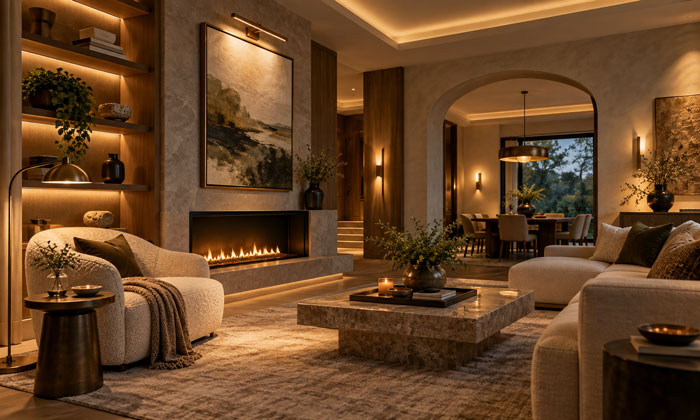
How Does Dimensional Lighting Work?
Dimensional Lighting vs. Flat and Layered Lighting
The Lighting Layers That Support Depth
Five Techniques for Creating Dimensional Lighting
Dimensional Lighting Examples in Real Spaces
How to Plan Dimensional Lighting in Five Steps
How to Choose the Right Fixtures
Common Dimensional Lighting Mistakes
FAQs
Dimensional lighting is an approach to lighting design that uses light direction, brightness differences, and shadows to reveal depth, shape, and texture. In interiors, it helps furniture, architectural details, and decorative objects stand out while giving the room a clearer sense of visual hierarchy.
A room can be bright enough for everyday activities yet still feel visually flat. When every surface receives similar illumination, there may be little distinction between a textured wall, a reading corner, and an artwork. Thoughtfully arranged light helps these elements become easier to see and appreciate.
This guide focuses on dimensional lighting in residential and commercial interiors. The term describes a visual effect and design approach rather than a particular type of fixture.
How Does Dimensional Lighting Work?
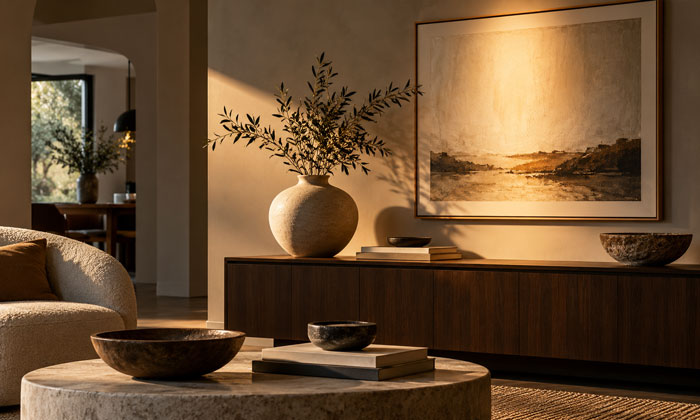
Our perception of form depends partly on the way light falls across surfaces. A rounded vase, for example, becomes easier to read as a three-dimensional object when one side is illuminated and the brightness gradually falls toward the other side.
Three relationships are especially useful when planning this effect.
Light direction reveals shape. Light arriving from an angle can create highlights and shadows that describe an object’s contours. Broad, diffuse illumination tends to soften those differences. Combining the two gives you control over how strongly a surface or object is modeled.
Brightness differences establish emphasis. A lit artwork against a quieter background can become a focal point. If several nearby surfaces compete at similar brightness, the composition may feel less focused.
Background illumination provides context. A softly illuminated wall can help define the room’s boundaries. The relationship between that wall and objects in front of it influences how clearly their shapes stand out.
The goal is controlled variation. Strong contrast may suit a display, while a living room may benefit from gentler transitions. In both cases, the lighting still needs to support the activities taking place.
Dimensional Lighting vs. Flat and Layered Lighting
These terms describe different aspects of a lighting scheme.
| Term | What it describes | Typical purpose |
|---|---|---|
| Flat lighting | Illumination with relatively little visible shadow or tonal variation across a subject | Even visibility or reduced emphasis on texture |
| Layered lighting | A combination of lighting functions, such as ambient, task, and accent lighting | Supporting different activities and visual needs |
| Dimensional lighting | Light and shadow arranged to make depth, shape, and texture apparent | Revealing form and establishing visual focus |
Layering provides a useful framework for creating dimension, but adding more fixtures does not guarantee the effect. Their direction, distribution, and relative brightness matter.
For example, a ceiling light, floor lamp, and spotlight may all be present in a room. If they illuminate everything equally, the result can still look flat. Adjusting the spotlight toward an artwork and reducing unnecessary background brightness can create clearer emphasis.
Flat lighting also has valid uses. Uniform illumination may be desirable for certain tasks or visual styles. A practical interior can combine even light where people work with more expressive lighting around architectural features.
The Lighting Layers That Support Depth
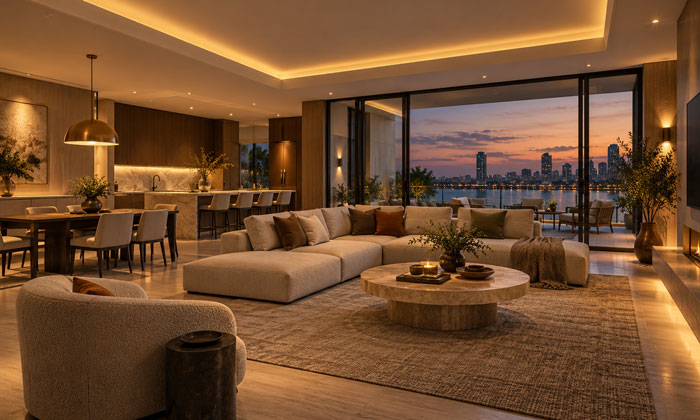
Ambient Lighting
Ambient lighting provides the room’s general illumination. It helps people move around and understand the space. Depending on the design, it may come from indirect ceiling lighting, pendants, wall lighting, or recessed fixtures.
For a dimensional scheme, think of ambient light as the foundation. It should support comfortable use while leaving room for other lighting elements to be noticeable.
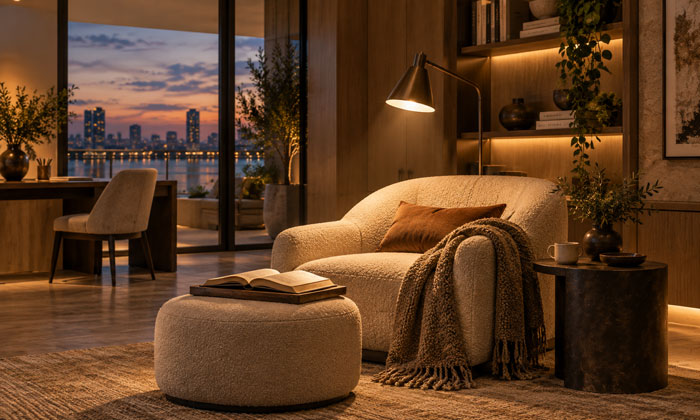
Task Lighting
Task lighting supports activities such as reading, cooking, or working. A reading lamp beside an armchair or a light beneath a kitchen cabinet provides illumination where it is needed.
Place task lights with the user in mind. A visually attractive room still needs a reading area where a person’s head does not block the light and a worktop where reflections do not interfere with the task.
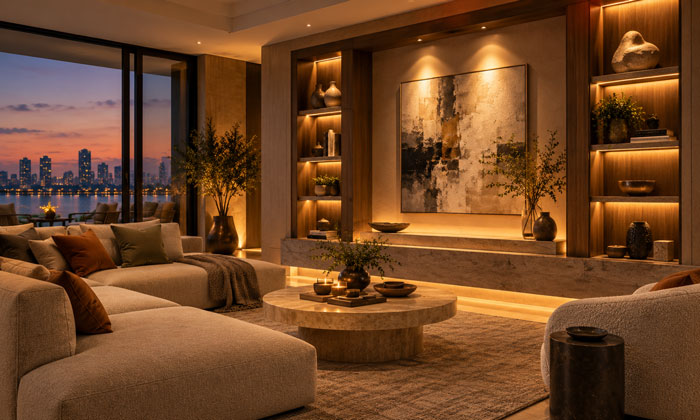
Accent Lighting
Accent lighting directs attention toward selected objects or surfaces. Adjustable spotlights, picture lights, and certain recessed fixtures can highlight artwork, shelving, or architectural details.
Choose focal points deliberately. One well-lit feature can give a room a clearer composition than a collection of equally bright accents.
Decorative fixtures can contribute to these layers while also acting as visual objects. A pendant’s appearance and the light it distributes should both be considered.
Five Techniques for Creating Dimensional Lighting
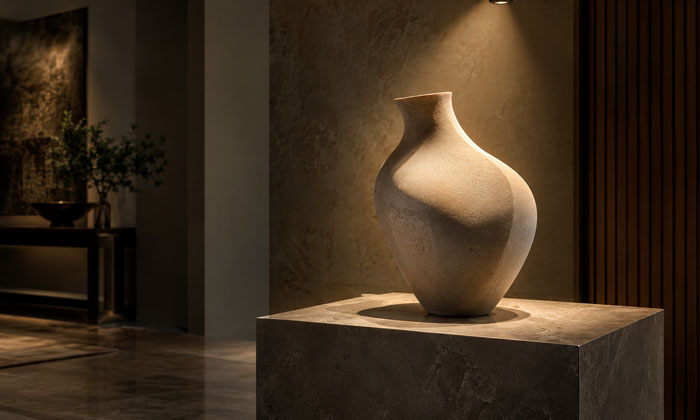
1. Directional Accent Lighting
Directional accent lighting concentrates light on a selected feature. An adjustable fixture allows you to change where the beam lands and how it interacts with the subject.
For an illustrative arrangement, try lighting a ceramic object from above and slightly to one side. Observe how its curve and shadow change as you adjust the direction. Check the result from the position where people will normally view it.
Avoid treating every object as a focal point. The lighting needs some quieter areas for the important features to remain distinct.
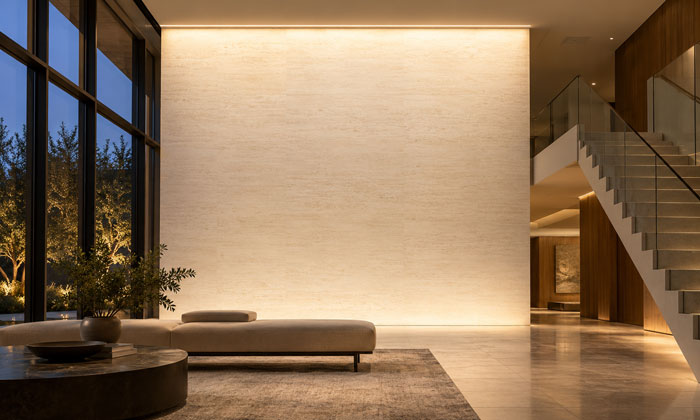
2. Wall Washing
Wall washing aims to illuminate a vertical surface evenly. It can provide a bright background and help make the surrounding architecture more visible.
Choose wall washer light fixtures designed for even vertical illumination, and follow the manufacturer’s spacing guidance. Ordinary downlights placed near a wall may create patches or scallops instead of a smooth wash.
In a dimensional lighting design, an evenly lit wall can balance more directional illumination elsewhere. Every surface does not need pronounced shadows.
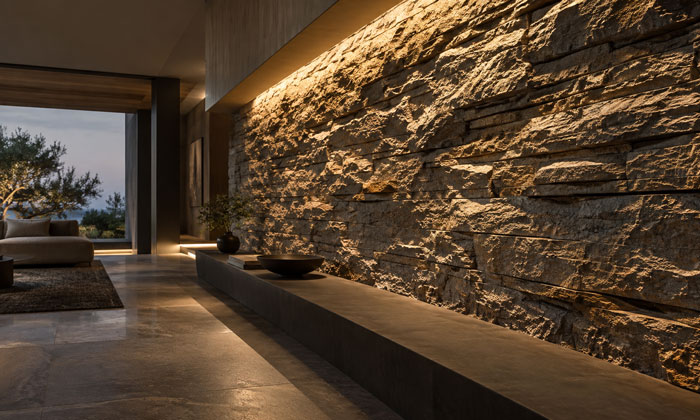
3. Wall Grazing
Wall grazing directs light across a surface at a shallow angle. On textured materials, the resulting highlights and shadows can emphasize relief.
Consider it for a stone feature wall or another surface whose texture is part of the design. Test the effect on the actual material before committing to a layout: the same technique may also make uneven joints or surface imperfections more noticeable.
Wall washing and grazing serve different visual goals. Choose between them according to whether you want the wall to read as an even illuminated plane or a more textured surface.
4. Backlighting
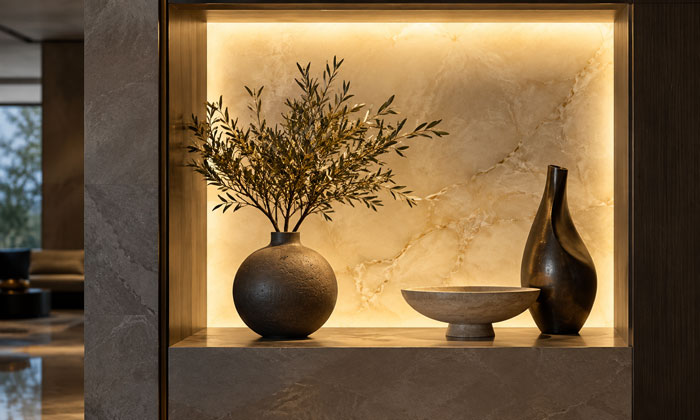
Backlighting introduces illumination behind an object or feature. Its appearance depends on what receives the light: a translucent panel may glow, while a concealed source behind an opaque feature may illuminate the surrounding background.
An illustrative application is a display niche with a softly lit rear panel. The objects in front can become more distinct, although they may still need light from another direction if their front surfaces must be clearly visible.
Conceal the source from normal viewing positions and check for reflections or visible LED dots.
5. Uplighting
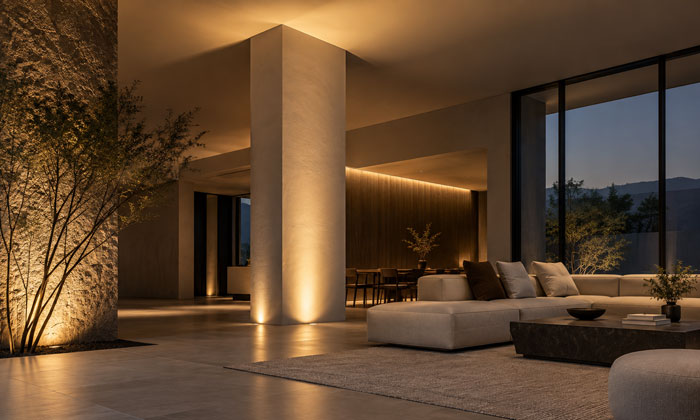
Uplighting directs light upward toward a surface or feature. A concealed fixture might illuminate a ceiling, a column, or the upper part of a decorative element.
The effect can be subtle or dramatic, depending on the beam and its target. In a room with limited ceiling access, a suitable floor-standing uplight may offer a way to introduce another direction of illumination.
Check sightlines carefully. A low fixture should not expose a bright source to someone seated nearby.
For a closer look at how light direction changes a space, explore the differences between uplighting and downlighting before deciding where to position your fixtures.
Dimensional Lighting Examples in Real Spaces
The following arrangements are illustrative lighting plans, not documented project results.
A Living Room with a Reading Corner and Artwork
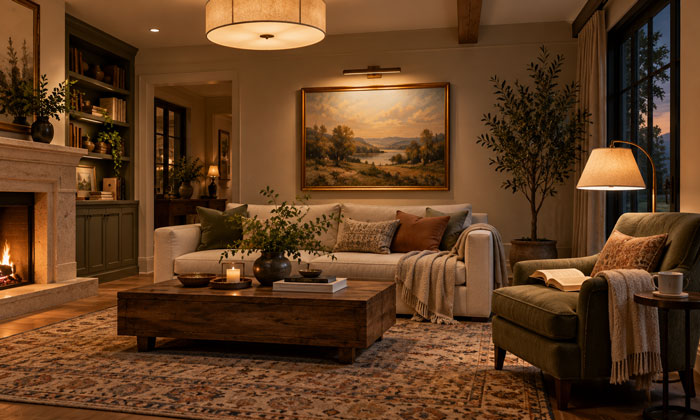
In a living room, combine soft ambient light with a floor reading lamp beside the armchair and an adjustable spotlight aimed at a painting.
A gentle wall wash can balance the background brightness, while the spotlight gives the artwork visual emphasis. Keep glare and reflections out of normal seated sightlines.
For a space-saving alternative to a floor lamp, consider wall sconces for a living room, choosing a design that provides comfortable reading light beside the armchair.
A Kitchen with a Textured Backsplash
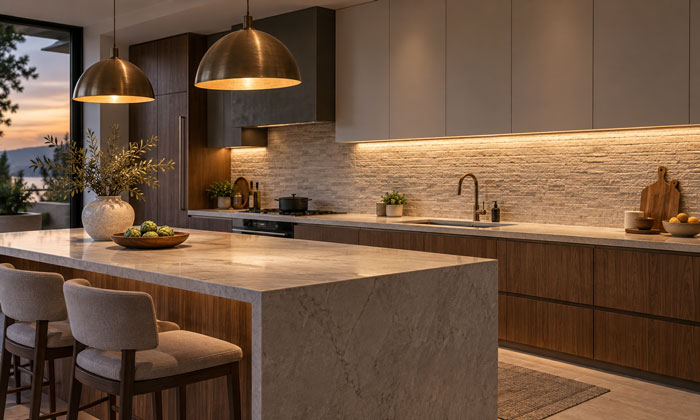
Begin with dependable illumination on the worktop. Under-cabinet lighting can serve this function, but placement should be tested against the countertop finish and normal standing positions.
Treat texture as a separate design decision. If grazing light produces distracting shadows or emphasizes unwanted irregularities, use a more even distribution. Pendants above an island can add another visual element while the work surfaces remain the priority.
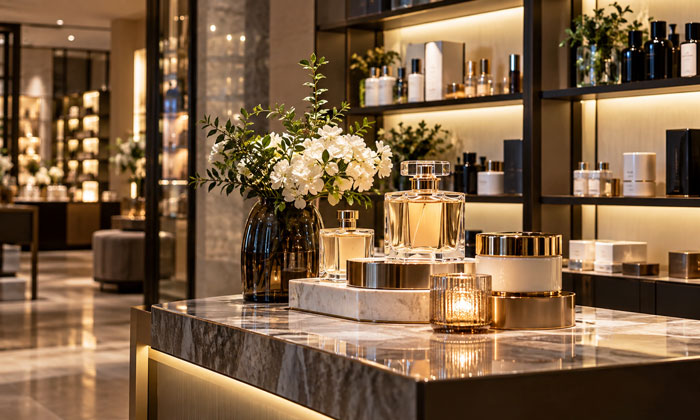
A Retail Display
Select the product or small group of products that should attract attention first. Use adjustable lighting to emphasize those items, then evaluate their appearance against the shelving and background.
Glossy packaging and reflective merchandise need particular attention because a poorly placed highlight can obscure the product. Review the display from customer approach angles as well as directly in front.
How to Plan Dimensional Lighting in Five Steps
Step 1: Identify Activities and Viewpoints
List what people do in the space and where they sit, stand, or walk. Include daytime conditions, since daylight can change the balance between surfaces.
Step 2: Choose the Main Focal Point
Select an artwork, architectural feature, or display that deserves emphasis. Decide what should remain visually quieter around it.
Step 3: Establish Ambient and Task Lighting
Make sure the room supports movement and everyday activities. Resolve poorly lit work areas before adding decorative effects.
Step 4: Adjust Direction and Contrast
Introduce accent lighting and compare different aiming positions. Adjust surrounding light as well as the accent itself. A focal point may become clearer simply by reducing competing illumination.
Step 5: Test and Refine
Review the room after dark and during the day. Check seated sightlines, glossy surfaces, screens, and task areas. Where appropriate, provide separate controls so different lighting functions can be adjusted independently.
If you document the change with photographs, keep the viewpoint and exposure settings consistent so the comparison is meaningful.
How to Choose the Right Fixtures
Select fixtures according to the effect they must produce and the constraints of the room.
| Design goal | Fixture type to consider | What to check |
|---|---|---|
| Highlight artwork or a display | Adjustable track spotlight or recessed accent light | Aiming range, beam coverage, glare control |
| Illuminate a wall evenly | Dedicated wallwasher | Distribution, setback, recommended spacing |
| Emphasize surface texture | Grazing fixture | Position relative to the surface, shielding |
| Light a reading area | Adjustable or shaded task lamp | Light on the page, comfort from the seat |
| Add concealed background light | Suitable linear LED system | Diffusion, reflections, driver access |
The spotlight beam angle affects how concentrated or broad the illumination appears, while the distance to the target influences the area covered. Consider both when selecting a fixture for artwork, shelving, or architectural details.
Color temperature influences whether the light appears warmer or cooler; color rendering concerns how colors look under it. Review samples with the room’s actual materials. If you need dimming, confirm compatibility between the light source, driver, and controls before purchase.
Common Dimensional Lighting Mistakes
Making every area equally bright. Revisit the lighting hierarchy and reduce unnecessary competition around the focal point.
Adding too many accents. A room can feel visually busy when every shelf, object, and wall demands attention. Select the features that contribute most to the design.
Ignoring glare and reflections. Check fixtures from normal viewing positions. Re-aim, shield, or reposition the source where necessary.
Using deep shadows in task areas. Preserve useful illumination where people read, prepare food, or work. Keep expressive contrast in locations where it does not interfere with those activities.
Choosing fixtures before defining their purpose. Decide what each light needs to illuminate before selecting its style, output, and optics.
FAQs
Is dimensional lighting the same as layered lighting?
No. Layered lighting combines different functions such as ambient, task, and accent illumination, while dimensional lighting focuses on creating depth, texture, and visual form through light and shadow.
A well-planned layered lighting system can help achieve a more dimensional appearance.
Can LED lights create dimensional lighting effects?
Yes. LED fixtures can be used for directional accents, wall illumination, concealed lighting effects, and focused task lighting.
The final result depends on factors such as optical design, fixture placement, beam angle, and brightness control.
Can dimensional lighting work effectively in a small room?
Yes. Small rooms can benefit from dimensional lighting by focusing on practical needs and highlighting one or two key features.
An adjustable accent light or carefully positioned task fixture can add depth without creating excessive brightness or visual clutter.
How is dimensional lighting different from volumetric lighting?
Dimensional lighting uses light and shadow to reveal depth, shape, and texture. Volumetric lighting refers to visible beams of light traveling through a space, often created by particles such as mist, smoke, or haze.
Interior dimensional lighting does not require visible light beams to create a sense of depth.
Do you need special fixtures for dimensional lighting?
No. Many standard fixtures, including adjustable spotlights, wall sconces, and table lamps, can contribute to dimensional lighting when positioned correctly.
Specialized fixtures such as wall washers and grazing lights can be useful when creating specific effects on textured surfaces or architectural features.
