
Start With Measurements and a Shared Layout
Estimate the Fence Installation Cost
Estimate the Outdoor Lighting Cost
Combine Both Projects Without Double-Counting
Example: A Combined Fencing and Lighting Budget
Calculate Electricity and Maintenance Costs
Reduce Costs by Adjusting the Scope
Compare Quotes Using the Same Written Scope
FAQs
To estimate fencing and lighting costs, measure the fence runs you need, price your chosen fencing material per linear foot, and create a lighting plan with a fixture count. Then add gates, electrical infrastructure, site preparation, installation, and a contingency allowance.
The most useful estimate separates the project into clear components:
Total project budget = installed fencing + installed lighting + additional site costs + contingency
Use the same pricing basis throughout. If a contractor’s rate already includes materials and installation, adding labor again will overstate your budget.
The figures below are U.S. planning references in dollars. Actual quotes depend on your location, specifications, and site conditions.
Start With Measurements and a Shared Layout
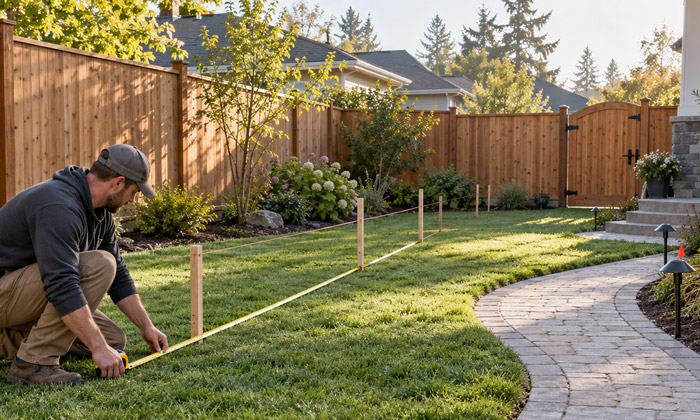
A property’s square footage does not tell you how much fencing it needs. Two lots with the same area can have different boundary lengths, and you may only need to fence part of your yard.
Sketch the proposed fence line and record each section separately. Mark gate openings, corners, slopes, existing structures, and anything that could make access difficult.
For example, a rectangular area measuring 40 by 60 feet has a perimeter of:
2 × (40 + 60) = 200 linear feet
If the project includes a 4-foot gate, your estimate might use 196 feet of standard fencing plus one separately priced gate. Confirm the contractor’s measurement method so the gate opening is not counted twice.
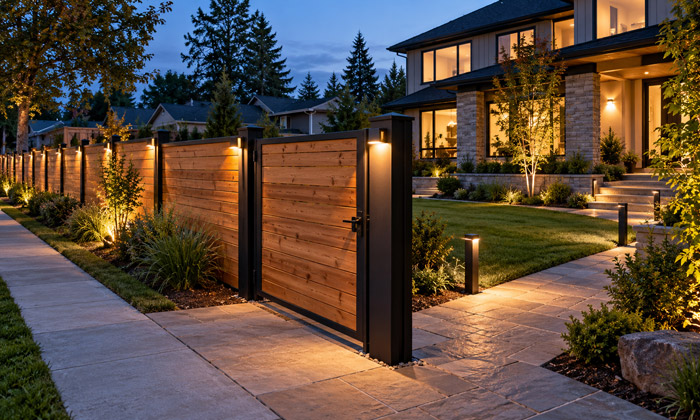
Add lighting locations to the same sketch. Identify entrances, walking routes, steps, and areas you use after dark. When planning garden lighting for fences, decide whether each light will illuminate a gate, light the ground, or highlight the fence itself. These functions can require different fixtures and mounting positions.
A shared layout also helps reveal where fence posts and lighting cable routes could interfere with each other.
Estimate the Fence Installation Cost
The starting calculation is:
Fence cost = standard fence length × installed price per linear foot + separately priced additions
Compare quotes for the same height, material grade, post specification, and design. A short decorative fence and a tall privacy fence should not share the same assumed unit price.
Fence Cost by Material
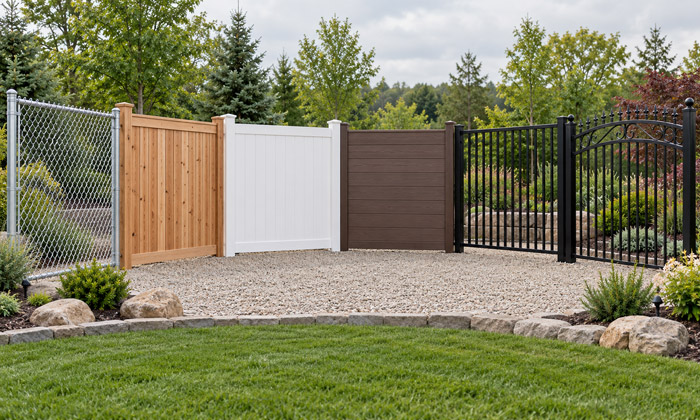
Angi publishes the following broad installation ranges:
| Fence material | Published cost per linear foot |
|---|---|
| Chain-link | $8–$40 |
| Wood | $10–$45 |
| Vinyl | $15–$40 |
| Composite | $11–$45 |
| Aluminum | $17–$90 |
| Wrought iron | $25–$55 |
These ranges are useful for an initial comparison; they do not guarantee the cost of a particular fence height or specification.
Suppose your measured fence length is 196 feet and a local contractor quotes $30 per foot for your selected design:
196 × $30 = $5,880
That is the base fence amount. Check the quote before adding anything else.
Identify What the Base Rate Excludes
Ask whether the installed rate covers posts, footings, hardware, delivery, and cleanup. Price gates separately when required, including their posts, hinges, latches, and installation.
Site conditions can also change the total. Slopes, difficult soil, underground utilities, taller fence sections, and additional gates are among the factors that can increase installation costs.
Your estimate should also state who handles old-fence removal, surface restoration, and any required approvals. A low per-foot price is less useful if those items remain undefined.
Estimate the Outdoor Lighting Cost
Lighting is usually easier to estimate by fixture count and system requirements than by property area.
Create a simple fixture schedule:
| Location | Intended purpose | Example quantity |
|---|---|---|
| Main gate | Illuminate the latch and entrance | 2 |
| Walkway | Light the walking surface | 6 |
| Seating area | Provide comfortable evening light | 2 |
| Garden feature | Highlight a focal point | 2 |
| Total | 12 |
This is an example, not a recommended layout for every property. The right quantity depends on fixture output, beam spread, mounting height, and obstacles.
Use Installed Prices for an Initial Estimate
HomeGuide lists landscape lighting at approximately $80–$300 per fixture installed, with substantial variation by fixture type. Its published ranges include $50–$150 for pathway lights, $100–$500 for security or motion-sensor lights, and $200–$800 for lamp-post or bollard lights.
For a preliminary allowance, 12 fixtures at an assumed installed rate of $200 each would give:
12 × $200 = $2,400
Before using that amount as your lighting budget, establish whether it includes the transformer, cable, connectors, controls, and any new electrical supply.
Choose the Power System Before Finalizing the Budget
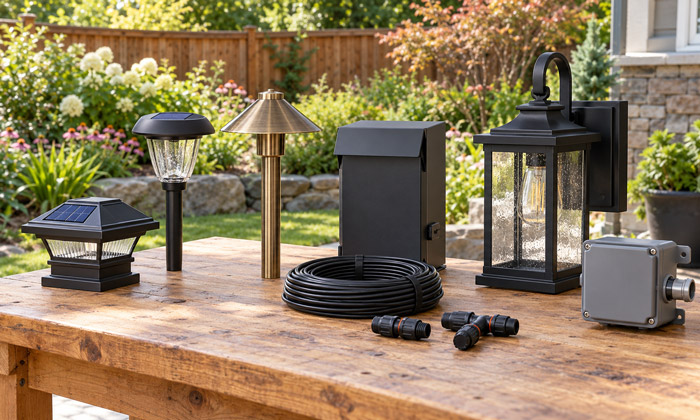
The choice between solar and low-voltage outdoor lighting affects both installation requirements and ongoing upkeep.
| System | Main items to budget for | Site consideration |
|---|---|---|
| Self-contained solar | Fixtures, mounting hardware, installation, future battery replacement | Available sunlight |
| Low-voltage wired | Fixtures, transformer, cable, connectors, controls, installation | Cable routes and access to power |
| Line-voltage wired | Fixtures, electrical wiring, protective infrastructure, electrical labor | Existing supply and installation requirements |
Solar fixtures can avoid the need to run power to each light, but their nighttime performance depends on charging conditions. Wired lighting provides a different cost structure because several fixtures share electrical infrastructure.
Compare systems against the same intended job. A decorative solar post cap and a wired fixture designed to illuminate steps may deliver very different results.
Include the Complete Lighting System
For a detailed estimate, use:
Lighting cost = fixtures + power equipment + cable and connectors + controls + installation + restoration
Cable should be priced using the actual installation route. The distance from the house to the last light may be much shorter than the cable needed to serve every branch of the system.
The appropriate landscape lighting wire size also affects material costs. Have the installer specify it for the proposed layout and connected load before you finalize the cable allowance.
Existing landscaping can make installation more expensive when crews must work around mature plants or hard surfaces and then repair disturbed areas. HomeAdvisor identifies landscaping, wiring, and labor as major lighting cost factors.
Combine Both Projects Without Double-Counting
Fencing and lighting may share access preparation, scheduling, and final cleanup. Ask contractors to identify any genuine savings from coordinating the work.
Do not assume all excavation can be combined. Fence foundations and lighting routes serve different purposes, and their locations must suit the finished design.
Review these items before adding the two estimates together:
- Labor: Is it already included in the fence rate or lighting package?
- Gate openings: Are they excluded from standard fence footage when gates are priced separately?
- Lighting equipment: Are transformers and controls already included?
- Restoration: Has each contractor charged to repair the same area?
- Mobilization and cleanup: Are these separate charges or part of the quoted installation?
Assign responsibility for each item in writing. This makes the estimate easier to compare and reduces gaps between contractors.
Example: A Combined Fencing and Lighting Budget
The following example uses assumed prices to demonstrate the calculation. It is not a contractor quote or a national average.
The project includes 196 feet of standard fencing, one pedestrian gate, and 12 low-voltage lights.
| Budget item | Calculation or allowance | Estimated cost |
|---|---|---|
| Standard fencing, installed | 196 feet × $30 | $5,880 |
| Pedestrian gate, installed | Separate allowance | $450 |
| Old-fence removal | Separate allowance | $600 |
| Lighting fixtures, supply only | 12 × $70 | $840 |
| Transformer and controls | Equipment allowance | $250 |
| Cable, connectors, mounting hardware | Materials allowance | $260 |
| Lighting installation | Labor allowance | $900 |
| Approvals and surface restoration | Project allowance | $400 |
| Subtotal | $9,580 | |
| Contingency | 15% × $9,580 | $1,437 |
| Planning total | $11,017 |
Here, fence labor is included in the per-foot rate, while lighting labor appears separately. The example assumes an existing suitable electrical supply and excludes applicable taxes and any new circuit or outlet.
The 15% contingency is a chosen planning allowance, not a required percentage. Adjust it to reflect unresolved conditions. Known work, such as a required electrical upgrade, belongs in the base estimate rather than being hidden inside contingency.
Calculate Electricity and Maintenance Costs
The purchase and installation price is only part of ownership cost.
For lighting, estimate electricity use with:
Annual electricity cost = total input watts ÷ 1,000 × daily operating hours × 365 × electricity rate
For example, assume 12 lights use 5 watts each, operate six hours a night, and electricity costs $0.18 per kWh:
60 ÷ 1,000 × 6 × 365 × $0.18 = $23.65 per year
This calculation covers the fixtures’ stated wattage. Actual consumption can be higher because of transformer losses and control equipment. Use measured system input for a more accurate result.
Maintenance deserves its own allowance. Consider fence finishing, damaged panels, gate adjustments, fixture cleaning, replacement parts, and solar batteries where applicable. Ask suppliers about replaceable components and warranty coverage before comparing long-term costs.
Reduce Costs by Adjusting the Scope
The most effective savings often come from deciding where each feature is necessary.
Use privacy fencing where screening matters, then price alternative designs for less sensitive boundaries. Compare gate sizes and styles carefully because a wider or more elaborate entrance can change both hardware and installation requirements.
For lighting, prioritize gates, steps, and regularly used paths. Add decorative areas later if the initial budget is tight. A smaller, well-planned layout can meet your needs without lighting every fence post.
If you intend to expand the system, ask the installer to price that possibility now. Future capacity and accessible cable routes may help, but their value should be weighed against the extra upfront cost.
Compare Quotes Using the Same Written Scope
Give each contractor the same measurements, layout, and specifications. Request an itemized quote showing:
- Fence length, height, material, and gate details.
- Lighting fixture models, quantities, and locations.
- Included power equipment, wiring, and controls.
- Removal, excavation, and restoration responsibilities.
- Taxes, exclusions, warranties, and optional upgrades.
Ask how unexpected conditions will be priced and approved. A clear process for changes is more useful than an unusually low initial figure with open-ended exclusions.
FAQs
Is It More Cost-Effective to Repair or Replace an Existing Fence?
Repair may be more economical when damage is limited to a few boards, panels, or fittings and the fence posts remain structurally sound.
Replacement may be worth considering when deterioration affects multiple sections or the fence no longer meets your needs. Compare both options over the same period, including likely future repairs and any work required to transfer attached lighting.
How Do Custom Fence Designs Affect the Total Budget?
Custom dimensions, decorative panels, curved sections, and detailed metalwork can increase fabrication and installation costs.
Matching gates and mounting brackets may also require custom work. Request separate pricing for a standard design and your preferred modifications so you can identify which features add to the total budget.
Does Adding Smart Controls Increase Outdoor Lighting Costs?
Yes, smart controls can add equipment, setup, and configuration costs to an outdoor lighting project.
Depending on the system, you may need compatible controllers, a hub, or additional components for separate lighting zones. Define whether you need scheduling, dimming, motion activation, or remote access before requesting quotes.
How Does a Coastal Location Affect Fencing and Lighting Costs?
Salt exposure can make corrosion resistance an important factor when choosing fencing materials and outdoor lighting components.
Compare fence hardware, fixture housings, fasteners, protective finishes, and warranty terms. Recommended cleaning or protective maintenance should also be included when comparing long-term ownership costs.
Can Existing Fence Posts Support New Lighting Fixtures?
It depends on the posts’ condition, dimensions, construction, and the mounting requirements of the selected fixtures.
Lightweight fixtures may only require suitable brackets, while heavier fittings may need reinforcement or separate supports. Include adapters, concealed cable routing, and any necessary post repairs in the installation estimate.
