


What Is a Soffit?
What Is Surface Mount Soffit Lighting?
How Does Surface Mount Exterior Soffit Lighting Work?
Main Types of Surface Mount Soffit Lights
Surface Mount vs. Recessed Soffit Lighting
Important Outdoor Ratings
How the Light Is Controlled
Light Output and Beam Placement
Advantages of Surface Mount Soffit Lighting
Installation Considerations
Maintenance
Conclusion
FAQs
Surface mount exterior soffit lighting is an outdoor lighting system installed directly onto the underside of a roof overhang, porch ceiling, canopy, entryway, or other exterior soffit surface. Unlike recessed fixtures, which require a hole and installation space above the ceiling, surface-mounted lights remain visible and attach to the face of the soffit.
This lighting method is commonly used when the soffit is too shallow for recessed fixtures, when cutting into the surface is impractical, or when property owners want a simpler installation process. It can provide functional illumination, improve nighttime safety, highlight architectural features, and strengthen a building’s overall exterior appearance.

A soffit is the finished underside of an architectural structure. On residential and commercial buildings, it is usually found beneath roof eaves, porches, balconies, canopies, and entrance overhangs.
Soffits help conceal structural components, wiring, ventilation systems, and the underside of roofing materials. Because they face downward, they also provide a practical mounting surface for exterior lights.
What Is Surface Mount Soffit Lighting?
Surface mount soffit lighting consists of fixtures attached directly to the exterior face of a soffit. The fixture’s housing, trim, and lens sit below the surface rather than inside it.
Most modern surface-mounted soffit lights use integrated LEDs or replaceable LED lamps. Their designs range from compact round disks to cylinders, squares, directional spotlights, and low-profile architectural fixtures.
A complete installation normally includes:
- A weather-resistant light fixture
- An electrical junction box
- Power wiring
- Mounting hardware
- A wall switch, timer, photocell, or smart lighting controller
The fixture must be rated for outdoor use and suitable for the level of moisture exposure at the installation location.
How Does Surface Mount Exterior Soffit Lighting Work?
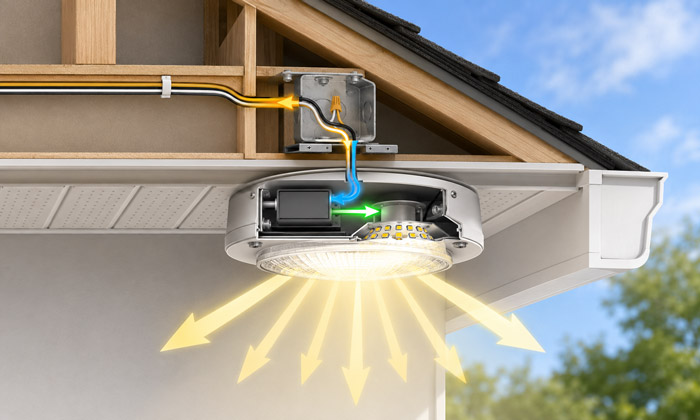
Surface mount soffit lighting works by drawing electrical power from a circuit connected to the building’s wiring system. The light fixture is secured to a junction box or approved mounting surface installed within or behind the soffit.
When the circuit is activated, electrical current reaches the fixture. In an LED soffit light, an internal driver converts the incoming electricity into the voltage and current required by the LED components. The LEDs then produce light, which is directed downward or outward through a lens, reflector, or adjustable housing.
The basic operating process is straightforward:
- Electrical power travels through the exterior lighting circuit.
- A switch, timer, sensor, or controller activates the circuit.
- The LED driver regulates the power supplied to the light source.
- The fixture produces and distributes light across the area below.
- The fixture housing protects the electrical components from dust and moisture.
Some models include motion sensors, dusk-to-dawn photocells, dimming controls, or smart connectivity. These features allow the lights to operate automatically or respond to changing conditions.
Esteki, M., Khajehoddin, S. A., Safaee, A., & Li, Y. (2023). LED systems applications and LED driver topologies: A review. IEEE Access, 11, 38324–38358.
Main Types of Surface Mount Soffit Lights
|
Fixture Type |
Light Distribution |
Typical Application |
Main Advantage |
|---|---|---|---|
|
LED disk light |
Wide, even downward light |
Porches, entrances, walkways |
Slim profile and broad coverage |
|
Cylindrical downlight |
Focused downward beam |
Architectural exteriors and columns |
Clean, modern appearance |
|
Adjustable spotlight |
Directional beam |
Walls, signs, landscaping, or features |
Flexible aiming |
|
Square surface fixture |
General downward illumination |
Contemporary homes and commercial buildings |
Strong geometric design |
|
Motion-sensor light |
Activated illumination |
Doors, garages, and security areas |
Energy savings and added security |
|
Dusk-to-dawn fixture |
Automatic nighttime lighting |
Entrances, pathways, and building perimeters |
Convenient automatic operation |
Surface Mount vs. Recessed Soffit Lighting
The main difference is the position of the fixture.
A recessed soffit light is installed inside a cutout, leaving only the trim and lens visible. It usually requires sufficient clearance above the soffit for the housing, wiring, insulation separation, and ventilation.
A surface-mounted fixture attaches below the soffit. It does not need a deep ceiling cavity, making it more suitable for shallow overhangs, solid surfaces, concrete soffits, and renovation projects.
Surface mount lighting may also be easier to inspect, replace, and maintain. However, the fixture remains visible, so its shape and finish become part of the exterior design.
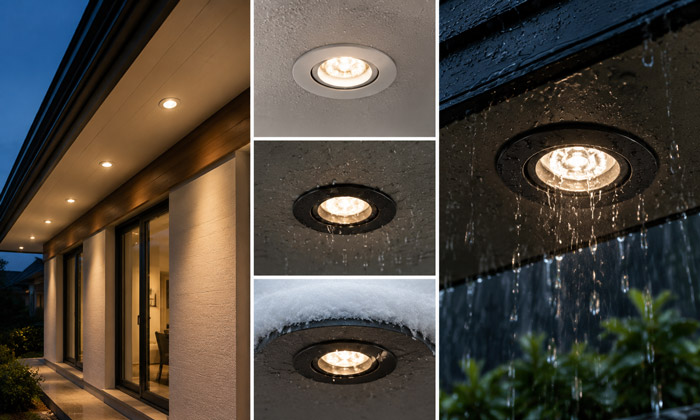
Exterior soffit lights must be selected according to their exposure to water and weather.
A damp-location-rated fixture is generally suitable for covered areas that may experience humidity, condensation, or occasional moisture but are not directly exposed to rain.
A wet-location-rated fixture is designed for areas where rain, wind-driven water, or direct water contact may occur. This rating is often the safer choice for exposed soffits and coastal or storm-prone environments.
Ingress Protection ratings may also be provided. An IP rating indicates how effectively the fixture resists solids and moisture. For example, an IP65-rated fixture is dust-tight and protected against water jets.
The correct rating depends on the soffit’s position, the local climate, and the amount of protection provided by the roof or overhang.
Surface-mounted exterior soffit lighting can be controlled in several ways.
A standard wall switch provides direct manual control. Timers turn the lights on and off according to a programmed schedule. Photocells detect ambient light and activate the fixtures after sunset. Motion sensors switch the lights on when movement is detected within a specified area.
Smart controls can connect the fixtures to a mobile application, home automation platform, or voice assistant. Depending on the system, users may adjust brightness, create schedules, group multiple lights, or monitor energy use.
For automatic operation, the sensor should be positioned where walls, rooflines, reflections, or nearby lights will not interfere with detection.
Soheilian, M., Fischl, G., & Aries, M. (2021). Smart lighting application for energy saving and user well-being in the residential environment. Sustainability, 13(11), 6198.
Light Output and Beam Placement
The effectiveness of soffit lighting depends on more than the fixture’s wattage. Important factors include lumen output, beam angle, color temperature, spacing, mounting height, and surface reflectivity.
Wide-beam fixtures spread light across larger areas and are useful for general illumination. Narrow-beam fixtures create concentrated pools of light and are better for highlighting architectural details.
Warm white light, often around 2700K to 3000K, creates a comfortable residential appearance. Neutral white light around 3500K to 4000K produces a clearer, more functional effect. Higher color temperatures can appear brighter but may feel harsh in residential settings.
Zhang, C., Xiao, L., Zhong, P., & He, G. (2018). Photometric optimization and comparison of hybrid white LEDs for mesopic road lighting. Applied Optics, 57(16), 4665–4671.
Fixtures should be spaced evenly to avoid dark gaps, excessive overlap, or visible bright spots. Proper placement also reduces glare through windows and prevents unwanted light from reaching neighboring properties.
Advantages of Surface Mount Soffit Lighting
Surface-mounted soffit lights are especially useful where installation depth is limited. They require less space than recessed housings and may reduce the amount of cutting or structural modification needed.
Other advantages include:
- Suitable for shallow or solid soffits
- Easier access for maintenance
- Compatibility with many architectural styles
- Effective illumination for doors and pathways
- Availability of weather-resistant LED models
- Support for sensors and smart controls
- Lower energy consumption when using LEDs
Because the fixture is visible, it can also serve as an intentional architectural element rather than only a hidden light source.
Sperber, A. N., Elmore, A. C., Crow, M. L., & Cawlfield, J. D. (2012). Performance evaluation of energy efficient lighting associated with renewable energy applications. Renewable Energy, 44, 423–430.
Exterior lighting should be installed in accordance with local electrical codes and the fixture manufacturer’s instructions. The mounting surface must be strong enough to support the fixture, and all electrical connections should be enclosed in an approved junction box.
Exterior wiring connections must be protected from moisture. Gaskets, seals, and cable entries should be installed correctly to prevent water from entering the fixture or electrical box.
The installer should also confirm that the circuit can support the total electrical load and that compatible controls are used. Dimmable LED fixtures, for example, require an appropriate LED-compatible dimmer.
For hardwired installations, a qualified electrician is generally recommended. Improper wiring, sealing, or grounding can create electrical, fire, and water-damage risks.
LED surface mount soffit lights generally require limited maintenance. Their lenses should be cleaned periodically to remove dirt, insects, salt deposits, and other debris that may reduce light output.
Fixtures should also be inspected for:
- Loose mounting hardware
- Damaged seals or gaskets
- Corrosion
- Cracked lenses
- Moisture inside the housing
- Flickering or reduced brightness
If an integrated LED fixture fails, the complete unit may need to be replaced. Fixtures with replaceable lamps allow only the bulb to be changed, but the replacement lamp must match the fixture’s size, wattage, and outdoor-use requirements.
Surface mount exterior soffit lighting is a practical outdoor lighting solution in which fixtures are attached directly to the underside of an overhang or exterior ceiling. It operates through a wired electrical circuit and may be controlled manually or automatically using switches, sensors, timers, or smart systems.
Its low installation-depth requirement makes it particularly valuable for shallow soffits and renovation projects where recessed lighting is not suitable. When properly selected, positioned, sealed, and installed, surface mount soffit lighting can provide reliable illumination, improve safety, and enhance the exterior design of a building.
Can surface mount soffit lights be installed on vinyl or aluminum soffits?
Yes, but the fixture must be supported by a secure junction box or structural backing rather than the thin soffit panel alone.
Mounting directly onto unsupported vinyl or aluminum may cause sagging, vibration, or damage as the material expands and contracts.
Will soffit lighting interfere with attic ventilation?
It can if fixtures are installed over ventilation openings or block airflow through perforated soffit panels.
Lights should be positioned between vents, and wiring or mounting components must not restrict the intake airflow required by the roof ventilation system.
Are low-voltage surface mount soffit lights available?
Yes. Some systems operate on 12-volt or 24-volt power supplied through a compatible transformer or LED driver.
Low-voltage fixtures can simplify zoning and landscape-lighting integration, but cable size, voltage drop, transformer capacity, and fixture compatibility must be calculated correctly.
How can exterior soffit lights attract fewer insects?
Choose LEDs with a warm color temperature and lower blue-light output. Amber or warm-white fixtures generally attract fewer insects than cool-white lamps.
Avoid excessive brightness and position fixtures away from frequently opened doors and windows.
Why do surface mount soffit lights flicker?
Common causes include an incompatible dimmer, a failing LED driver, loose wiring, voltage fluctuations, moisture intrusion, or overloaded controls.
Confirm that every fixture, driver, dimmer, sensor, and transformer is electrically compatible before replacing the light.
