
Understanding Landscape Lighting Evergreen
Why Evergreen Plants Work Well With Landscape Lighting
Common Landscape Lighting Techniques for Evergreens
Choosing Fixtures for Evergreen Landscape Lighting
Selecting the Right Light Intensity
Light Color for Evergreen Landscapes
Fixture Placement Around Evergreen Trees
Avoiding Overlighting
Seasonal Considerations
Energy Efficiency
Safety and Functionality
Designing a Balanced Evergreen Lighting Plan
FAQs
Landscape lighting evergreen refers to a landscape lighting approach designed to provide attractive, functional, and visually consistent outdoor illumination throughout the year. The idea combines professional outdoor lighting with evergreen landscape features such as conifer trees, evergreen shrubs, hedges, and other plants that retain their foliage across seasons.
Because evergreen plants maintain their shape and color even during winter, they are especially valuable in landscape lighting design. Properly placed lights can emphasize their texture, height, structure, and depth after dark while improving the safety and usability of the surrounding outdoor space.
Understanding Landscape Lighting Evergreen
Landscape lighting evergreen is not a single type of fixture. Instead, it describes a lighting strategy centered on year-round landscape appeal.
Unlike seasonal plants that may lose leaves or disappear during colder months, evergreen plants remain prominent in the landscape. This makes them reliable focal points for outdoor lighting. A well-designed lighting system can illuminate these plants continuously while maintaining a balanced appearance regardless of the season.
Common evergreen features used in landscape lighting include:
- Pine, cedar, fir, and spruce trees
- Arborvitae and cypress
- Boxwood shrubs
- Holly
- Juniper
- Evergreen hedges
- Foundation shrubs
- Evergreen groundcovers
Lighting these plants can create strong vertical elements, highlight architectural landscaping, and give a property greater visual depth at night.
Why Evergreen Plants Work Well With Landscape Lighting
Evergreen plants provide consistent structure. Their foliage creates surfaces that interact effectively with artificial light, producing shadows, highlights, and texture.
Tall evergreen trees can become dramatic nighttime focal points when illuminated from below. Dense shrubs can create soft layers of reflected light, while evergreen hedges can help define pathways, property boundaries, and outdoor living areas.
Evergreens are also useful during winter, when deciduous plants may have little foliage. Lighting them helps prevent a landscape from looking empty after sunset during colder months.
| Evergreen Feature | Recommended Lighting Technique | Main Effect |
|---|---|---|
| Tall evergreen trees | Uplighting | Emphasizes height and structure |
| Dense shrubs | Soft uplighting | Reveals foliage and texture |
| Evergreen hedges | Grazing or directional lighting | Defines boundaries |
| Small ornamental evergreens | Accent lighting | Creates focal points |
| Evergreen-lined paths | Path lighting | Improves visibility and safety |
| Evergreens near walls | Shadow lighting | Creates decorative silhouettes |
| Large specimen trees | Cross-lighting | Adds depth from multiple angles |
Common Landscape Lighting Techniques for Evergreens
Uplighting
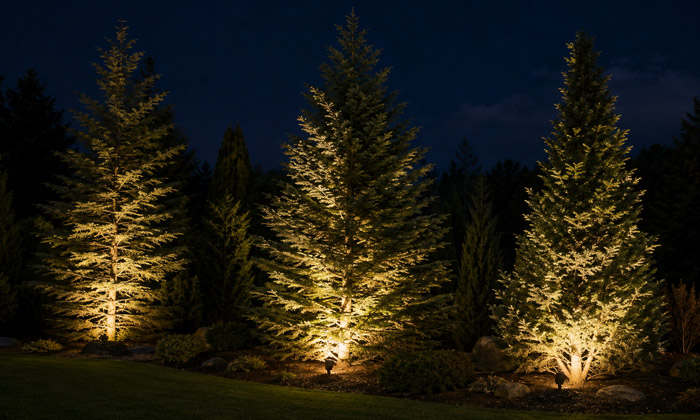
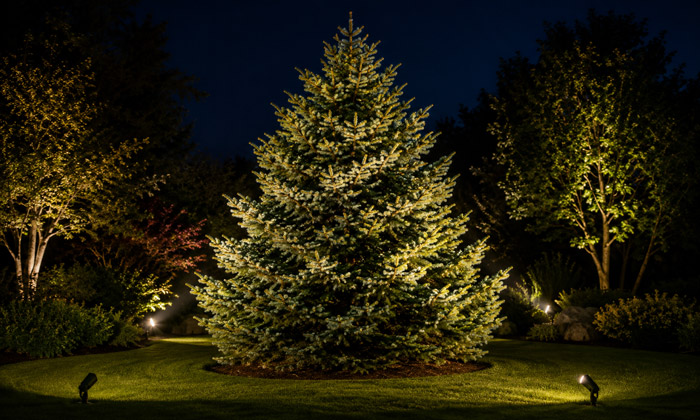
Uplighting is one of the most effective methods for illuminating evergreen trees . A fixture is installed near the base of the plant and aimed upward through the branches.
This technique emphasizes height while creating dramatic shadows within dense foliage. It works particularly well for mature pine, spruce, cedar, and cypress trees.
The fixture should not always point directly at the center of the tree. Slightly offsetting the beam can create a more natural appearance and reveal more texture.
Cross-Lighting
Cross-lighting uses two or more fixtures aimed at the same evergreen from different directions.
It is useful for large specimen trees because a single light source may illuminate only one side. Multiple carefully positioned fixtures create greater depth and allow the tree to remain visually interesting from several viewing angles.
Grazing
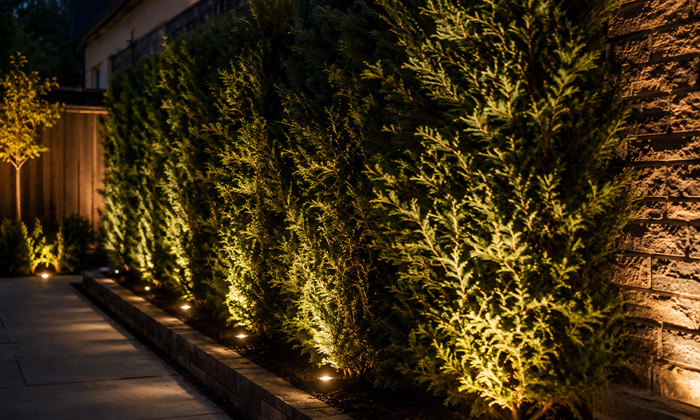
Grazing places light close to a textured surface and directs the beam across it.
When used with evergreen hedges or dense shrubs, grazing can emphasize irregular foliage, branch structure, and natural texture. It is especially effective when evergreens grow close to walls, fences, or architectural features.

Silhouetting
Silhouetting places a light source behind the plant and directs it toward a nearby surface.
The illuminated background creates a dark outline of the evergreen in front of it. This works particularly well with plants that have distinctive forms, such as narrow cypress trees or carefully shaped ornamental shrubs.
Shadow Lighting
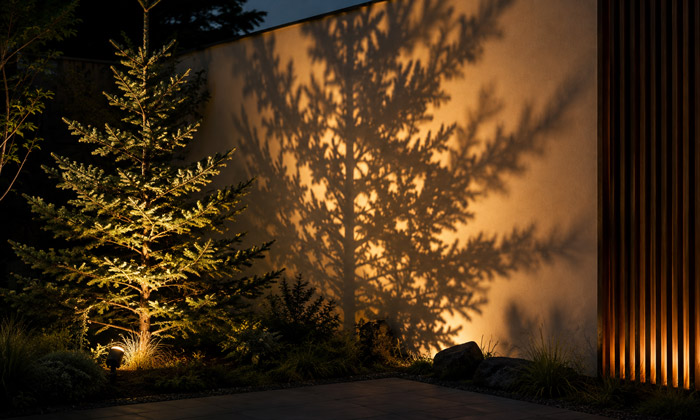
Shadow lighting directs light toward an evergreen so that its branches cast shadows onto a wall, fence, or other surface.
The result can be more decorative than lighting the plant itself. Plants with interesting branch patterns tend to produce the strongest effects.
Choosing Fixtures for Evergreen Landscape Lighting
Fixture selection affects both appearance and long-term performance.
Outdoor landscape fixtures should be designed to tolerate moisture, temperature changes, soil exposure, and other environmental conditions. Materials such as brass, copper, stainless steel, and durable coated aluminum are commonly used.
Different fixtures serve different purposes.
Spotlights provide concentrated beams suitable for tall trees and focal points.
Floodlights distribute light across wider areas and can illuminate large shrubs or groups of plants.
Well lights are installed partially or completely below ground, allowing them to illuminate trees while remaining visually unobtrusive.
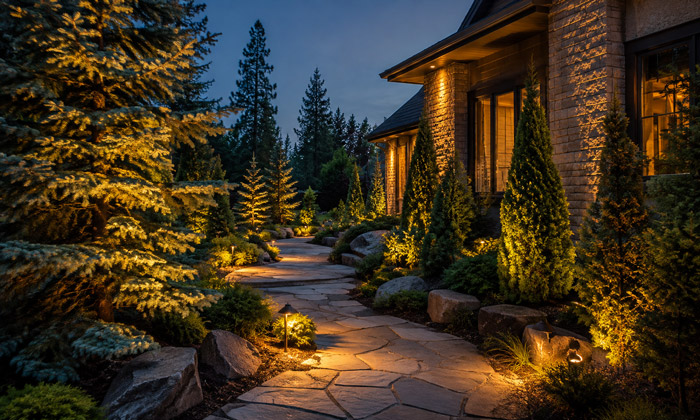
Path lights provide downward illumination around walkways bordered by evergreen plants.
For most residential installations, low-voltage landscape lighting is commonly used because it allows flexible fixture placement and relatively efficient operation.
Selecting the Right Light Intensity
More light does not necessarily produce a better landscape.
Evergreen foliage can be dense and reflective, so excessive brightness may create harsh highlights while hiding natural texture. The goal should usually be controlled illumination rather than flooding the entire plant with light.
Smaller shrubs generally require lower-output fixtures, while tall trees may need stronger or narrower beams capable of reaching upper branches.
Beam angle is equally important.
A narrow beam concentrates light on tall vertical plants, while a wider beam spreads illumination across broad shrubs or hedges.
Using different beam spreads throughout the landscape helps create visual layers instead of producing uniform brightness.
Light Color for Evergreen Landscapes
Color temperature influences how evergreen foliage appears after dark.
Warm white lighting often creates a softer and more natural residential atmosphere. It can emphasize the rich green tones of shrubs while complementing stone, brick, wood, and warm-colored architecture.
Cooler lighting can create a sharper appearance, but excessive cool light may make some landscapes feel less natural.
Consistency is important. Using dramatically different color temperatures within the same small landscape can make the lighting design appear disconnected unless the contrast is intentional.
Fixture Placement Around Evergreen Trees
Correct placement prevents glare while improving visual impact.
Fixtures should generally be positioned so that the light source itself is not the main thing people notice. Instead, viewers should notice the illuminated landscape.
For a tall evergreen, a fixture may be placed near the trunk and angled upward. Larger trees may require several fixtures positioned around the canopy.
For shrubs, lights can be positioned slightly away from the plant to allow the beam to spread across the foliage.
Designers should also consider how plants grow. A fixture installed too close to a young evergreen may eventually become blocked by expanding branches.
Avoiding Overlighting
One of the most common landscape lighting mistakes is illuminating every plant equally.
Good landscape lighting depends on contrast. Some plants should receive stronger accent lighting, others should remain softly illuminated, and some areas should remain relatively dark.
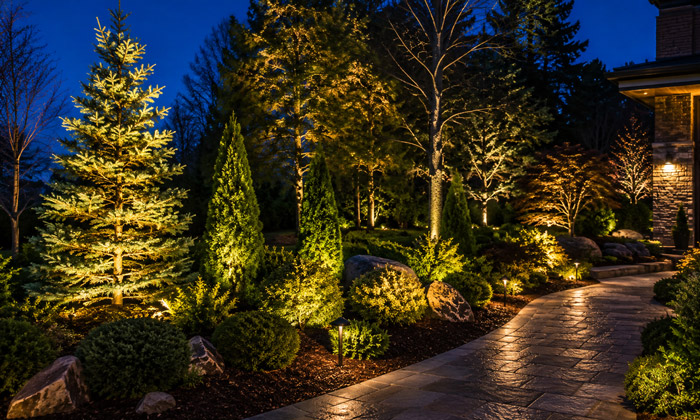
For example, a large evergreen specimen tree can serve as a primary focal point while nearby shrubs receive much lower illumination. This creates depth and directs attention naturally through the landscape.
Overlighting can eliminate shadows and make the property appear flat.
Seasonal Considerations
Although evergreens maintain foliage throughout the year, their lighting requirements can still change.
Snow can reflect significant amounts of light, making winter landscapes appear brighter. Plants may also grow enough during spring and summer to block previously well-positioned fixtures.
Seasonal maintenance should therefore include checking:
- Fixture alignment
- Plant growth around lights
- Accumulated leaves or debris
- Exposed wiring
- Lens cleanliness
- Timer settings
- Damaged fixtures
- Changes in landscaping
Small adjustments can preserve the original lighting effect as the landscape develops.
Energy Efficiency
Energy-efficient lighting is especially important for systems that operate every night.
LED landscape fixtures are widely used because they consume relatively little electricity while providing long operating life. They are available in different brightness levels, beam spreads, and color temperatures, making them suitable for both large evergreen trees and smaller shrubs.
Timers, photocells, and smart lighting controls can further reduce unnecessary operation. A system may automatically turn on after sunset and shut off later at night rather than remaining illuminated until morning.
Safety and Functionality
Landscape lighting evergreen can contribute to more than visual appearance.
Evergreen shrubs frequently grow near walkways, stairs, entrances, driveways, and property boundaries. Lighting these areas can make changes in elevation and potential obstacles easier to see.
However, fixtures should be aimed carefully to prevent glare. A powerful spotlight directed toward windows, neighboring properties, pedestrians, or drivers can create discomfort and reduce visibility rather than improve it.
Functional lighting and decorative lighting should therefore be planned together.
Designing a Balanced Evergreen Lighting Plan
An effective design usually begins by identifying the most important evergreen features in the landscape.
A large specimen tree may become the dominant nighttime focal point. Smaller shrubs can support it with softer illumination, while path lights provide functional lighting at ground level.
A balanced plan often uses several layers:
- Primary lighting highlights major evergreen trees or focal points.
- Secondary lighting illuminates shrubs, hedges, or architectural landscaping.
- Functional lighting improves visibility around walkways and entrances.
- Background lighting provides depth without competing with the main focal points.
This layered approach makes the landscape appear more natural and visually organized.
FAQs
How much does professional evergreen landscape lighting cost?
The cost varies based on fixture quality, property size, wiring requirements, transformer capacity, and installation complexity.
Professional systems generally cost more upfront but often provide better durability, electrical reliability, and long-term lighting consistency.
Can landscape lighting damage evergreen trees or roots?
Properly installed landscape lighting should not damage evergreen trees.
Installers should avoid cutting major roots, placing hot fixtures against foliage, or positioning underground wiring where future root growth could create problems.
How do you hide landscape lighting wires around evergreen beds?
Low-voltage cables are typically buried shallowly beneath soil or mulch and routed along planting beds whenever possible.
Careful cable planning keeps wiring hidden while maintaining access for future repairs, fixture additions, or landscape changes.
Should landscape lighting be installed before or after new landscaping?
Lighting infrastructure is often easiest to install during landscape construction because cables, transformers, and fixture locations can be coordinated before planting is completed.
Existing landscapes can also be retrofitted with minimal disruption when installation is properly planned.
Does evergreen landscape lighting increase property value?
A professionally designed lighting system can improve nighttime curb appeal, highlight premium landscaping, and make outdoor areas more usable.
While the exact effect on property value varies by market, quality exterior lighting can strengthen the overall presentation of a home.
