

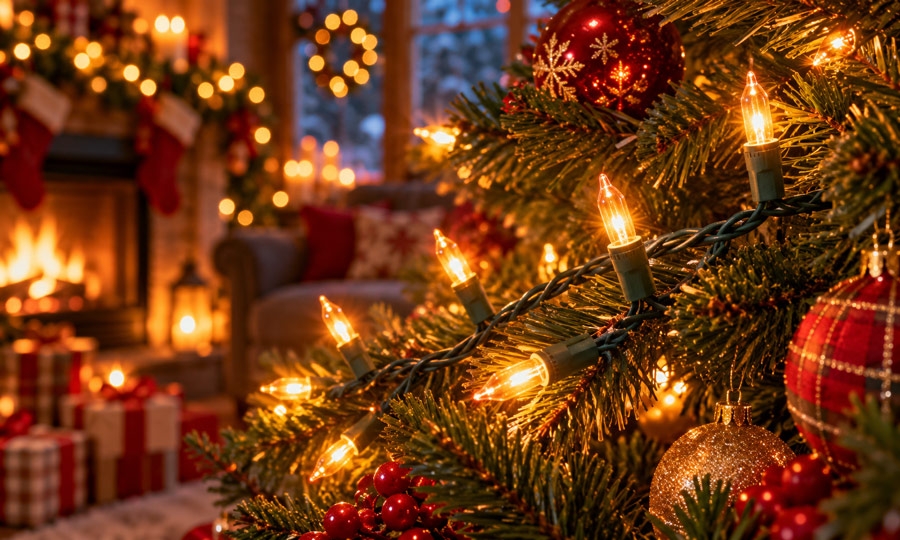
How Do Incandescent Christmas Lights Work?
Why Do Incandescent Christmas Lights Look Warm?
Common Types of Incandescent Christmas Lights
Incandescent vs. LED Christmas Lights
How Much Electricity Do Incandescent Christmas Lights Use?
Can Incandescent Christmas Lights Be Used Outdoors?
How to Use Incandescent Christmas Lights Safely
Are Incandescent Christmas Lights Right for Your Display?
FAQs
Incandescent Christmas lights are decorative lights that produce illumination by passing electricity through a thin metal filament until it glows. They are the traditional glass-bulb lights associated with warm Christmas trees, colorful window displays, and classic holiday rooflines.
Their appeal is easy to understand: clear bulbs give off a warm glow, while colored bulbs create the familiar look of traditional Christmas decorations. The trade-offs are higher electricity consumption, greater heat output, and more frequent bulb replacement than comparable LED lights.
How Do Incandescent Christmas Lights Work?
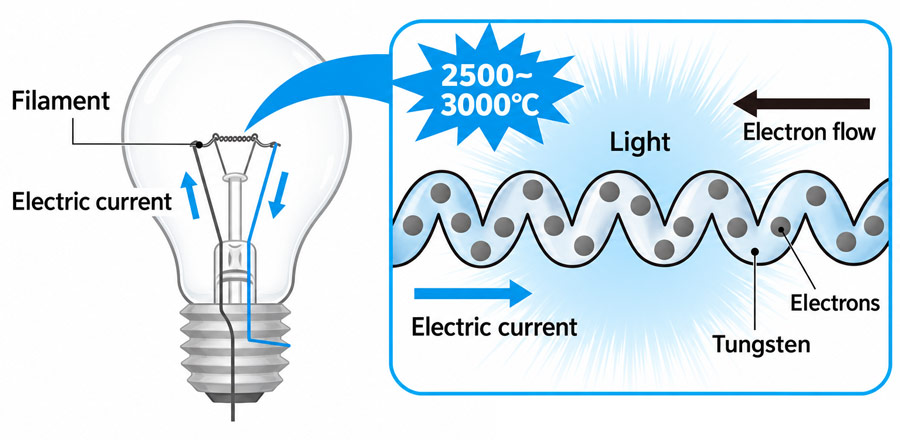
Inside each bulb, a fine filament heats up when electricity flows through it. Once hot enough, it emits visible light. The glass enclosure protects the filament.
Producing light this way also produces considerable heat. That is why incandescent Christmas lights become warm during use, with larger bulbs potentially becoming hot to the touch. LEDs use a semiconductor to produce light and require much less electricity for comparable decorative lighting.
The word “incandescent” describes the lighting technology, rather than a particular shape or color. Mini lights, larger pointed bulbs, and some specialty decorations can all use incandescent bulbs.
Why Do Incandescent Christmas Lights Look Warm?
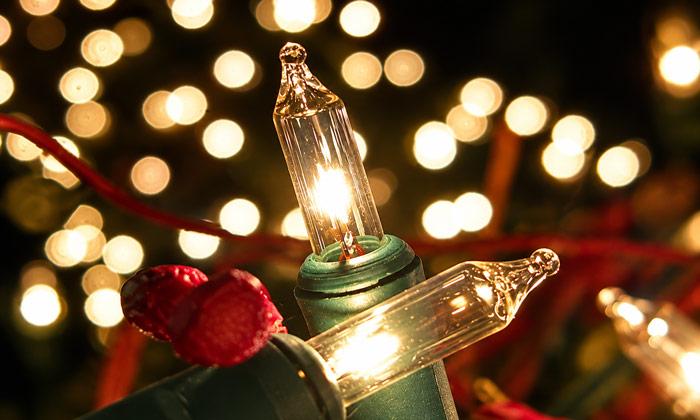
The heated filament naturally produces a warm-looking light. With clear glass bulbs, this gives decorations a gentle golden tone that many people associate with traditional Christmas displays.
Incandescent light color temperature helps explain this appearance. However, the exact look varies with the bulb’s design, operating conditions, and glass finish.
Colored incandescent bulbs use tinted glass or coatings to filter the light. Transparent finishes reveal a brighter point of light inside the bulb, while opaque finishes spread the light across the bulb’s surface for a softer appearance.
When choosing lights, consider both the color and the finish. Two red bulbs can create noticeably different effects if one is transparent and the other is opaque.
Common Types of Incandescent Christmas Lights
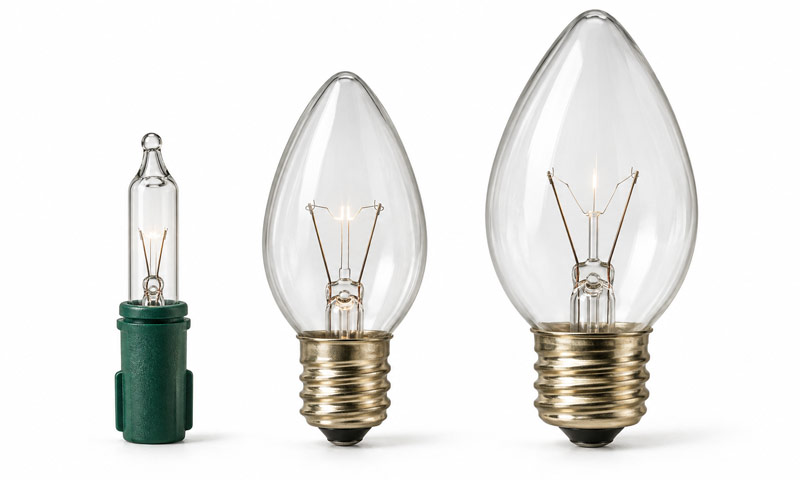
The most familiar choices are miniature lights and larger C7 or C9 bulbs.
| Type | Appearance | Common decorative uses | What to check |
|---|---|---|---|
| Mini lights | Small bulbs that create closely spaced points of light | Christmas trees, wreaths, and smaller decorations | Replacement-bulb specifications and total set wattage |
| C7 bulbs | Smaller traditional pointed bulbs | Windows, doorway outlines, and decorative borders | Screw-in versions commonly use an E12 base |
| C9 bulbs | Larger traditional pointed bulbs | Rooflines and displays viewed from farther away | Screw-in versions commonly use an E17 base |
For traditional screw-in products, 5-watt C7 and 7-watt C9 bulbs are common examples, but wattage varies. Always read the actual product label. C7 and C9 bases are not interchangeable.
Bulb shape alone does not identify the technology. LED products are also available in familiar Christmas-light shapes, so check whether the packaging says “incandescent” or “LED.”
Incandescent vs. LED Christmas Lights
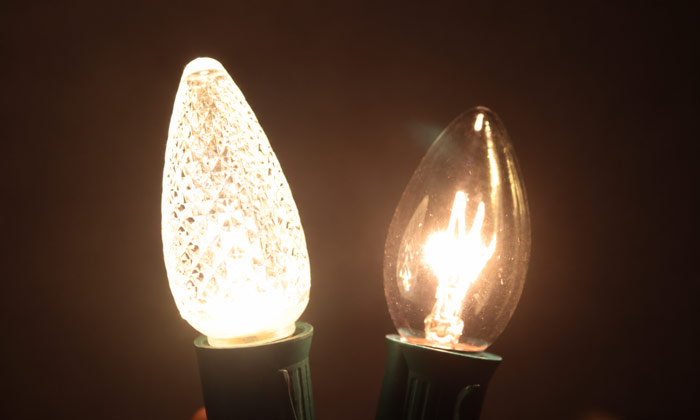
Both technologies can create an attractive holiday display. The practical differences become more noticeable as the number of lights and operating hours increase.
| Feature | Incandescent Christmas lights | LED Christmas lights |
|---|---|---|
| Light production | A heated filament | A semiconductor |
| Appearance | Naturally warm clear light; traditional colored-glass effects | Available in warm white, cool white, and many colors |
| Electricity use | Higher for a comparable display | Generally much lower |
| Heat | Bulbs become warm or hot | Generally much cooler |
| Purchase price | Often lower for basic sets | Varies; some sets cost more initially |
| Service life | Filaments burn out and need replacement | Typically longer, although wiring and other components can still fail |
| Handling | Glass bulbs require careful handling | Many sets use durable plastic lenses |
These differences make incandescent lights appealing for a modest display where the traditional appearance is the priority. LEDs are generally more practical for extensive decorations or long daily operating schedules.
Warm-white LEDs are also worth considering if you prefer a golden appearance. Compare a small sample in the intended setting before buying enough lights for the entire display.
How Much Electricity Do Incandescent Christmas Lights Use?
Electricity consumption depends on the total wattage and how long the lights stay on. Bulb count alone is not enough: 100 miniature bulbs can use a very different amount of power from 100 large screw-in bulbs.
The wattage of a light bulb indicates its electrical power consumption. For a complete light string, use the total wattage printed on its label.
Calculate the running cost with this formula:
Running cost = total watts ÷ 1,000 × operating hours × electricity price per kWh
For an illustrative comparison, assume the lights operate for six hours each evening over 30 days, with electricity costing $0.20 per kWh:
| Example display | Total power | Electricity over 30 days | Estimated cost |
|---|---|---|---|
| One light set rated at 40 W | 40 W | 7.2 kWh | $1.44 |
| Five sets rated at 40 W each | 200 W | 36 kWh | $7.20 |
| Twenty-five bulbs rated at 7 W each | 175 W | 31.5 kWh | $6.30 |
These are calculated examples, not universal product ratings or electricity prices. Substitute your own label information and utility rate.
The calculation also shows why display size matters. A single strand may cost little to operate, while multiple high-wattage strings can create a much larger seasonal load.
Can Incandescent Christmas Lights Be Used Outdoors?
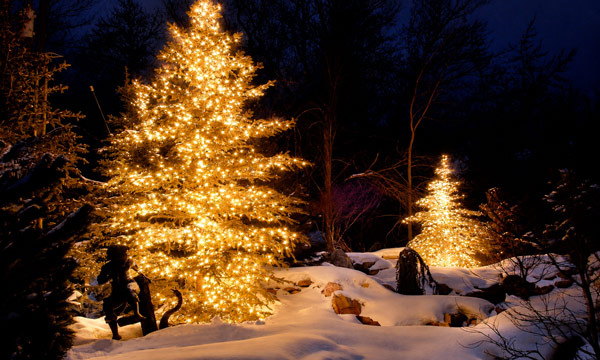
Yes, provided the complete light set is specifically rated for outdoor use. Incandescent technology itself does not make a product suitable for rain, snow, or exposed locations.
Before installation:
- Confirm that the lights and extension cords are suitable for outdoor use.
- Check for frayed insulation, loose connections, and broken sockets.
- Use a ground-fault circuit interrupter, or GFCI, protected outdoor outlet.
- Follow the manufacturer’s connection limits.
- Route cords where doors cannot pinch them and people will not trip over them.
An indoor-only set should remain indoors, even if its bulbs resemble those on an outdoor set.
How to Use Incandescent Christmas Lights Safely
Heat and electrical load deserve particular attention when using incandescent decorations.
Keep hot bulbs away from paper, fabric, and dry greenery. Avoid covering bulbs or trapping them inside tightly packed decorations. If you decorate a real tree, keep it watered and remove it when it becomes dry.
Inspect the entire set before each season. Replace damaged strings, and use only manufacturer-specified replacement bulbs. Unplug the lights before changing bulbs or performing maintenance.
Turn the lights off before going to bed or leaving home. Secure strings with suitable supports that do not damage the wiring.
There is no universal number of strings that can safely connect end to end. Follow the set’s stated maximum, and account for the ratings of extension cords, timers, and the electrical circuit. Spare circuit capacity does not override a light string’s connection limit.
Are Incandescent Christmas Lights Right for Your Display?
Incandescent lights are worth considering when you want to match an existing traditional display or prefer the appearance of glowing filaments behind glass.
Before choosing a set, check:
- Viewing distance: Small bulbs suit close-up detail, while larger bulbs make individual points of light more visible from farther away.
- Lighted length: Measure the illuminated section, rather than relying only on the total cord length.
- Bulb spacing: Closer spacing creates a denser appearance.
- Location rating: Match the set to the installation environment.
- Power requirements: Add up the wattage of the complete display.
- Replacement availability: Check that correctly specified spare bulbs are available.
Incandescent Christmas lights offer a distinctive traditional appearance. The best choice depends on how much you value that look alongside power consumption, heat, and ongoing maintenance.
FAQs
1. Why Does Half of My Incandescent Christmas Light String Stop Working?
Many miniature light strings contain separate series-connected sections. A loose bulb, damaged connection, or failed internal bypass can interrupt one section while another section continues operating.
Some miniature bulbs include a shunt that allows current to continue flowing when the filament fails. If this bypass does not function correctly, part of the string may go dark. Unplug the lights before inspecting bulbs and follow the manufacturer’s troubleshooting guidance.
2. Can I Replace Incandescent Christmas Light Bulbs With LED Bulbs?
Do not install ordinary LED replacement mini bulbs into an incandescent miniature string unless the product specifically supports that conversion. The electrical requirements may differ even when the bulbs appear physically compatible.
Some C7 and C9 socket strings may accept compatible screw-in LED bulbs. Check the base type, voltage, string specifications, and controller compatibility before replacing bulbs. For many miniature sets, replacing the entire string is the simplest upgrade option.
3. Are Incandescent Christmas Lights Dimmable?
Traditional incandescent Christmas lights are generally dimmable, but the complete lighting system must be compatible with the selected dimmer. Strings with built-in controllers or special effects may have additional limitations.
Use a dimmer rated for incandescent loads and capable of handling the total wattage. Outdoor displays also require controls and connections designed for outdoor conditions.
4. Does a Replacement Miniature Bulb Only Need to Fit the Socket?
No. A physical fit does not confirm electrical compatibility. Replacement bulbs should match the required voltage, wattage or current rating, and base specification of the original set.
Using an incorrectly rated bulb can affect performance or cause problems with the remaining lights. Do not assume spare bulbs from another string will work just because they look the same.
5. Why Do Some Incandescent Christmas Bulbs Blink Without a Controller?
Some decorative twinkle bulbs contain a heat-sensitive metal strip that expands and contracts as the bulb temperature changes. This repeatedly opens and closes the circuit, creating a blinking effect.
This behavior is intentional for specialty bulbs. If a string designed for steady illumination begins flickering unexpectedly, inspect the bulbs, connections, and power supply rather than assuming it is a normal feature.
