
Give Every Installer the Same Project Brief
Compare Coverage Before Fixture Counts
Use a Consistent Quote Comparison Checklist
Check the Equipment Behind the Description
Review Wiring and Installation Assumptions
Adjust Prices to Match the Same Scope
Verify the People Who Will Complete the Work
Separate Product Warranties from Service Coverage
Define Completion Before Accepting the Quote
Make the Final Decision on Documented Value
FAQs
Receiving several outdoor lighting quotes should make your decision easier. Yet one proposal may list individual fixtures, another may offer a complete lighting package, and a third may show little more than a total price.
The most effective way to evaluate quotes from multiple outdoor lighting installers is to compare the same lighting goals, installation scope, equipment specifications, and service commitments. Then ask each installer to price any missing work before deciding which proposal offers the best value.
A lower quote can be a good choice. First, you need to understand exactly what it buys.
Give Every Installer the Same Project Brief
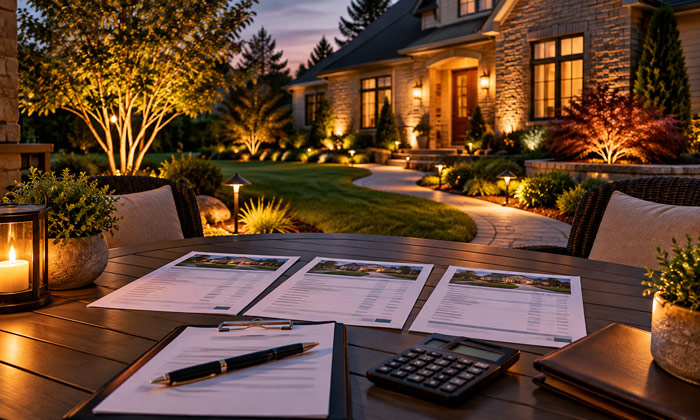
Start with three detailed proposals based on a consistent brief. Tell each installer which areas you want illuminated, how you use those spaces, and what you want the lighting to achieve.
For example, your priorities might include a clearly visible front walkway, subtle lighting on two mature trees, and comfortable illumination around a patio. Identify essential areas separately from optional decorative features.
Provide the same information to everyone:
- Areas and features to include.
- Preferred appearance and brightness.
- Existing lighting and available power locations.
- Budget range and desired completion date.
- Access restrictions and landscaping that needs protection.
A basic landscape lighting design helps keep these conversations focused. Ask installers to explain alternative designs separately so you can distinguish a different creative approach from a different price for the same work.
Whenever practical, have each shortlisted installer inspect the property before issuing a final proposal.
Compare Coverage Before Fixture Counts
Two quotes offering 20 lights may describe very different results.
One installer might allocate most fixtures to the front facade. Another might spread them across pathways, planting beds, and outdoor seating. Even when the totals match, the coverage may not.
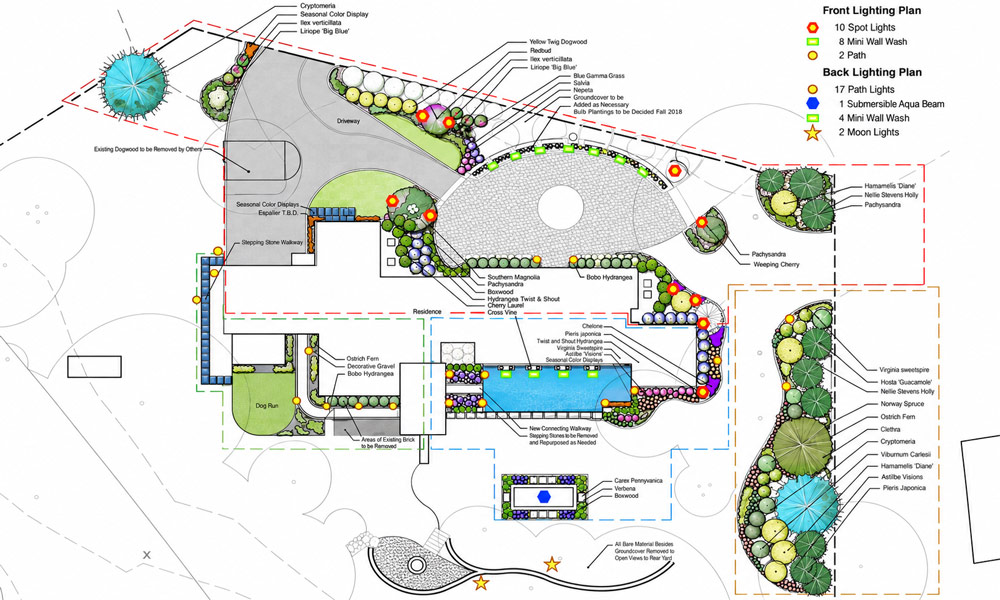
Request a marked property plan or annotated photographs showing fixture locations and intended lighting effects. For each area, ask:
- What will be illuminated?
- Where will the fixtures be installed?
- What will remain intentionally dark?
- How will the design limit glare from normal viewing positions?
A proposal with fewer fixtures may still meet your goals if the placement and light distribution work well. Equally, a low fixture count may leave requested areas unfinished. The installer should explain the design clearly enough for you to tell the difference.
Use a Consistent Quote Comparison Checklist
Create one comparison table and record what each installer has committed to in writing.
| Comparison item | Details to request |
|---|---|
| Lighting layout | Included areas, fixture positions, and intended effects |
| Fixtures | Quantities, model numbers, materials, finishes, and product specifications |
| Power equipment | Transformer or power supply, location, and proposed connected load |
| Wiring | Cable specification, routing assumptions, and connection method |
| Installation | Trenching, mounting, hardscape crossings, and access equipment |
| Electrical work | Existing power assumptions and any separately priced work |
| Controls | Included hardware, programming, and homeowner setup |
| Site restoration | Treatment of disturbed lawn, planting beds, and paving |
| Completion | Testing, nighttime adjustment, and handover documents |
| Warranty | Separate product and workmanship terms |
| Price | Included charges, exclusions, allowances, and optional upgrades |
| Schedule | Expected start, duration, and conditions that could cause delays |
Mark unclear items as “not specified.” An empty line is a question to resolve, not proof that the work is included.
An installer can use package pricing and still provide a clear scope. What matters is whether you can identify the deliverables and understand the cost of requested changes.
Check the Equipment Behind the Description
Terms such as “premium fixtures” or “professional lighting package” do not provide enough information for a meaningful comparison.
Ask for product specifications that identify light output, beam angle, color temperature, housing material, and suitability for the proposed installation location. Also establish whether a failed light source can be replaced separately or whether the whole fixture may need replacement.
Use those details to ask practical questions:
“Why is this fixture appropriate for this tree?”
“What makes this housing suitable for the conditions in this planting bed?”
“How will the selected beam avoid shining into the seating area?”
The goal is to understand why the equipment suits your property. An expensive fixture does not automatically justify a higher quote, and an economical fixture should not be dismissed without reviewing its specifications and application.
Ask the installer to obtain your approval before substituting equipment after you accept the proposal.
Review Wiring and Installation Assumptions
The visible fixtures represent only part of the work. Ask how the installer has allowed for cable routes, connections, mounting, and access.

For a low-voltage system, request an explanation of how the proposed cable size and transformer arrangement suit the load and distance of each run. A landscape lighting wire size guide can help you understand the terminology and ask more precise questions.
You do not need to design the electrical system yourself. You need the installer to explain the assumptions behind the quote.
Pay particular attention to difficult sections of the property. A cable crossing beneath an existing walkway, fixtures mounted high in trees, or work beside established planting may need a different installation approach.
Clarify who is responsible for identifying underground services, protecting irrigation, and restoring disturbed surfaces. If new electrical supply work is needed, ask who will perform it and whether its price is included. Confirm applicable licensing and permit requirements with the relevant local authority.
Adjust Prices to Match the Same Scope
A broad guide to the cost to install landscape lighting can help you understand cost categories. Your actual comparison should rely on written prices for your property.
Use this calculation:
Comparable project price = quoted price + required omitted work + selected options needed to meet your brief.
Ask installers to price the omissions. Avoid filling the gaps with optimistic guesses.
Consider this hypothetical example, using illustrative dollar amounts rather than market estimates:
| Item | Installer A | Installer B | Installer C |
|---|---|---|---|
| Initial quote | $3,800 | $4,500 | $4,150 |
| Required electrical work | $450 extra | Included | $350 extra |
| Required surface restoration | $300 extra | Included | $250 extra |
| Agreed nighttime adjustment | $150 extra | Included | Included |
| Comparable project price | $4,700 | $4,500 | $4,750 |
Installer A initially appears cheapest. Once the same required work is included, Installer B has the lowest comparable price.
That still does not establish a winner. You must also compare design, equipment, workmanship, and service. The calculation simply makes the financial comparison fairer.
Treat allowances carefully. If a quote includes a provisional amount for difficult ground conditions, ask what happens when the actual cost exceeds that amount.
Verify the People Who Will Complete the Work
Evaluate the installer’s relevant experience alongside the proposal.
Ask to see completed projects with conditions similar to yours. A company experienced in roofline installations may have a different portfolio from one specializing in garden paths, mature trees, and architectural accents.
Request recent references and ask useful questions:
“Did the final invoice match the agreed scope?”
“How did the company handle adjustments?”
“Was the property left in the expected condition?”
“How responsive were they after payment?”
Confirm who will supervise the project and whether subcontractors will perform any part of it. Request evidence of appropriate insurance and any credentials required for the proposed work.
The quality of the quotation process also provides useful evidence. Clear answers, documented revisions, and realistic scheduling make the proposal easier to evaluate.
Separate Product Warranties from Service Coverage
A long warranty headline does not tell you what a repair will cost.
Request the actual terms and distinguish between coverage for fixtures, power equipment, controls, and installation workmanship. Ask who handles a claim and whether diagnosis, travel, removal, and replacement labor are covered.
A useful question is:
“If one fixture stops working after two years, what would I pay to have the system working again?”
Also ask about routine maintenance pricing and the availability of replacement components. Record known service charges separately from the installation price so you can compare ongoing commitments without treating uncertain repair costs as guaranteed expenses.
Define Completion Before Accepting the Quote
Agree on what a completed project includes.
For outdoor lighting, a daytime check alone cannot show the finished nighttime appearance. Request an after-dark review or adjustment visit, with its timing and scope included in the proposal.
Your acceptance checklist can cover:
- The agreed areas receive the intended illumination.
- Fixtures are aimed appropriately from normal viewing positions.
- Unwanted spill into windows or neighboring spaces is addressed.
- Controls operate according to the agreed schedule.
- Disturbed surfaces are restored as specified.
- You receive operating instructions and warranty information.
Also establish the payment milestones, quote expiration date, and process for approving changes. Any extra work should have a written scope and price before it proceeds.
Make the Final Decision on Documented Value
Before selecting an installer, resolve any proposal that leaves equipment, necessary work, or service responsibilities unclear.
Then compare the remaining options against your priorities. If appearance is your main concern, examine the layout and finished projects closely. If maintenance access is difficult, give more attention to service arrangements and replaceable components. If your budget is firm, prioritize a complete scope with clearly priced options.
Be cautious when an installer pressures you to commit before answering reasonable questions, changes specifications without explanation, or relies on verbal promises that never appear in the proposal.
Choose the installer whose written offer best matches your goals, whose price covers the agreed work, and whose team gives you confidence in the finished result.
FAQs
1. Can I negotiate an outdoor lighting installation quote?
Yes. Ask whether changes to the scope, scheduling flexibility, or removal of optional features could reduce the price. Request a revised proposal showing exactly what changes. A discount is easier to evaluate when you can confirm that essential work and agreed specifications remain included.
2. Is it cheaper to buy the fixtures myself and pay only for installation?
It can reduce the equipment purchase price, but compare the complete arrangement before ordering. Ask whether the installer accepts customer-supplied fixtures, charges for compatibility checks, and covers installation labor if a supplied product fails. Confirm responsibility for missing parts, unsuitable products, and returns.
3. Can an installer reuse my existing landscape lighting system?
Possibly. Request an inspection of the existing fixtures, cables, connections, and power equipment before accepting a reuse allowance. Ask for separate reuse and replacement options, including the testing involved and any limitations on coverage for retained components. This makes the saving and its trade-offs visible.
4. Can I install outdoor lighting in phases?
Yes, if the overall layout and infrastructure are planned around the intended final system. Ask for a complete design with separately priced phases and an explanation of any work that would need to be repeated. Future phases should show how additional fixtures, cable routes, and power capacity will be accommodated.
5. Will smart outdoor lighting still work if the internet goes down?
That depends on the controller and how its functions operate. When considering smart technology in landscape lighting, ask which schedules and manual controls work locally, which features require internet access, and whether there are subscription charges. Request a demonstration of offline operation before choosing a connected system.
