

Table of Contents
- Emergency Lighting Testing Schedule at a Glance
- How to Carry Out A Monthly Functional Test
- How to Run the Annual Duration Test Safely
- Plan for the test and the recharge period
- Observe the equipment through the full test
- Restore power and verify recovery
- How Self-Testing Lights and Central Power Systems Change the Procedure
- What Real Inspections Found
- What to Record in the Emergency Lighting Log
- FAQs
Emergency lighting should generally receive a functional test every month and a duration test every year. For required battery-powered systems tested under NFPA 101 in the United States, the usual schedule is at least 30 seconds monthly and at least 90 minutes annually. Under UK guidance, the monthly test runs long enough to confirm the lights work in emergency mode, and the annual test runs for the system’s full specified duration, commonly three hours. Check the requirements that apply to your building, its occupancy, and its emergency power system.
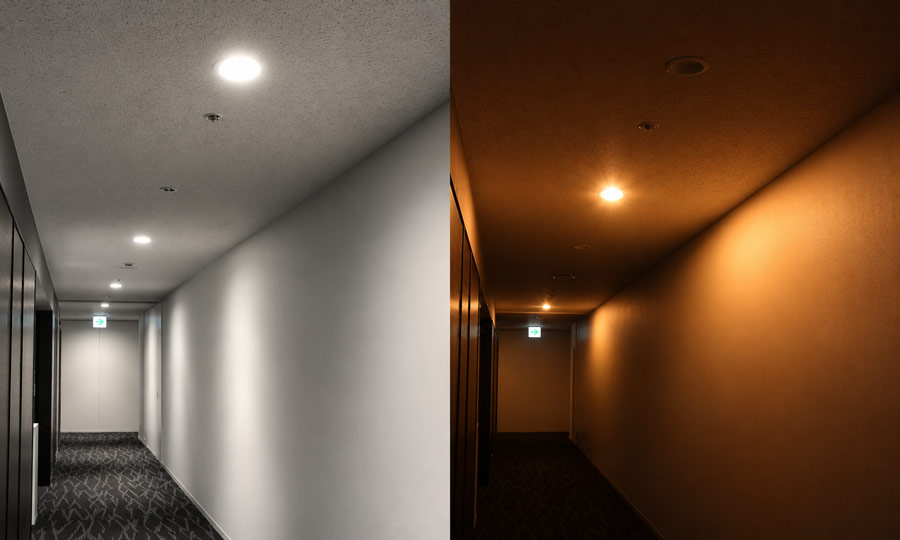
The monthly test checks whether the lights switch to emergency power and operate for a short period. The annual test checks whether they keep working through a prolonged loss of normal power. A stairwell light can pass the first test and still go out halfway through the second. It can also stay on while a displaced lamp head leaves the bottom steps in shadow. Checking the route as well as the fixtures helps catch both problems.
Emergency Lighting Testing Schedule at a Glance
| What to check | United States | United Kingdom |
|---|---|---|
| Monthly functional test | Under common NFPA 101 battery-powered testing options, run the lights in emergency mode for at least 30 seconds. The exact interval depends on the adopted code and testing method. | Under BS EN 50172:2024, simulate a failure of the normal lighting supply for long enough to confirm each emergency light source operates. |
| Annual duration test | Under the standard NFPA 101 battery-powered test provisions, the equipment must operate for at least 90 minutes. | Test for the system’s full specified duration. Check the design or commissioning records. Three hours is common, and a one-hour design may be appropriate for some premises. |
| Additional checks | Generator and transfer-switch testing follows the applicable emergency power standard, such as NFPA 110 where adopted. | BS EN 50172:2024 calls for daily checks of central safety power supply indicators and illuminance measurements every five years. |
The current UK code of practice, BS 5266-1:2025, is used alongside BS EN 50172:2024. It recommends a three-hour duration in circumstances such as sleeping accommodation or phased evacuation, where people may remain in the building after power is lost. In U.S. workplaces, OSHA’s 29 CFR 1910.37 requires adequately lit exit routes and functioning exit lighting. The 30-second and 90-minute testing intervals come from the applicable fire or life safety code.
How to Carry Out A Monthly Functional Test
- Start with the fixture list. Identify the emergency luminaires, backup-powered exit signs, and combination units that serve the approved egress routes. Include the less obvious locations, such as a rear stairwell, a service corridor, or the exterior landing beyond an exit door where emergency lighting is required. A fixture ID and a precise location make the next inspection easier to verify.
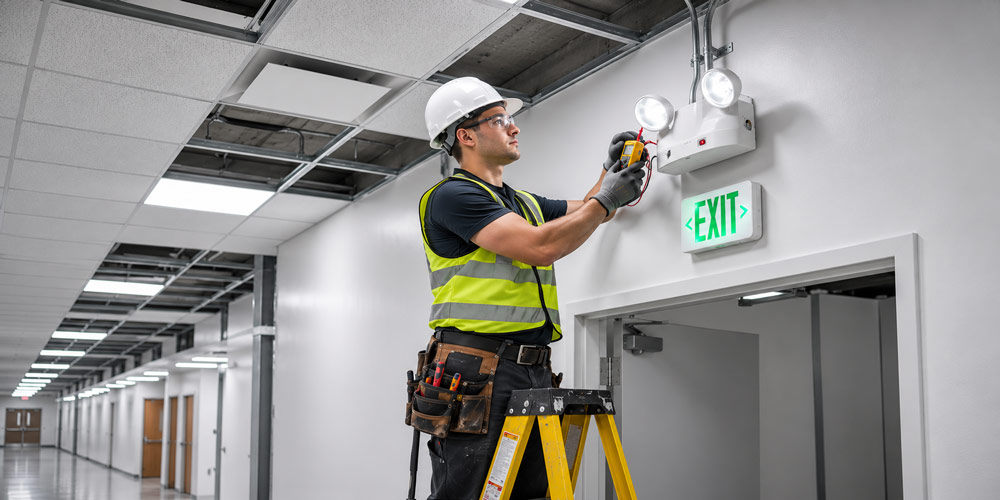
- Use the designated test control. Follow the equipment instructions and the site procedure for simulating loss of normal power. Depending on the installation, the test may use a push button, a keyed test switch, or an approved system control. Observe all emergency light sources on each unit for the required interval. For a combination unit, check the exit sign and each lamp head it powers. Panel-level switching and electrical troubleshooting should be handled by qualified personnel.
- Walk the route with the lights in emergency mode. Look at the stairs, ramps, turns, and landings from the direction people will approach them. Check whether a shelf, door, partition, or temporary display blocks the light or hides a directional sign. In a warehouse, moving a tall rack can leave a turn in shadow even when the fixture operates correctly.
- Verify that normal supply has returned. Check the relevant charging or ready indicator and log the result. If a locked room or an offline device prevents verification, record the check as incomplete and arrange a follow-up. For systems subject to a 30-day limit, schedule by elapsed days. A reminder set to the same date each month can leave a 31-day gap.
- A test button deserves particular attention on older equipment. If the circuitry that interrupts the normal supply has failed, the button may light the lamps without exercising the battery. If the response during testing seems inconsistent with how the fixture is supposed to operate, have a qualified person verify how it responds to a simulated loss of its normal supply.
How to Run the Annual Duration Test Safely
Plan for the test and the recharge period
Confirm the required runtime and allow the batteries to charge according to the equipment instructions before the test. Choose a low-risk period that accounts for cleaners, security staff, and anyone working outside normal hours. For premises that operate around the clock, have the responsible person arrange suitable coverage during testing and recharge. The plan may involve approved temporary arrangements or testing in stages that preserve the required emergency lighting along occupied routes.
Observe the equipment through the full test
Use the designated procedure to simulate loss of normal power. Record the start time, verify that the equipment transfers to emergency mode, and confirm that it continues to operate through the required period. If a fixture goes dark early, record when it went out. “Failed after 42 minutes” gives the technician a more useful starting point than “battery issue.” If several lights fail in the same zone, check whether they share a supply or charging system before treating each one as an isolated fault.
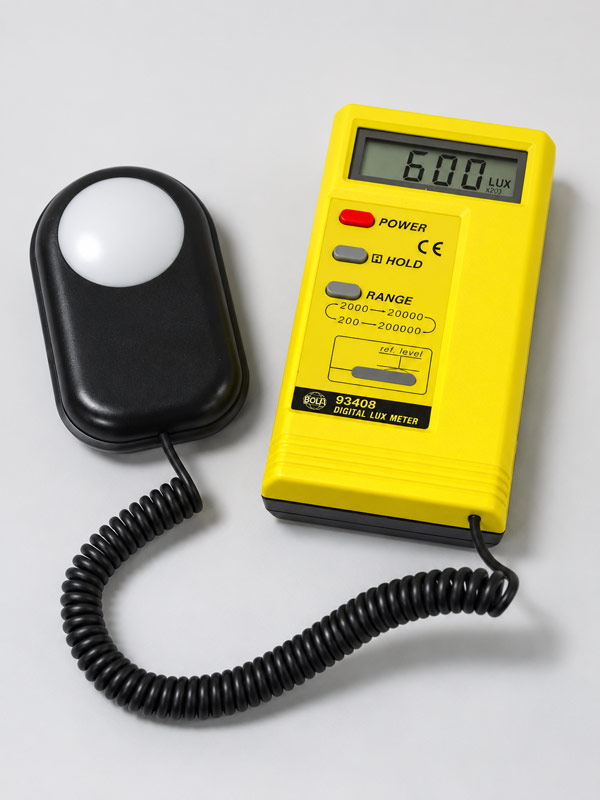
If part of the route looks underlit, have illuminance checked at the walking surface against the applicable standard. NFPA 101, for example, specifies an initial average of at least 1 foot-candle and a minimum of 0.1 foot-candle at any point along the egress path. At the end of 90 minutes, the corresponding minimums are 0.6 and 0.06 foot-candle. Some decline is permitted within those limits, so the condition of the route matters more than how bright a lamp looks from below.
National Fire Protection Association. (2025, June 20). 2025 NFPA technical meeting [Meeting transcript].
Restore power and verify recovery
At the end of the test, restore normal supply and check the relevant indicators. Allow the specified recharge time before relying on the batteries for their full rated duration. UK guidance notes that self-contained units typically recharge within 24 hours, though the actual time depends on the equipment. For example, a three-hour test that ends shortly before opening may leave too little time for recovery. Include the recharge window when booking the test.
How Self-Testing Lights and Central Power Systems Change the Procedure
Self-testing fixtures. Under one NFPA 101 testing option, self-diagnostic battery units run an automatic test of at least 30 seconds every 30 days, indicate faults, and receive a visual inspection at intervals of no more than 30 days. An annual 90-minute test still applies under that option. A qualifying computer-based system can also perform the annual test automatically and provide a history of tests and failures. For mixed installations, identify which fixtures report automatically and which need a manual check. Review missed tests and offline devices alongside reported failures.
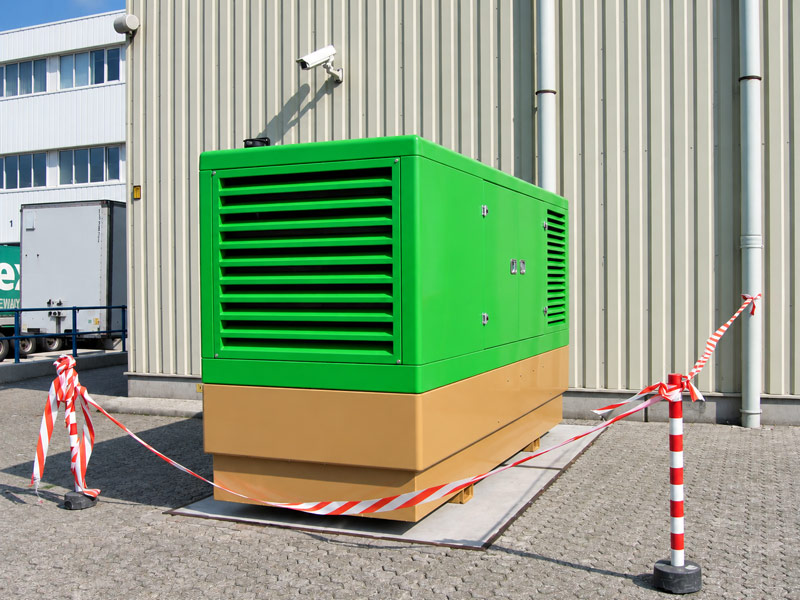
Generator-backed lighting. Coordinate the lighting check with the applicable generator and transfer-switch test program. Verify that the intended emergency circuits receive power and that the fixtures on the evacuation route actually illuminate when the system transfers. If the same building has separate battery-powered units, track their tests as well. A central stored-energy system may be subject to a separate standard, such as NFPA 111 where applicable.
What Real Inspections Found
- Monthly tests were done, but the annual test was missed. In a 2025 Wisconsin healthcare inspection, staff confirmed that they performed the 30-second monthly checks. The survey found that the annual 90-minute test had not been performed. Tracking the annual due date separately helps prevent a completed monthly checklist from obscuring an overdue duration test.
Centers for Medicare & Medicaid Services. (2025, September 3). Statement of deficiencies: Wisconsin Laser And Surgery Center (CMS Certification No. 52C0001039), deficiency tag K0291. U.S. Department of Health and Human Services.
- Several fixtures failed during the same inspection. A California fire marshal reported failures at multiple locations and noted that the lights did not appear to be charging. When several units fail together, record their locations and have qualified staff check for a shared power or charging problem.
- A light was visibly on and did not respond to its test button. A 2025 Washington healthcare inspection documented this on an egress path and identified it as a repeat finding. When the test control produces an unexpected response, log the fault and confirm emergency operation with an appropriate test method after the issue is investigated.
Centers for Medicare & Medicaid Services. (2025, April 2). Statement of deficiencies: Sam Naficy MD PS Inc. (CMS provider number 50C0001246), deficiency tag K0291—Emergency lighting. U.S. Department of Health and Human Services.
| What you observe | What to check next |
|---|---|
| One lamp head works and the other stays dark. | Record which head failed and the part of the route it serves. Have the failed head or its connection checked. |
| The fixture starts normally and goes out early. | Record the elapsed time. Have the battery, charging circuit, and connected load checked. Repeat the duration test after the repair and the specified recharge period. |
| The lamps stay on, but a landing is in shadow. | Check for obstructions, displaced lamp heads, and changes to the layout. Have the light level at the walking surface verified if coverage is in doubt. |
| A fault indicator remains active after normal supply returns. | Record the indicator pattern and check it against the equipment instructions. Assign the fault for follow-up and confirm that the system returns to a ready state. |
If a failure leaves a required exit route without adequate emergency illumination, escalate it promptly through the building’s fire safety procedure. The responsible team can assess the affected area, arrange suitable interim coverage, and confirm that the repair restores operation.
What to Record in the Emergency Lighting Log
Keep enough detail for someone else to identify the fixture, understand what was tested, and see whether any defect was resolved. Record the test date, fixture or zone ID, location, test type and method, required and observed duration where relevant, outcome, and the person who performed or verified the test. For a failure, add the work order or corrective action and the date and outcome of the retest. Keep the original failure entry so the next person can see if the same fixture has failed before.
| Fixture | Location | Test | Result and follow-up |
|---|---|---|---|
| EM-17 | West stairwell, level 2 landing | Annual, 90 minutes required | Failed at 42 minutes. Work order opened. Full-duration retest pending after repair and recharge. |
Keep the records accessible for inspection and follow the retention period that applies to your site. After a renovation, compare the fixture list with the current egress plan. A new partition can change the route, a replacement fixture can be absent from the testing system, and an old fixture ID can still appear in an automated report. Updating the inventory gives the next test a reliable starting point.
FAQs
1. Do emergency lights need to stay on all the time?
It depends on the fitting. A maintained luminaire provides illumination during normal operation and continues to operate in emergency mode. A non-maintained luminaire is normally dark and comes on when the normal lighting supply fails. Exit signs are subject to their own visibility and illumination requirements, so check the rules for the sign separately from those for the nearby emergency lamp.
2. How often should emergency light batteries be replaced?
Use the equipment manufacturer’s service-life guidance and take account of the operating temperature and the battery’s condition. Battery chemistry and installation conditions affect how long a pack lasts. If testing identifies a battery that can no longer supply the required runtime, use the approved replacement specified for that fixture. For sealed fittings, check whether the manufacturer calls for replacing the complete unit.
3. How quickly should emergency lighting come on after a power failure?
Where NFPA 101 §7.9.1.3 applies, up to 10 seconds is permitted when maintaining illumination depends on transferring between power sources. Under BS EN 1838:2024, escape-route and open-area lighting must reach at least 50% of the required illuminance within 5 seconds and the full required level within 60 seconds. Use the criteria for the installation when checking for slow activation.
4. Is the landlord or tenant responsible for emergency lighting testing?
Check the local fire safety rules and the lease for who controls each area and who arranges maintenance. In England and Wales, government guidance identifies the landlord, freeholder, or managing agent as responsible for common or shared areas. Where several parties have duties, agree who schedules tests, who keeps the records, and who acts on a fault in a shared corridor, staircase, or exit.
5. Can solar pathway lights count as emergency lighting at an outdoor exit?
Count a fixture toward required emergency lighting only if it’s accepted as part of the building’s emergency lighting system and meets the applicable equipment, activation, illumination, and runtime requirements. Ordinary solar pathway lights can provide supplemental outdoor lighting. Their charging and nighttime runtime depend on how much sunlight reaches the panel, so a covered landing or a shaded path can reduce the light available overnight.
