
Why Light Color Matters to Plants
How Different Light Colors Affect Photosynthesis
Light Color Works Together With Intensity and Duration
How to Choose Lighting for Healthy Plant Growth
What Does This Mean for Garden Lighting?
FAQs
The color of light affects photosynthesis by changing how efficiently leaves absorb and use incoming photons. Chlorophyll absorbs red and blue light strongly, but green light also contributes to photosynthesis. The effect of any color depends on light intensity, leaf structure, and the plant’s growing conditions. There is no single color that produces the best results in every situation.
For gardeners, understanding these differences helps explain why a lamp’s visible color alone cannot tell you how well it will support plant growth.
Why Light Color Matters to Plants
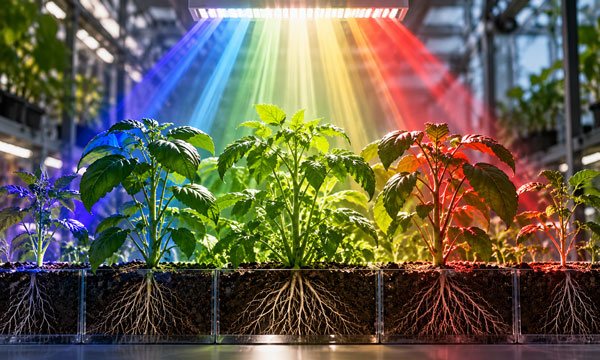
Light supplies the energy plants use to turn carbon dioxide and water into carbohydrates. Those carbohydrates support the development of leaves, stems, roots, and other tissues.
Different colors correspond to different wavelengths, measured in nanometers, or nm. The conventional photosynthetically active radiation range, known as PAR, extends from 400 to 700 nm.
Plants also respond to light as an environmental signal. A change in spectrum can influence leaf expansion or stem development without producing an equivalent change in photosynthetic rate. This distinction matters: a taller plant has not necessarily made more food or accumulated more biomass.
How Different Light Colors Affect Photosynthesis
The table below summarizes the main differences. Wavelength boundaries are approximate because visible colors blend into one another.
| Light color | Approximate wavelength | Role in photosynthesis |
|---|---|---|
| Blue | 400–500 nm | Strongly absorbed; also influences plant form and pigment development |
| Green | 500–570 nm | Supports photosynthesis and can reach deeper into leaf tissue |
| Yellow and orange | 570–620 nm | Provide usable photons within the conventional PAR range |
| Red | 620–700 nm | Strongly absorbed and often efficient at driving photosynthesis |
| White | A mixture of wavelengths | Supplies several useful wavebands together |
These categories describe broad tendencies rather than a universal ranking.
Red Light
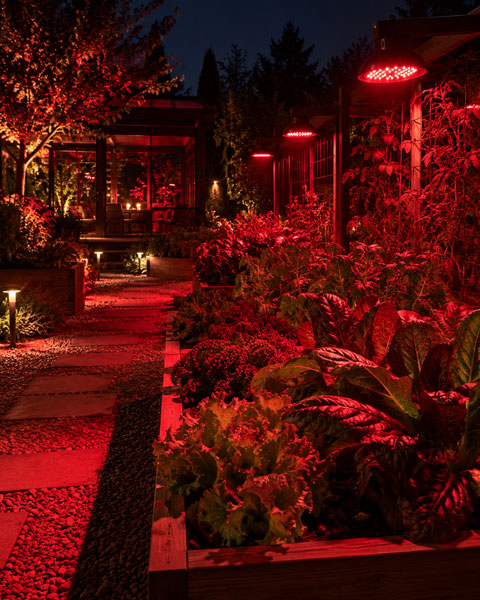
Red light can drive photosynthesis efficiently. However, a strong short-term response to red photons does not establish that red-only lighting is the best choice for an entire growing cycle.
Plants must also develop a suitable leaf area and structure to intercept light. Selecting a spectrum therefore involves both photosynthesis and the plant’s longer-term growth response.
Blue Light
Blue light supports photosynthesis and influences pigment concentration and plant architecture. Its effects vary with the proportion of blue light and the crop being grown.
More blue does not automatically mean more growth. In one lettuce experiment, a higher blue-light proportion produced smaller individual leaves and higher pigment concentrations, while shoot dry weight was lower than under the treatment containing more red light. This illustrates why darker or more compact foliage should not automatically be interpreted as greater productivity.
Green Light
Green light is useful to plants. Although leaves reflect and transmit some of it, they also absorb a substantial amount.
Because green light penetrates farther into leaves, it can supply energy to deeper photosynthetic tissue. Research on lettuce found that its photosynthetic efficiency became comparable to red light under high light intensity. Calling green light “wasted light” overlooks this contribution.
Yellow, Orange, and White Light
Yellow and orange wavelengths also fall within the conventional PAR range. Their contribution should not be dismissed simply because they lie between the strongest absorption regions of chlorophyll.
White light combines multiple wavelengths. A suitable broad-spectrum white light can support plant growth while making foliage easier to inspect under a natural-looking light. Plants do not need their surroundings to appear purple for photosynthesis to occur.
How to Choose Lighting for Healthy Plant Growth
For general indoor growing, broad-spectrum white lighting is a practical starting point. Choose a fixture that can provide adequate coverage and intensity for the plants you intend to grow.
The difference between grow lights and regular lights involves more than visible color. Purpose-designed fixtures may provide useful spectrum and PPFD information, but ordinary white lights can also support some plants when their output and placement are suitable.
When comparing options, focus on three questions:
- Does the fixture provide spectrum and PPFD information?
- Can it illuminate the full growing area at the intended distance?
- Does its output match the plant’s needs and the available natural light?
A “full-spectrum” label alone does not answer those questions. Neither does a warm-white or cool-white color-temperature rating.
After installation, watch new growth. Long, weak stems and reduced flowering can indicate insufficient light, while bleaching or scorching can indicate excessive exposure. These symptoms can have other causes, so assess them alongside the rest of the growing environment.
What Does This Mean for Garden Lighting?
Landscape lighting serves a different purpose from growing lights. A decorative lamp illuminating a path or shrub should not automatically be treated as a meaningful source of supplemental photosynthesis.
However, low-intensity night lighting can still affect the timing signals of sensitive plants. This is relevant when considering whether solar garden lights affect plant growth: exposure time and the amount of light reaching the foliage matter alongside color.
Direct outdoor lighting toward the area that needs illumination and avoid unnecessary overnight exposure of sensitive plants. A decorative light can influence a plant’s perception of night without supplying enough energy to substantially improve growth.
FAQs
1. Does Far-Red Light Contribute to Photosynthesis?
Yes, particularly when combined with shorter wavelengths. Research shows that far-red photons around 700–750 nm can contribute efficiently to canopy photosynthesis when supplied alongside conventional PAR light. Their performance in a mixed spectrum differs from their performance alone, so far-red should not be treated as a standalone replacement for visible growing light.
2. Do Plants Need UV Light to Grow Indoors?
UV supplementation is generally unnecessary for routine indoor growing. Adequate visible light can support healthy growth. UV is sometimes used in controlled cultivation to influence pigments and other plant compounds, but that is a separate objective from supplying the main light needed for photosynthesis. A UV feature is not, by itself, evidence of a better growing light.
3. Can Plants With Red or Purple Leaves Photosynthesize?
Yes. Red and purple leaves can contain chlorophyll even when other pigments mask its green appearance. Anthocyanins contribute much of the red or purple coloration and alter the light environment inside the leaf. Visible leaf color alone therefore cannot reveal whether a plant is photosynthesizing effectively.
4. How Can You Test the Effect of Light Color on Photosynthesis?
A floating leaf disk assay offers a practical demonstration. Prepared leaf disks initially sink, then rise as oxygen accumulates during photosynthesis.
Compare light treatments using the same leaf material, solution, temperature, and exposure time, with repeated trials and a dark control. Match PPFD rather than lamp wattage or distance alone. The floating rate provides an indirect indication of net oxygen accumulation, rather than an exact measurement of photosynthetic carbon fixation.
5. Does Light Color Affect Seed Germination Before Photosynthesis Begins?
It can. Some seeds use light as a germination signal, and red light promotes germination in certain species, including lettuce. This response differs from using light to manufacture carbohydrates.
Early growth initially relies on stored seed reserves. Once photosynthetic tissues develop and receive sufficient light, the seedling increasingly produces its own carbohydrates. Germination lighting requirements should therefore be checked for the particular species.
