
Solar lights are a popular choice for gardens, pathways, patios, and outdoor decorations because they provide illumination without increasing electricity costs. However, many homeowners wonder whether these lights create a gathering spot for insects at night. The answer depends on the type of light, its brightness, color temperature, and placement.
Solar lights attract some bugs, but they are generally less attractive to insects than many traditional outdoor lights. The main reason insects gather around certain lights is not the solar power source itself but the light spectrum produced by the bulb. Many flying insects respond strongly to shorter wavelengths, especially ultraviolet and blue light, which interfere with their natural navigation patterns.
See also: Owens, A. C. S., & Lewis, S. M. (2018). The impact of artificial light at night on nocturnal insects: A review and synthesis. Ecology and Evolution, 8(22), 11337–11358.
Why Do Some Solar Lights Attract Bugs?
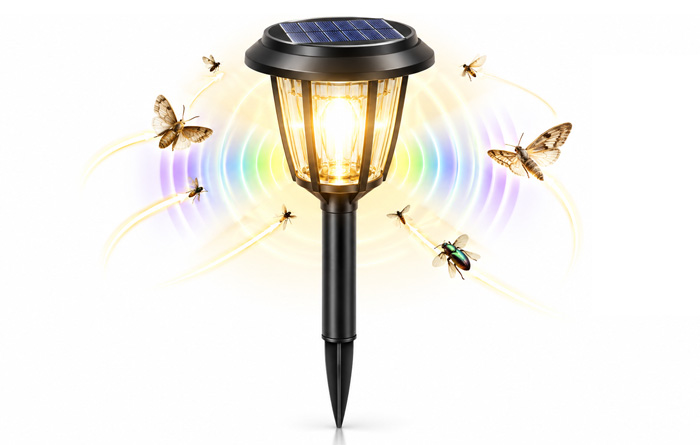
Illustration of a solar garden lamp and insect phototactic response to artificial light.
Insects respond differently to various wavelengths of light, so the LED spectrum used in solar lights plays an important role in nighttime insect activity. Shorter wavelengths, especially ultraviolet and blue light, are more noticeable to many nocturnal insects, while longer wavelengths such as yellow, orange, and red light generally attract fewer species. The following table shows how different light wavelengths are commonly categorized and their typical effects on insect attraction.
| Light Wavelength Range | Light Type | Effect on Insects |
|---|---|---|
| 380–450 nm | UVA / Ultraviolet Light | Highly visible to many insects and often attracts moths, flies, and other nocturnal species |
| 450–495 nm | Blue Light | Strongly detected by many insects and can increase attraction around outdoor lighting |
| 495–570 nm | Green Light | Less attractive than ultraviolet and blue light for many insect species |
| 570–590 nm | Yellow Light | Generally attracts fewer insects and is often used for insect-friendly outdoor lighting |
| 590–620 nm | Orange Light | Less noticeable to many insects and produces lower attraction levels |
| 620–750 nm | Red Light | Least attractive to many nocturnal insects due to limited visibility |
Note: Different insect species respond differently to light wavelengths, so the attraction levels shown are general patterns rather than fixed rules.
The position and intensity of a solar light can also change how insects respond to it. A bright fixture placed near plants, water features, or darker areas creates a stronger attraction point, especially when the light spreads widely or shines upward. Using a downward-facing design helps provide outdoor illumination while limiting unnecessary light exposure.
The presence of a few insects around solar lights does not usually damage garden plants. However, continuous artificial lighting throughout the night influences some natural processes, especially for plants. The effect depends on light intensity, duration, and the sensitivity of nearby species.
Are Solar Lights Worse Than Other Outdoor Lights?
Solar lights are not automatically more attractive to bugs than other lighting options. In many cases, modern solar garden lights use LED technology, which produces little ultraviolet light and attracts fewer insects compared with some older lighting types.
The key factor is the LED color temperature. Warm white or amber solar lights usually create a softer glow and are less likely to attract large numbers of insects than bright cool white lights. Choosing the right style of solar light can reduce unwanted insect activity while still providing outdoor visibility.
See also: Wakefield, A., Broyles, M., Stone, E. L., Jones, G., & Harris, S. (2016). Experimentally comparing the attractiveness of domestic lights to insects: Do LEDs attract fewer insects than conventional light types? Ecology and Evolution, 6(22), 8028–8036.
How to Choose Solar Lights That Attract Fewer Bugs
Selecting solar lights that are less likely to attract insects depends on factors such as light color, brightness, and placement. Warm white, yellow, and amber tones are usually more suitable for outdoor spaces because they are less noticeable to many insects than cool white or blue-tinted lighting. Keeping the brightness at a reasonable level and choosing downward-facing fixtures can also reduce unnecessary light exposure around the garden.
The position of solar lights affects both their performance and their impact on the surrounding environment. Areas with limited sunlight reduce charging efficiency and shorten nighttime operation, while locations with better exposure help maintain stable illumination. Shade, nearby structures, and seasonal changes in sunlight should all be considered when arranging outdoor lighting, especially since solar lights can still work under certain shaded conditions depending on the amount of available light.
Placing fixtures away from windows, seating areas, and spaces where people gather can further reduce unwanted insect activity while keeping outdoor areas well illuminated.
How to Reduce Bugs Around Solar Lights
A few simple adjustments can make solar lights less attractive to insects:
- Replace cool white bulbs with warm white or amber options.
- Install lights only in areas that need illumination.
- Clean solar panels regularly to maintain efficient operation and avoid reduced brightness that may encourage longer nighttime use.
- Turn off decorative lighting when it is not needed.
Solar lights attract some insects, but the effect is mainly related to light characteristics rather than solar technology itself. Choosing warm-toned LEDs, using suitable placement, and avoiding unnecessary nighttime illumination can create a comfortable outdoor space with fewer unwanted bugs.
FAQs
