
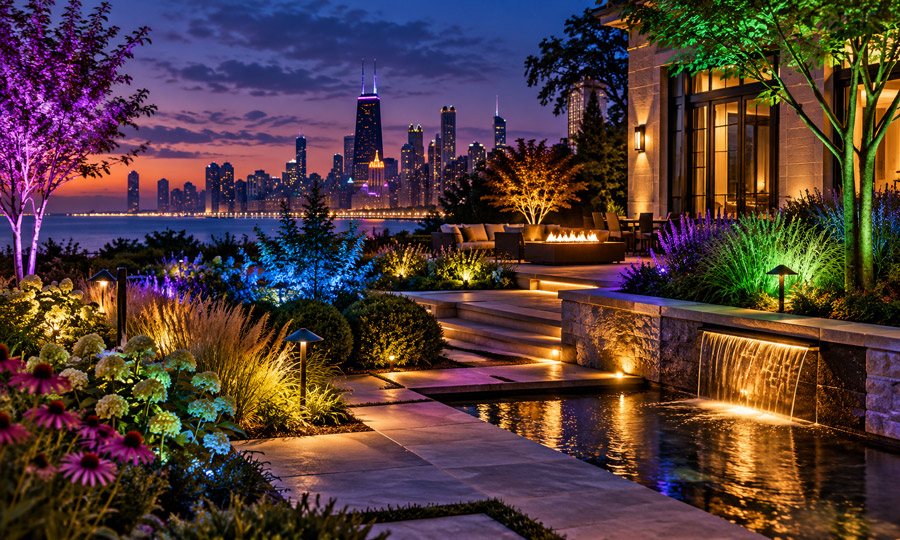
A Chicago garden can take on a completely different character after sunset. A brick wall becomes a backdrop for soft color, a tree becomes a sculptural focal point, and a small patio feels ready for an evening with friends.
The most effective Chicago color changing landscape lighting designs begin with the landscape itself. Think about what you want to highlight, where people walk, and how the yard looks from inside your home. Then choose colors that support those features.
These ten ideas combine everyday lighting with expressive accents, offering ways to personalize everything from a compact city courtyard to a spacious suburban backyard.
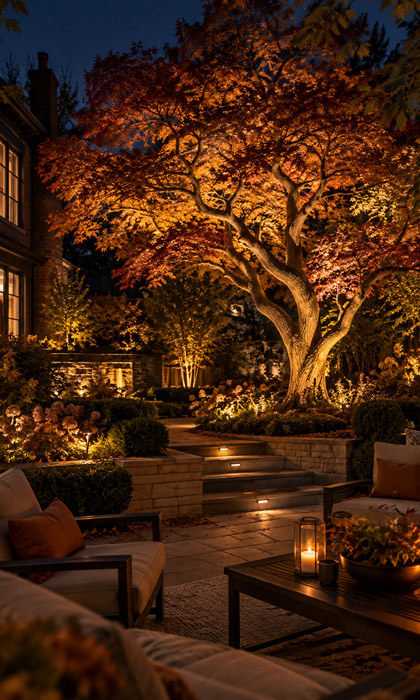
Give a Statement Tree a Seasonal Color Palette
Choose one tree with an interesting trunk or branching shape and make it the main feature of your nighttime garden.
Position adjustable spotlights so their beams stay on the trunk and canopy. Try amber for a quiet autumn evening, a restrained green accent for a celebration, or warm white when you want the tree’s natural character to stand out.
Combining uplighting and downlighting can give the scene more depth: color draws attention to the tree, while gentle downward light supports the surrounding space.
Recheck the aiming after leaves fall. A beam that disappears into summer foliage may shine beyond bare branches in winter. Keep neighboring windows and views from your own seating area in mind.
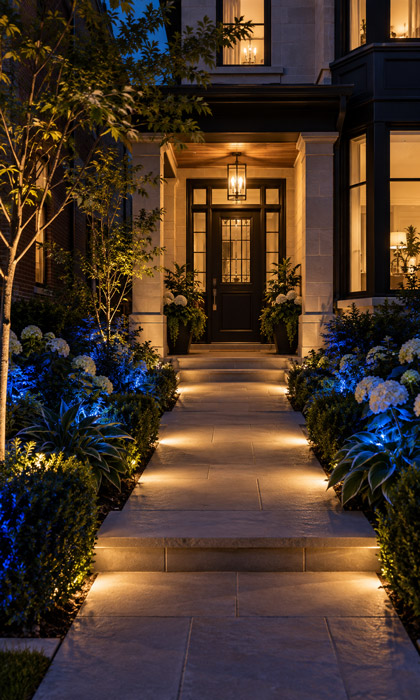
Pair Warm White Pathways With Colorful Garden Borders
For a welcoming entrance, keep the walking surface clearly illuminated and place the color in the planting beds beside it.
Imagine a warm white path leading to the front door, with a low blue glow across a nearby shrub group. For a holiday, that same planting bed could switch to red or green while the route to the house stays visually consistent.
Place accent fixtures where planting conceals their bodies without blocking the light. Avoid putting a bright colored spotlight directly opposite someone approaching the entrance.
This arrangement works especially well when a narrow front garden has limited room for decorative elements. The planting supplies the color, and the path remains easy to follow.
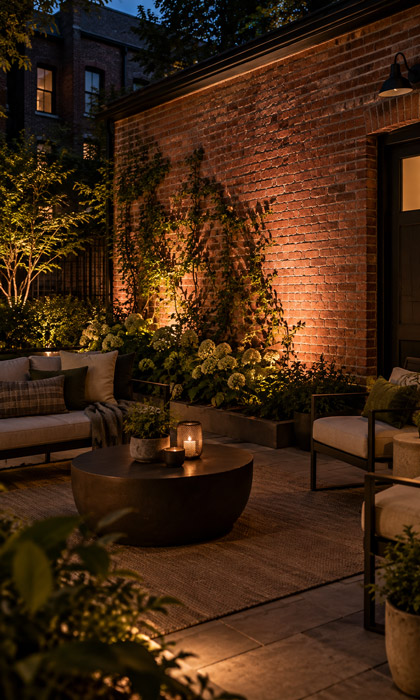
Use a Brick Wall as a Backdrop for Color
A brick garden wall or garage facade can become the backdrop for an outdoor seating area.
Use a wall washer light fixture to spread color across a selected section of masonry. Start with a muted amber, rose, or blue scene, then test it against the actual surface after dark. Red brick and pale stone can make the same setting look noticeably different.
For a compact Chicago courtyard, illuminating one wall creates a clear visual anchor. Leave other surfaces quieter so the space retains contrast.
Adjust the fixture position until the wash feels balanced. A bright patch near the ground with little light above it can distract from the wall’s overall appearance.
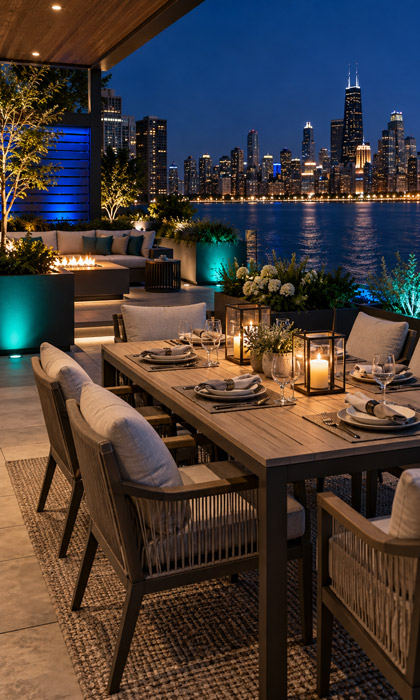
Create a Lake-Inspired Patio With Blue and Teal Accents
Borrow a palette of blue, teal, and soft white for a patio with a relaxed lakeside feel.
Keep dining and seating areas in comfortable white light, then introduce color around the perimeter. A teal-lit planter, a blue accent on a privacy screen, or a subtle glow beneath a bench can establish the theme.
Choose one dominant accent color and use the second sparingly. For example, repeat teal across two planters and reserve blue for a single background feature.
Check the scene from a seated position. Concealed fixtures should create the atmosphere without shining into anyone’s eyes. During dinner, keep the strongest color away from faces and food so the table remains comfortable to use.
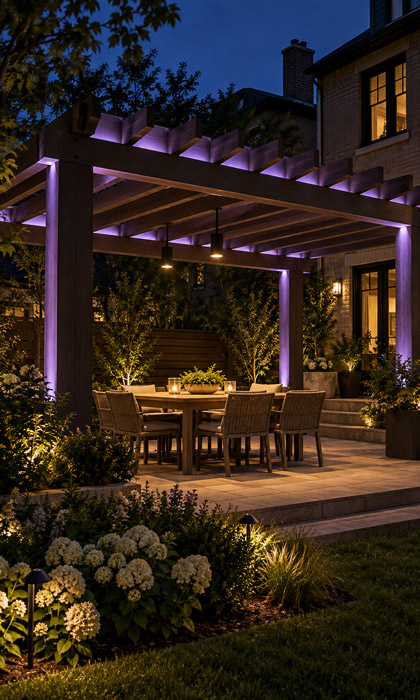
Frame a Pergola With Concealed Color
A pergola offers several places to hide light sources while making its structure visible at night.
Place suitable outdoor linear fixtures along the inside of beams or use compact accents to illuminate selected posts. A soft lavender scene can suit an evening gathering, while amber creates a quieter setting.
Keep the design selective. Outlining every beam can become visually busy, particularly above a small patio. Lighting two opposing edges or a few vertical supports gives the structure definition with less visual clutter.
Use a separate white-light layer over the table. This lets the pergola carry the decorative color while guests still have useful illumination for eating, reading, or playing a board game.
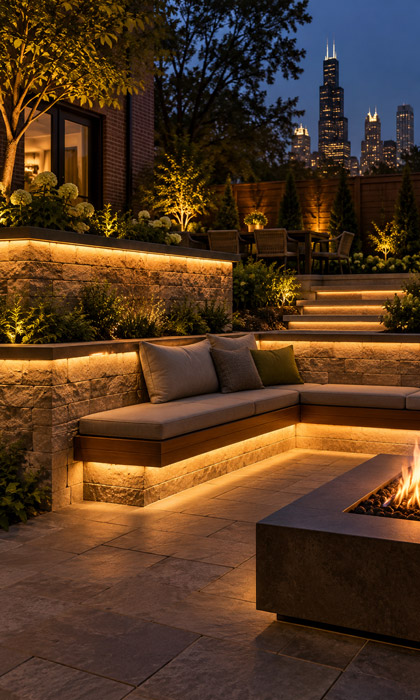
Add a Floating Effect to Seating and Retaining Walls
Low walls and built-in benches can become subtle nighttime features when light is concealed beneath their edges.
With hardscape lighting for retaining walls, position fixtures under the cap so light falls across the wall face. A similar approach beneath a bench can create a floating effect.
Try a dim amber scene for everyday evenings or a restrained violet accent during a gathering. Keep the output low enough that the wall supports the larger composition.
Where a retaining wall meets steps, give the treads their own clear illumination. Preview the layout from the approach and from nearby chairs; a source hidden from standing eye level may still be visible when someone sits down.
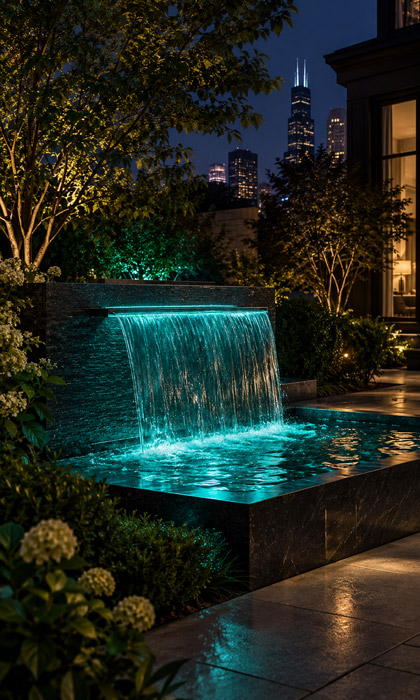
Turn a Fountain Into a Single-Color Focal Point
A fountain or small waterfall can carry an entire lighting scene without needing color across the whole yard.
Try teal around a contemporary basin or soft white on moving water with a blue accent on the stone behind it. For a celebration, change the water feature’s color while leaving nearby planting subdued.
If fixtures go underwater, use equipment specifically designed and rated for that installation. An ordinary outdoor spotlight should not be treated as a submersible light.
Aim the lighting so you see the water and reflections rather than the source. For a fountain that is shut down seasonally, plan an alternative scene that highlights its shape or surrounding stonework when the water is off.
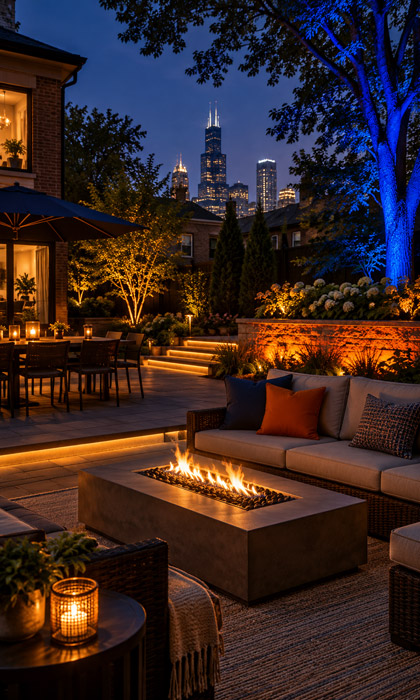
Build a Chicago Game-Day Scene
Color changing lighting can give a backyard gathering a local identity.
Try orange and blue accents for a Bears-inspired evening, or red and blue for a Cubs-inspired setup. Assign each color to a separate feature: one tree in blue and a garden wall in orange, for example. Keeping the colors spatially distinct makes the combination easier to read.
Limit the theme to the entertaining area or a few front-yard focal points. A small number of deliberate accents can communicate the idea clearly.
Save the arrangement as a preset if your system supports scenes. After the gathering, return to the everyday setting with a single command. Static colors also keep the atmosphere comfortable during conversation.
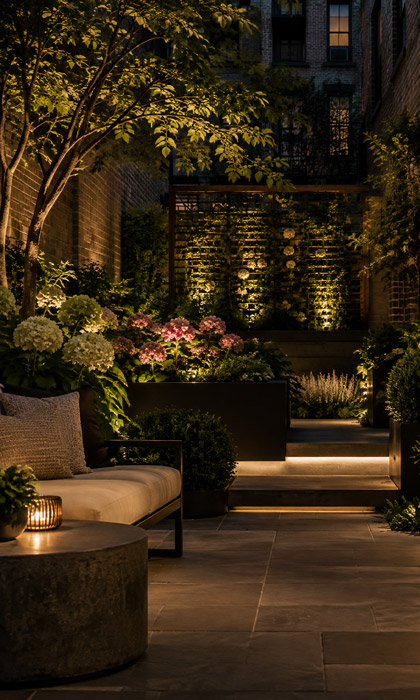
Create Depth in a Small Courtyard With Three Lighting Layers
A small garden benefits from a clear foreground, middle ground, and background.
Begin with gentle white light near the door or seating area. Add a colored accent to a planter in the middle of the space, then softly illuminate a feature at the far end. Leave some areas dark to preserve separation between the layers.
For example, combine a warm white bench area, a muted pink planter, and a softly lit rear trellis. Keep the background dim enough that it does not dominate the courtyard.
Check the arrangement through the windows you use most often. A design that looks balanced from the garden gate may feel very different from the living room. Choose the main viewing angle before finalizing fixture positions.
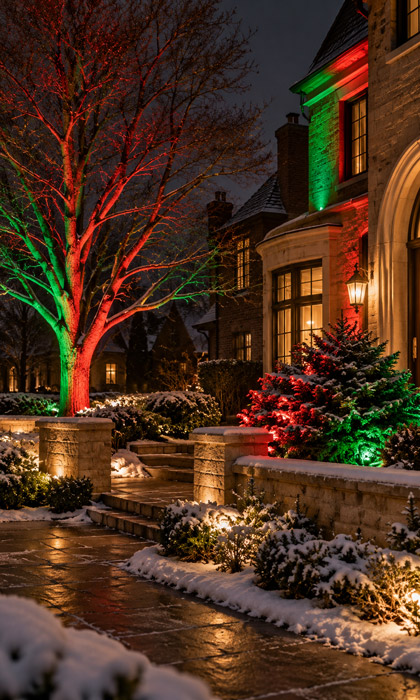
Design a Holiday Garden That Returns Easily to Everyday Lighting
Use permanent fixtures to create occasional holiday scenes without making the garden feel seasonal all year.
Select a few repeatable focal points, such as an entry shrub, a specimen tree, and a garden wall. Try green accents for St. Patrick’s Day, orange and purple for Halloween, or red and green for Christmas.
By integrating smart technology in landscape lighting, you can organize compatible fixtures into groups and save scenes. Check whether the chosen system supports date-based scheduling, individual fixture control, and the behavior you want after a power interruption.
For Chicago installations, check the manufacturer’s operating-temperature limits and exposure requirements for fixtures, connections, and controls. Keep equipment clear of snow-clearing routes, and adjust brightness when snow makes the scene appear more intense.
Give each holiday scene an end date or a simple return-to-white command. The everyday setting should be just as carefully designed as the celebration.
A successful color changing landscape lighting design gives every illuminated feature a purpose. Start with one or two ideas that suit your property, test them after dark, and adjust color and brightness from the places where you actually spend time. A thoughtful arrangement can make a Chicago garden feel welcoming on an ordinary evening and ready for something special whenever the occasion arrives.
FAQs
Can I Upgrade Existing Landscape Lights to Color Changing LEDs?
Some existing fixtures can use compatible color changing replacement bulbs. Check the bulb base, physical dimensions, voltage, and transformer compatibility before making the change.
Fixtures with integrated LEDs may require a compatible replacement module or a completely new fixture. Adding a smart transformer alone does not make standard white lights change color.
Do Color Changing Landscape Lights Require Wi-Fi?
No. Control methods vary by product and may include handheld remotes, Bluetooth, or Wi-Fi-connected gateways.
Remote-controlled systems can provide color adjustment without an internet connection, while some app-based systems require Wi-Fi for setup, cloud features, or remote access. Check the connectivity requirements before choosing a system.
Can Different Brands of Color Changing Landscape Lights Work Together?
Not necessarily. Using the same voltage does not guarantee that products from different brands will share the same color controls or communication system.
Electrical compatibility and control compatibility should be checked separately. Some systems require proprietary transformers, controllers, or fixtures, so confirm manufacturer-supported combinations before mixing products.
How Much Electricity Do Color Changing Landscape Lights Use?
Electricity consumption depends on the system’s actual power draw and daily operating time.
For example, a 60-watt system operating for five hours per night uses approximately 9 kWh over 30 days. Multiply this figure by your electricity rate to estimate the energy cost, and include transformer losses and controller standby consumption for a more complete calculation.
Can I Control Each Landscape Light Separately?
Individual control depends on the lighting system. Some products allow each fixture to be adjusted independently, while others control groups of fixtures or an entire circuit together.
If you want different colors on nearby landscape features, confirm that the selected system supports individual fixture addressing. A transformer that only controls power cannot independently change the colors of ordinary connected lights.
