
10 Outdoor Soffit Lighting Ideas for Your Home
- 1. Create a Clean Look with Recessed Lights
- 2. Make Your Front Entrance More Welcoming
- 3. Highlight Brick and Stone Details
- 4. Frame Your Garage with Balanced Lighting
- 5. Add a Soft Glow to a Covered Patio
- 6. Illuminate a Side Passage Under the Eaves
- 7. Define Long Eaves with Concealed Linear Lighting
- 8. Draw Attention to Columns and Architectural Details
- 9. Switch Between Everyday and Holiday Lighting
- 10. Combine Soffit Lights with Landscape Lighting
Outdoor Soffit Lighting Placement Tips and Mistakes to Avoid
Bring Your Outdoor Soffit Lighting Ideas to Life
FAQs
What Is Outdoor Soffit Lighting?
A soffit is the underside of an architectural overhang, such as a roof eave or porch ceiling. Outdoor soffit lighting uses fixtures installed in or on that surface to illuminate the area below or nearby architectural details.
Recessed lights sit within a cutout, with their trim and lens visible from below. Surface-mounted lights attach beneath the soffit and make the fixture itself more noticeable. Linear lighting offers another approach, creating an extended line of light along an overhang.
The most suitable option depends on both the appearance you want and the available mounting space. A shallow soffit, for example, may call for a different fixture from a deep porch ceiling.
10 Outdoor Soffit Lighting Ideas for Your Home
Start with the areas you use most often. This quick comparison can help you choose which ideas to explore first.
| Your goal | Idea to consider | Main planning question |
|---|---|---|
| Keep the exterior visually simple | Recessed downlights | Is there suitable space above the soffit? |
| Make the entrance stand out | Focused porch lighting | Can visitors clearly see the door and landing? |
| Reveal a distinctive exterior finish | Lighting for brick or stone | Do you want gentle coverage or stronger texture? |
| Enjoy evenings outdoors | Dimmable patio lighting | How does the light feel from a seated position? |
| Emphasize a long overhang | Concealed linear lighting | Can the light source and wiring be neatly integrated? |
| Change the mood for occasions | Zoned, color-changing lighting | Can decorative effects operate separately from essential lighting? |
1. Create a Clean Look with Recessed Lights
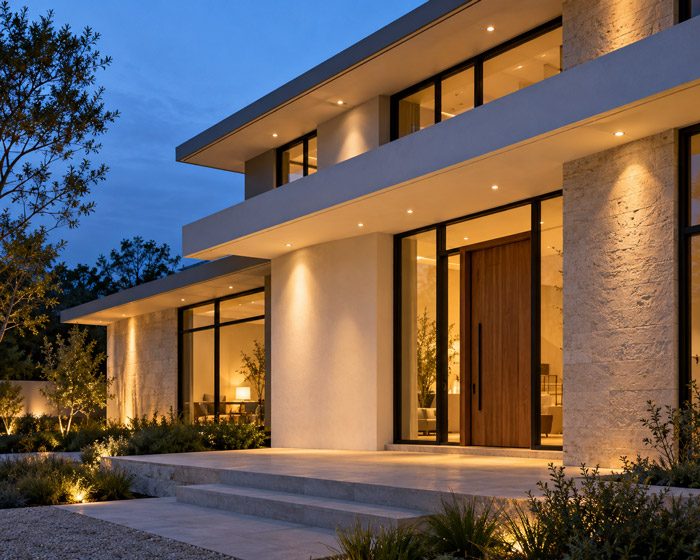
Recessed fixtures suit homes where you want the architecture to remain the main attraction. During the day, a trim that coordinates with the soffit keeps the ceiling unobtrusive. At night, the pools of light establish a rhythm along the façade.
Try this approach beneath a broad porch or a simple, straight eave. Consider how each pool of light relates to doors, windows, and wall sections before deciding on the fixture count.
Check installation depth, mounting requirements, and access for servicing before committing to recessed fittings. Where recessing is impractical, surface mount exterior soffit lighting offers an alternative worth comparing.
2. Make Your Front Entrance More Welcoming
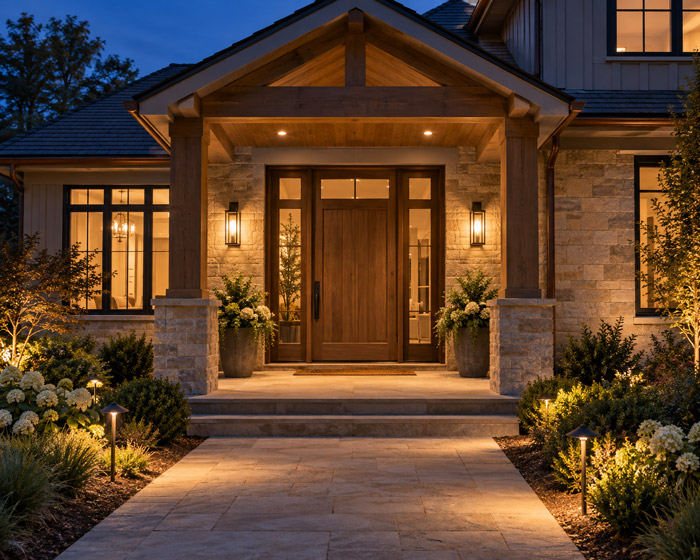
Give the front door a clear place in the nighttime view. A softly illuminated entrance helps guests recognize where to go and brings attention to details such as a timber door, house number, or porch columns.
Plan the light around the landing and approach as well as the door itself. If you already have wall sconces, consider what they illuminate before adding overhead fixtures. You may need a small amount of supplementary light rather than a second strong layer over the same area.
Combining soffit downlights with wall sconces is one of several practical front door entrance lighting ideas that can help define the entrance and complement your home’s architectural style.
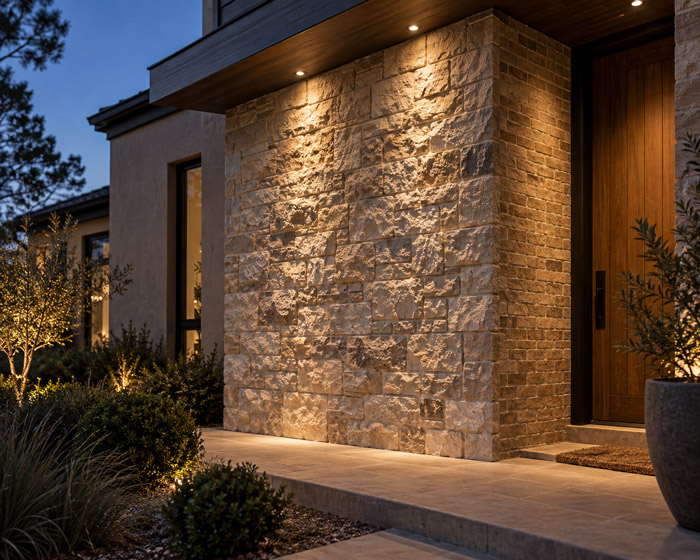
3. Highlight Brick and Stone Details
A brick porch wall or stone-clad entrance can become an evening focal point. Before choosing a fixture, decide whether you want the surface to appear gently illuminated or strongly textured.
Compare a broad, even-looking treatment with a more directional effect in a nighttime mockup. Pay attention to mortar lines, projecting stones, and any irregularities you would prefer not to emphasize. The appearance can change substantially as the position and direction of the light change.
Keep adjacent surfaces quieter so the material has room to stand out. A single feature wall may give the entrance enough character without extending the same treatment across every part of the house.
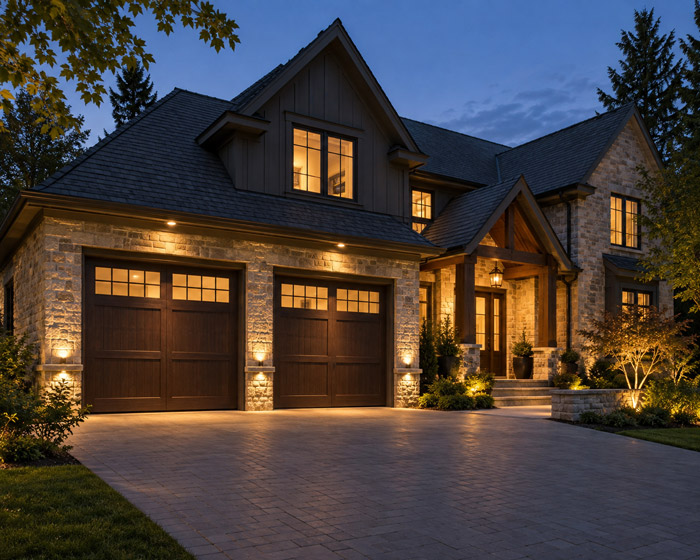
4. Frame Your Garage with Balanced Lighting
Garage doors often occupy a large part of the front elevation. Lighting this area thoughtfully can help it feel connected to the entrance without making it the dominant feature.
Use the door openings and the wall sections between them as starting points for your layout. View the arrangement from the driveway and street, especially if the garage projects forward of the house.
Consider a restrained accent effect around the garage, with the front door remaining the clearer focal point. Also assess the driveway separately: an attractive glow on a garage door does not establish whether the area where people walk or park receives enough light.
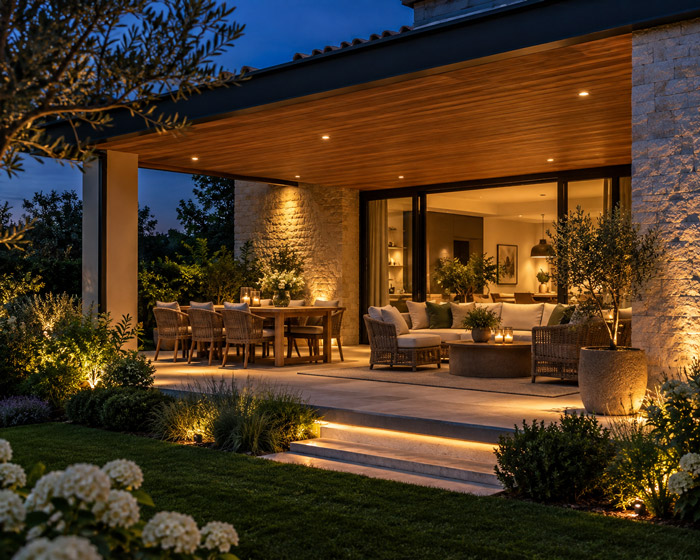
5. Add a Soft Glow to a Covered Patio
A covered patio needs lighting that feels comfortable while people sit, eat, and talk. Outdoor soffit lighting can provide an overhead layer, but the experience should be judged from the furniture rather than from the garden alone.
Sketch the dining table and seating positions before marking fixtures. Test whether a light is distracting when someone leans back in a chair or looks across the table.
Choose a dimmable fixture and compatible control if you want to adjust the atmosphere. Separate the patio from the front façade where practical, so an evening outside does not require every exterior light to run at the same brightness.
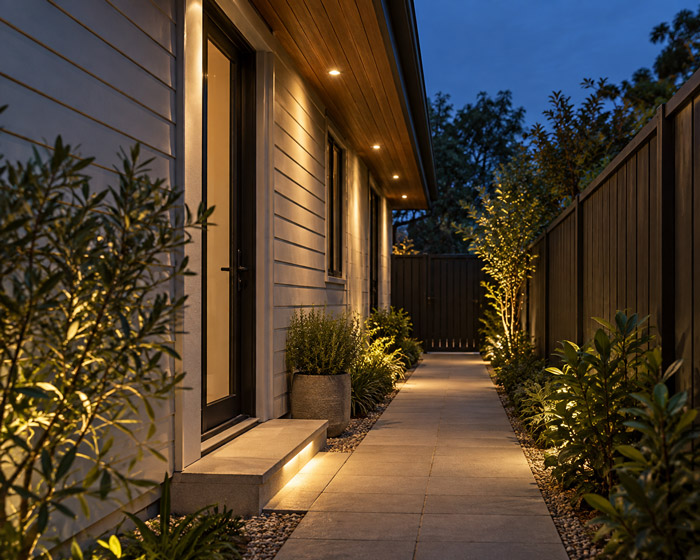
6. Illuminate a Side Passage Under the Eaves
A side entrance or narrow passage can benefit from lighting integrated into the overhang. This keeps the design visually tidy and helps connect the route between the front and back of the house.
Walk the entire route when assessing the layout. Gates, bins, planting, and projecting walls may interrupt the light or create areas that need separate attention. Include any change in level in your review.
Be especially considerate where the passage faces a neighboring window. Aim to illuminate the walking area and doorway within your own property. For an infrequently used route, consider whether a compatible motion control would suit the way you use the space.
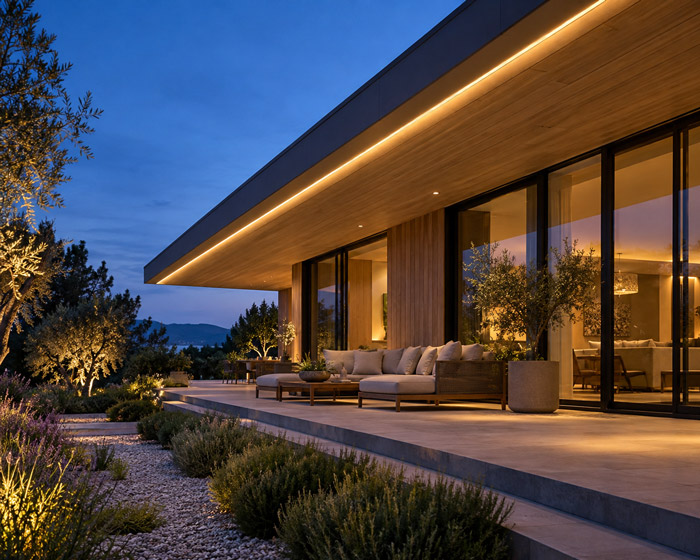
7. Define Long Eaves with Concealed Linear Lighting
Linear lighting offers a different visual character from individual downlights. It can emphasize the horizontal shape of a long porch, balcony overhang, or contemporary roof edge.
The detail works best when it looks intentional during daylight as well as after dark. Plan how the light source, channel, wiring, and power supply will fit into the construction. Examine the effect from below and from the street so exposed bright points do not spoil the result.
Use components approved for the installation conditions, including connections and end treatments. Before choosing this approach, ask how the system will be accessed if a section or power supply eventually needs service.
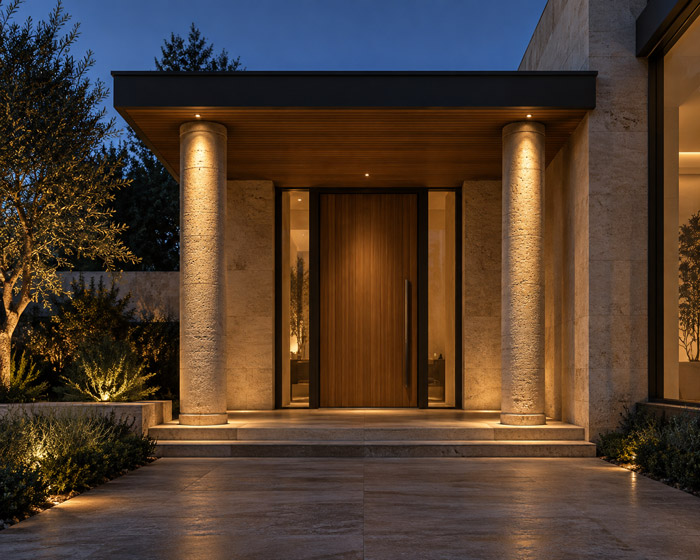
8. Draw Attention to Columns and Architectural Details
Choose one or two architectural features that deserve attention: an entrance column, a recessed doorway, or a decorative panel beneath a porch roof.
An adjustable fixture can be useful when the target does not sit directly beneath the mounting position. Its adjustment range and light distribution should match the feature you want to illuminate.
Narrow spotlight beam angles concentrate light on details such as slender columns, while wider beams spread illumination across larger surfaces. Match the beam to the size of the feature, and test it in place after dark. Adjust the aim or light output if it creates an overly bright patch or spills onto nearby windows.
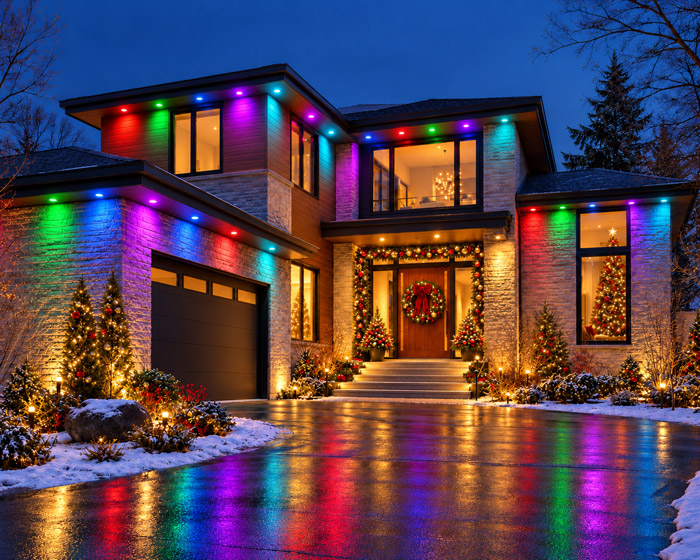
9. Switch Between Everyday and Holiday Lighting
Color-changing fixtures can offer a subdued everyday setting and a more playful appearance for a celebration. The useful design question is how easily you can return to a comfortable nightly arrangement.
Create an everyday scene first, then add occasional color effects to selected parts of the façade. Keep entrances and walking routes readable when decorative scenes are active.
Check the system’s white-light appearance, dimming range, and grouping options before buying. If you simply want the lights to turn on and off at set times, compatible landscape lighting timers can provide that function without a full smart lighting setup. Confirm that the timer supports your soffit lighting system’s power supply and electrical load.
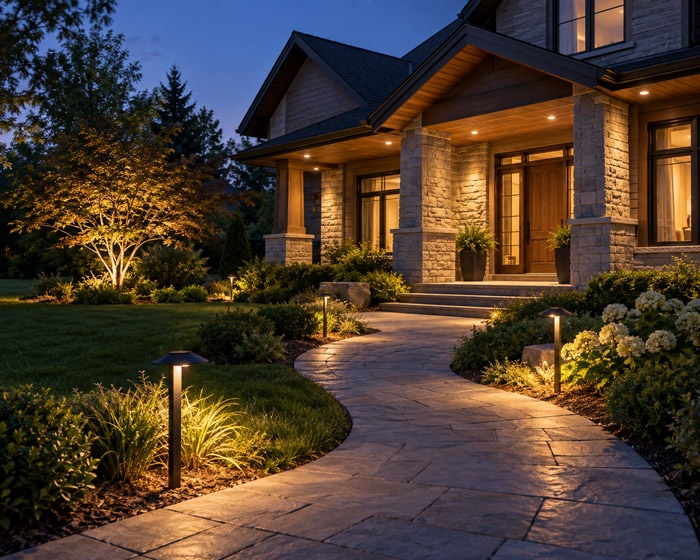
10. Combine Soffit Lights with Landscape Lighting
Think about the view beyond the wall of the house. A well-lit porch can still feel disconnected if the route leading to it disappears into darkness.
Plan the soffit lighting alongside the garden and walkway lighting, assigning each a purpose. The porch might draw attention to the entrance while separate fixtures reveal the path approaching it. A nearby planted area can provide a secondary point of interest.
Review the view from indoors, too, because you will often experience the garden through a window. For a broader planning framework, see our guide to designing landscape lighting.
How to Choose Outdoor Soffit Lighting for Your Space
Once you have selected a design direction, compare fixtures against the conditions of your project.
| Factor | What to check |
|---|---|
| Mounting | Recess depth, cutout dimensions, mounting support, and service access |
| Light distribution | Whether the beam suits a wall detail, landing, or wider seating area |
| Output | Published lumens and distribution data, rather than wattage alone |
| Color appearance | How the light looks on your actual exterior finishes |
| Environmental suitability | Manufacturer approval for the moisture, temperature, and exposure conditions |
| Controls | Compatibility between the fixture, driver, dimmer, sensor, or smart system |
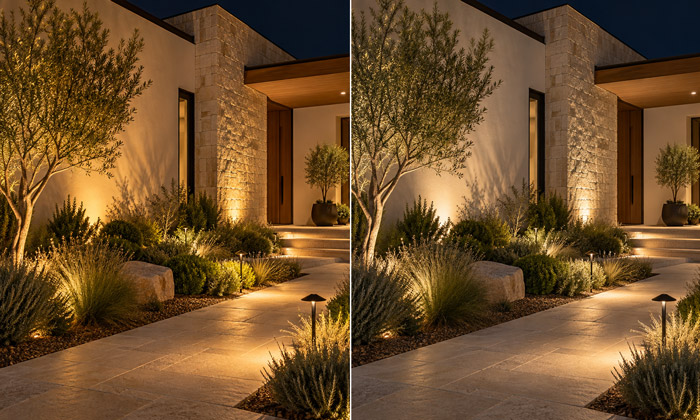
When choosing between 2700K vs 3000K landscape lighting, consider how each looks on your exterior finishes. Both produce warm white light, but 2700K appears more golden, while 3000K has a slightly less yellow tone. Compare samples on your walls after dark and alongside existing fixtures. Color temperature describes the light’s appearance, not how much light reaches the surface.
Do not assume a fixture is suitable simply because it will sit under a roof. Confirm that the manufacturer's location rating and installation instructions cover the actual exposure. Review the complete assembly, including any separate driver and connections.
For new hardwired fixtures or circuit changes, have a qualified electrician assess the installation and applicable local requirements. A design plan should leave room for those practical checks before fixtures are ordered.
Outdoor Soffit Lighting Placement Tips and Mistakes to Avoid
Begin with a sketch of the façade showing doors, windows, columns, vents, and the areas you want to illuminate. Add proposed fixtures only after those features are marked.
There is no universal spacing that suits every house. Mounting height, the distance to the target, light distribution, and the intended effect all influence placement. Use the manufacturer's photometric information and a nighttime trial where practical instead of copying a distance from another project.
As an illustrative example, imagine a single-story home with a recessed entrance, an attached garage, and a side gate. Plan these as three areas: an entrance scene, restrained garage accents, and separately controlled passage lighting. Assess each from the approach used by visitors before reviewing the whole façade from the street. This is a planning example, not a fixture-count recommendation.
Avoid these common mistakes:
- Marking equal intervals before considering the architecture. A regular pattern may place light over a window or miss a doorway.
- Judging the effect only while standing. Check glare from patio chairs and indoor seating positions.
- Making every surface equally bright. Decide which area should attract attention first.
- Treating decorative coverage as complete route lighting. Inspect steps, landings, and turns separately.
- Forgetting the daytime appearance. Visible fittings, channels, and wiring affect the finished design.
Use light where it serves a purpose, direct it toward that area, and set controls to reduce unnecessary operating time.
Bring Your Outdoor Soffit Lighting Ideas to Life
Choose one area to improve first: the entrance, garage façade, or covered patio. Decide what you want to see there after dark, select a fixture suited to that purpose, and test its appearance before extending the scheme.
FAQs
Can outdoor soffit lighting be added to an existing home?
Yes, but the installation approach depends on wiring access, soffit construction, and available space.
An installer should inspect the area before recommending recessed or surface-mounted fixtures. Existing wiring may be reusable, but its condition and suitability should be checked first.
Can lights be installed in a vented soffit?
Installation may be possible as long as the fixtures do not interfere with required ventilation or structural support.
Have the proposed locations checked before cutting into vented panels. Where possible, use an appropriate solid mounting area while preserving the soffit’s ventilation function.
Is outdoor soffit lighting expensive to run?
Running costs depend on total wattage, operating hours, and your electricity rate.
For example, ten 5-watt fixtures operating for five hours each night use approximately 7.5 kWh over 30 days. Multiply that figure by your local electricity price per kWh to estimate the monthly cost.
Should outdoor soffit lighting stay on all night?
It depends on how the area is used. Decorative lighting can usually follow an evening schedule, while frequently used entrances may require illumination later at night.
Separate controls make it possible to turn off decorative zones while keeping lighting available where it is still needed.
Can you replace the bulbs in LED soffit lights?
Some fixtures use replaceable LED bulbs, while others contain integrated LED modules.
With an integrated fixture, servicing may involve replacing the LED module, driver, or entire fitting depending on its design. Check the manufacturer’s replacement options and warranty before purchasing.
