

The Main Risk: Direct Eye Exposure
Are Garden Laser Lights Safe for Children?
Are Garden Laser Lights Safe for Pets?
How to Use a Garden Laser Light Safely
When Should You Avoid Using One?
What to Do After Accidental Exposure
FAQs
Garden laser lights can be safe around children and pets, but only when the product is properly classified, securely installed, and carefully aimed. A laser projector should never be treated like an ordinary outdoor lamp. Unlike standard decorative lighting, it produces concentrated beams that may injure the eyes if viewed directly.
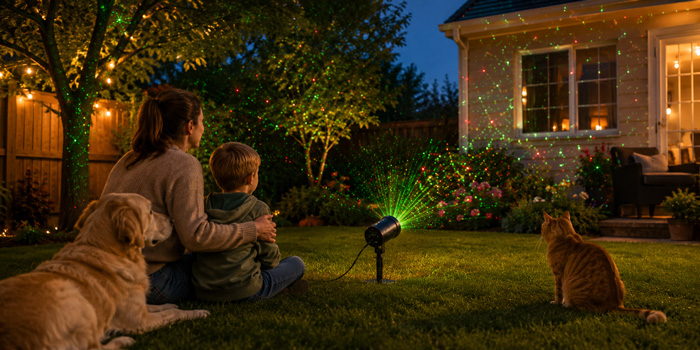
The Main Risk: Direct Eye Exposure
The greatest concern is accidental exposure to the laser beam. Looking directly into a laser—or catching a strong reflection from glass, mirrors, polished metal, or other shiny surfaces—can damage the retina. The U.S. Food and Drug Administration warns that laser-related eye injuries may not cause immediate pain, and changes in vision may not become noticeable until later.
Risk depends heavily on the laser’s power and safety classification. Class 1 products are considered low risk under normal operating conditions. Class 2 visible lasers rely partly on a person’s natural blink response but still should never be stared into. Class 3R products can be hazardous when viewed directly, while higher classes present substantially greater risks.
For a family garden, avoid any projector that does not clearly display its laser class, output information, manufacturer details, and required safety warnings. Claims such as “low power” or “harmless” should not replace proper certification and labeling.
Are Garden Laser Lights Safe for Children?
Children are more likely to approach a projector, move it, look into its lens, or treat it as a toy. For this reason, even a compliant garden laser light should remain completely out of their reach.
The unit should be firmly fixed rather than placed loosely on the ground. Children should not be allowed to operate the controls, adjust the angle, cover the lens, or stand directly in front of the projector. The FDA specifically advises never aiming a laser at a person or animal and recommends Class 1 products for laser toys used by children.
See also: U.S. Food and Drug Administration. Laser Toys: How to Keep Kids Safe. Updated December 11, 2023.
A garden projector becomes unsafe when its beams pass through windows, cross walking areas at eye level, or reach places where children may climb. Installation should be checked from several positions, including a child’s height, rather than only from an adult’s viewpoint.
Are Garden Laser Lights Safe for Pets?
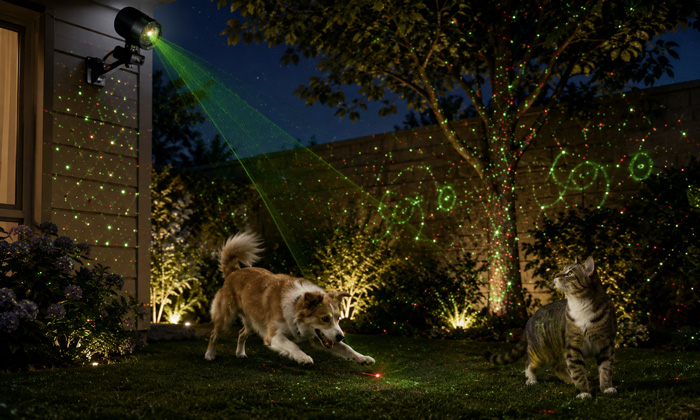
Pets’ eyes can also be harmed by direct laser exposure. Dogs and cats may investigate the light source, follow moving dots, or unexpectedly cross the beam path. The projector should therefore be mounted where an animal cannot sniff, knock over, chew, or stare into it.
Moving laser patterns may create an additional behavioral concern. Some dogs become highly focused on chasing lights and shadows because the moving target can never be physically caught. Repeated laser chasing may contribute to frustration or compulsive light-seeking behavior.
Do not intentionally use a garden laser projector as a pet toy. Observe your pet when the display is first switched on. Stop using it if the animal repeatedly searches for the dots, becomes agitated, ignores normal activities, or remains fixated after the projector is turned off.
How to Use a Garden Laser Light Safely
Choose a clearly labeled product from a reputable manufacturer. Do not use an unlabeled projector, a modified unit, or a product with damaged housing or lenses.
Mount the projector securely and high enough that children and pets cannot reach it. Aim all beams at a solid, non-reflective surface such as a wall, fence, or dense hedge. The complete pattern should end on that surface rather than extending beyond its edges.
Keep beams away from faces, windows, mirrors, polished decorations, swimming pools, vehicles, neighboring properties, roads, and public walkways. Reflected laser light can still present a hazard.
Never point an outdoor laser display into the open sky. Misaligned residential laser lights can distract or temporarily impair pilots, creating a serious aviation risk.
Use the projector only while a responsible adult is present, especially when young children or curious pets are outdoors. Recheck its direction after wind, rain, gardening work, or contact from an animal. A small movement can redirect the beams toward an unsafe area.
When Should You Avoid Using One?
A garden laser light should not be used when:
- Its laser class or output is not clearly stated.
- The casing, cable, lens, mount, or weather seal is damaged.
- Children can touch or reposition it.
- Pets repeatedly chase or fixate on the projected dots.
- The pattern cannot be fully contained on a safe surface.
- Beams enter windows, roads, neighboring gardens, or the sky.
- The product produces unusually intense blue or violet beams.
Blue or violet lasers that appear as bright as red or green lasers may be more powerful than expected and can cause rapid eye damage.
What to Do After Accidental Exposure
Switch the projector off immediately after suspected direct eye exposure. Do not assume everything is fine simply because the child or adult feels no pain. Blurred vision, dark spots, unusual glare, headaches, or changes in color perception require prompt professional eye assessment.
For a pet, contact a veterinarian promptly if the animal squints, appears disoriented, bumps into objects, avoids light, or behaves as though its vision has changed. Do not attempt to test its eyesight with the laser.
Are garden laser lights waterproof?
Not all garden laser lights are fully waterproof.
Choose a model with an appropriate IP rating for outdoor use, such as IP65 or higher, and keep plugs, adapters, and extension connections protected from rain and standing water.
See also: What Is IP65? The Waterproof Rating of Garden Lights
How long do garden laser lights usually last?
A quality garden laser light can operate for several thousand hours.
Its lifespan depends on laser-diode quality, operating temperature, weather exposure, daily runtime, and whether the unit is properly maintained.
Do garden laser lights use a lot of electricity?
Most residential garden laser lights use relatively little electricity compared with traditional outdoor decorations.
Actual power consumption varies by model, brightness level, projection mode, and operating duration.
How large an area can one garden laser light cover?
Coverage depends on the projector’s output, lens design, installation distance, and projection angle.
Many models can cover a house wall or medium-sized garden, but the stated coverage should be checked before purchase.
Can cold weather affect a garden laser light?
Yes. Extremely low temperatures can reduce brightness, slow moving patterns, or affect startup performance.
Use a projector designed for the local climate and follow the manufacturer’s specified operating-temperature range.
