


The Fundamental Principle: Converting Sunlight into Usable Energy
Key Components of a Solar Lantern
Solar Panels: Small Scale, High Importance
Energy Storage: The Role of Rechargeable Batteries
Charge Controllers: The Brain of the System
LEDs: Efficient Light Generation
Optical Design and Light Distribution
FAQs
Solar lanterns are deceptively simple devices. At a glance, they appear to be nothing more than portable lamps with a small solar panel attached. In reality, however, a solar lantern is a compact energy system that integrates photovoltaics, electrochemistry, power electronics, optics, and thermal management into a single, rugged product. Understanding how solar lanterns work requires looking beyond the light itself and examining how sunlight is captured, converted, stored, regulated, and finally transformed into visible illumination.
The Fundamental Principle: Converting Sunlight into Usable Energy
At the core of every solar lantern lies the same principle that governs all solar-powered devices: photovoltaic energy conversion. Sunlight consists of photons—packets of electromagnetic energy. When these photons strike a photovoltaic (PV) cell, they transfer energy to electrons within the semiconductor material. If the photon energy exceeds the band gap of the material, electrons are freed from their atomic bonds, creating an electric current.
In solar lanterns, this process is optimized for low power, portability, and affordability rather than maximum efficiency. Unlike large rooftop panels designed to operate at high voltages, lantern-scale solar panels typically produce low-voltage direct current (DC), often in the range of 4–6 volts under full sunlight. This voltage is well suited for charging small batteries and powering light-emitting diodes (LEDs).
The simplicity of the photovoltaic effect masks several engineering challenges. Solar lanterns must operate under widely varying light conditions—bright midday sun, cloudy skies, partial shading, and short winter days. Designing a system that remains reliable across all these conditions is one of the defining features of high-quality solar lanterns.
Key Components of a Solar Lantern

Although designs vary, most solar lanterns share a common architecture. Each component plays a specific role in the energy flow from sunlight to illumination.
-
Solar panel (photovoltaic module)
Converts sunlight into electrical energy. Typically made from monocrystalline or polycrystalline silicon. -
Rechargeable battery
Stores electrical energy for later use, usually during nighttime hours. -
Charge controller circuit
Regulates energy flow from the solar panel to the battery, preventing overcharging and deep discharge. -
LED light source
Converts electrical energy into visible light with high efficiency. -
Driver and power regulation electronics
Ensure stable current and brightness regardless of battery voltage fluctuations. -
Optical housing and diffuser
Shapes and spreads the light evenly while protecting internal components.
These elements form a closed energy loop that repeats daily: capture, store, regulate, and emit.
Solar Panels: Small Scale, High Importance

The solar panel on a lantern is often the most visually prominent feature, but its size is usually modest—sometimes no larger than a smartphone. Despite this limitation, it must generate enough energy to fully charge the battery within a single day of sun exposure.
Most modern solar lanterns use monocrystalline silicon panels because they offer higher efficiency per unit area. However, cost-sensitive models may use polycrystalline or thin-film technologies. The panel is typically laminated and sealed to resist moisture, dust, and mechanical stress, especially for outdoor or off-grid use.
From an electrical perspective, the panel’s output is highly variable. Voltage and current change constantly depending on sunlight intensity and temperature. This variability makes direct connection to a battery impractical, which is why a charge controller is essential.
Energy Storage: The Role of Rechargeable Batteries
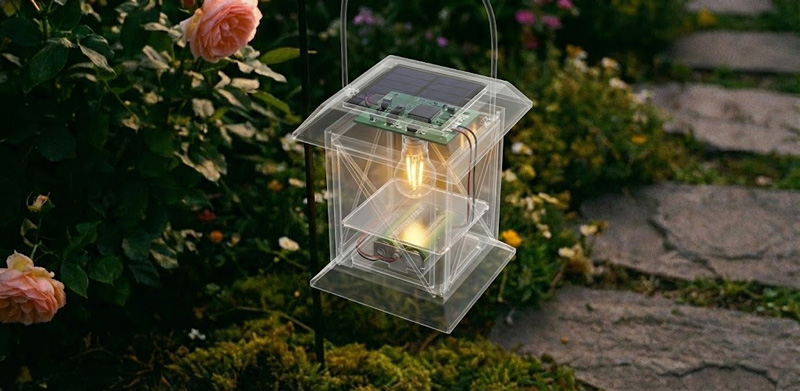
Solar energy is intermittent by nature. Lanterns are used primarily at night, when sunlight is unavailable. Batteries solve this mismatch by storing energy during the day and releasing it on demand.
Historically, early solar lanterns relied on nickel-metal hydride (NiMH) or sealed lead-acid batteries. Modern designs overwhelmingly favor lithium-ion or lithium iron phosphate (LiFePO₄) batteries due to their superior energy density, longer cycle life, and lighter weight.
Battery capacity is a critical design parameter. A battery that is too small will result in short lighting times, while an oversized battery may never fully charge under real-world conditions. Engineers must balance:
- Daily solar energy availability
- Desired runtime (often 6–12 hours)
- LED power consumption
- Battery longevity and safety
Thermal management is also crucial. Batteries degrade faster at high temperatures, which can be an issue when lanterns are left in direct sunlight. Quality designs isolate the battery from excessive heat while still allowing efficient charging.
Charge Controllers: The Brain of the System
The charge controller is the most technically sophisticated part of a solar lantern. Its job is to manage energy flow intelligently, protecting the battery while maximizing usable energy.
In basic lanterns, the controller may be a simple linear regulator or diode-based circuit. In higher-end models, it may include a maximum power point tracking (MPPT) or pseudo-MPPT algorithm. While full MPPT systems are rare in low-cost lanterns due to complexity and cost, even simplified versions can significantly improve charging efficiency under low-light conditions.
Key functions of the charge controller include:
- Preventing battery overcharge during strong sunlight
- Disconnecting the load if battery voltage falls too low
- Managing charging current to extend battery life
- Automatically switching between charging and lighting modes
Without proper regulation, batteries would degrade rapidly, making the lantern unreliable and unsafe.
LEDs: Efficient Light Generation
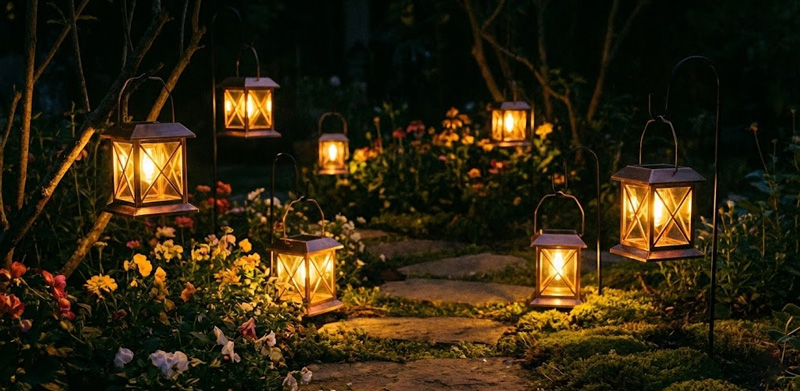
Light-emitting diodes are the enabling technology that makes solar lanterns practical. Compared to incandescent or fluorescent bulbs, LEDs produce far more light per unit of electrical energy.
Modern white LEDs achieve luminous efficacies exceeding 150 lumens per watt under optimal conditions. In solar lanterns, LEDs are usually driven at conservative power levels to maximize efficiency and lifespan rather than absolute brightness.
The LED driver circuit ensures that the LED receives a stable current. Since battery voltage decreases as it discharges, direct connection would cause brightness to fade unevenly. Instead, drivers use switching regulators or constant-current circuits to maintain consistent illumination until the battery reaches its cutoff voltage.
Optical Design and Light Distribution
Producing light is only half the challenge; distributing it effectively is equally important. Solar lanterns often use diffusers, reflectors, or light pipes to spread illumination evenly across a space.
From an engineering standpoint, good optical design allows a lantern to feel brighter without increasing power consumption. Uniform light distribution reduces glare and shadows, improving usability for tasks such as reading, cooking, or working.
The housing must also protect the optics from dust, insects, and moisture while remaining lightweight and impact-resistant.
FAQs
How long do solar lantern batteries typically last before replacement is needed?
High-quality solar lantern batteries typically last between 3 to 7 years.
Lifespan depends on battery chemistry, depth of discharge, charging conditions, ambient temperature, and daily usage patterns.
Lanterns designed with conservative charge control and moderate brightness settings tend to achieve the longest service life.
Do solar lanterns still charge efficiently in cloudy or low-light environments?
Yes, but at reduced efficiency.
Modern solar lanterns often use high-sensitivity photovoltaic cells and advanced charge controllers that allow partial charging under diffuse or cloudy light.
Full charging may require longer exposure times compared to clear, direct sunlight.
What factors determine the brightness level of a solar lantern?
Brightness is determined by more than LED wattage alone.
Key factors include LED efficiency, driver circuit design, battery voltage stability, and optical components such as diffusers and reflectors.
Well-designed lanterns balance brightness with runtime and battery longevity.
How does temperature affect the performance of solar lanterns?
Temperature has a significant impact on both batteries and charging performance.
Extreme heat can accelerate battery degradation, while very low temperatures reduce available capacity and charging efficiency.
Good thermal design and appropriate battery selection help maintain stable performance across varying climates.
Are solar lanterns suitable for continuous daily use in off-grid applications?
Yes. When properly designed and correctly sized, solar lanterns are intended for daily charge-discharge operation.
They are widely used in off-grid households, camps, humanitarian settings, and emergency situations.
Consistent performance depends on adequate solar exposure and responsible brightness settings.