
Seven Neon Chandelier Design Ideas for Bold Architectural Spaces
- 1. Create a Floating Halo with Layered Neon Rings
- 2. Add Movement with a Sculptural Neon Ribbon
- 3. Build Vertical Drama with a Cascading Composition
- 4. Echo the Architecture with Geometric Neon Frames
- 5. Turn Typography into a Suspended Centerpiece
- 6. Anchor a Long Space with a Linear Neon Chandelier
- 7. Reinterpret a Classic Chandelier Silhouette in Neon
Choosing Light Color Materials and Supporting Lighting
What to Plan Before Commissioning a Custom Neon Chandelier
FAQs
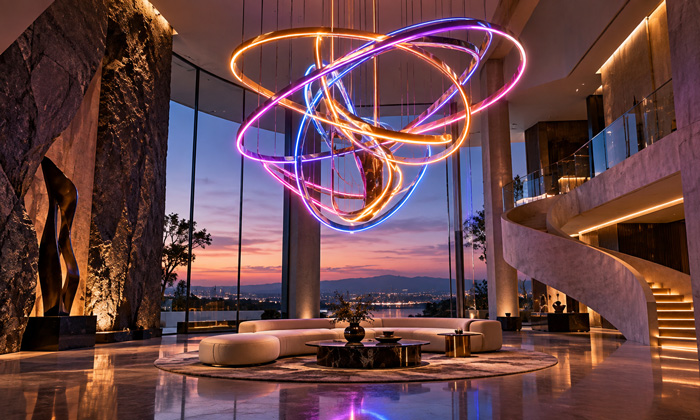
A double-height lobby, a concrete loft, or a sweeping staircase already has a strong architectural identity. The right chandelier gives the eye a place to settle within it. With luminous lines, open forms, and carefully chosen color, a neon light chandelier can establish that focal point while leaving the surrounding architecture visible.
The design starts with the room. A vertical composition can draw attention through a stairwell, while a long suspended outline can bring definition to a dining area. Color, supporting materials, and the appearance of the fixture during daylight all influence whether it feels at home.
The following seven ideas explore how to connect a statement neon chandelier with the space around it, followed by practical guidance on proportion, lighting, and commissioning a custom piece.
What Makes a Neon Chandelier an Architectural Statement
A convincing statement chandelier has a clear relationship with its setting. Its outline may echo an arch, continue the rhythm of exposed beams, or introduce a curve into an angular room. Its position should make sense from the entrance and from the places where people spend time.
Visual weight matters as much as overall size. An open arrangement of luminous lines can occupy a generous volume without hiding the background. A tightly packed composition may feel more substantial, even with a smaller footprint. Consider both the outer dimensions and the amount of empty space inside the form.
The term neon chandelier also needs some clarity. Glass neon and LED neon are different lighting systems that can produce related visual effects. Sygns discusses both in its ceiling-lighting projects, including suspended text and an RGB LED installation. The appropriate system depends on the intended shape, construction, and lighting requirements. Establish which technology a proposed fixture uses before comparing specifications.
Seven Neon Chandelier Design Ideas for Bold Architectural Spaces
1. Create a Floating Halo with Layered Neon Rings
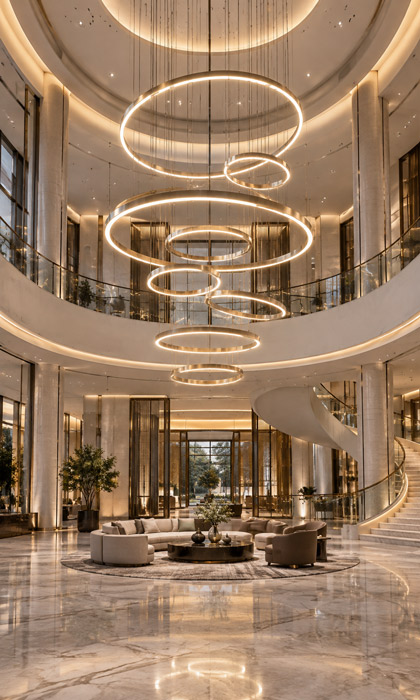
Picture a series of luminous rings suspended within a tall entrance hall. Their circular outlines create a center for the room, while the spaces between them allow views toward the ceiling and upper floors. This is a useful direction to explore where a lobby, circular stair, or central seating group already establishes a strong organizing point.
For a composed effect, align the rings around a shared axis. For more movement, vary their diameters and offset selected layers. Keep those shifts deliberate: each ring should contribute to the overall silhouette when viewed from the entrance, rather than appearing randomly placed.
Pair the arrangement with a restrained background so the geometry remains legible. Before finalizing the design, review views from both ground level and any overlooking balcony. The fixture needs to work as a three-dimensional composition, including the appearance of its supports and upper surfaces.
2. Add Movement with a Sculptural Neon Ribbon
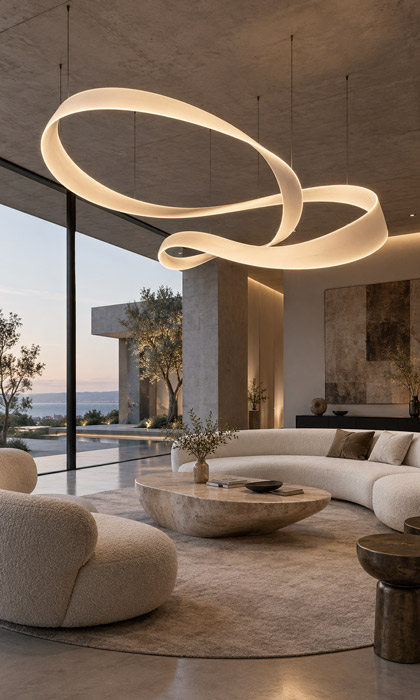
A suspended ribbon introduces a flowing line into a room. Imagine a broad loop above a lounge, or an elongated curve that moves through the space beneath a flat concrete ceiling. This approach can echo rounded walls and curved furniture, or soften a setting dominated by straight edges.
Begin with one readable gesture. A simple sweep with a few changes in direction is often easier to appreciate than a dense knot of overlapping curves. Let the shape relate to the furniture below without tracing every contour of the seating arrangement.
The support system is part of the design. Ask the fabricator how the illuminated line will hold its form, where the suspension points will sit, and whether the visible surface will look consistent from different angles. Review an unlit rendering as well as a glowing one; the piece should still make visual sense during the day.
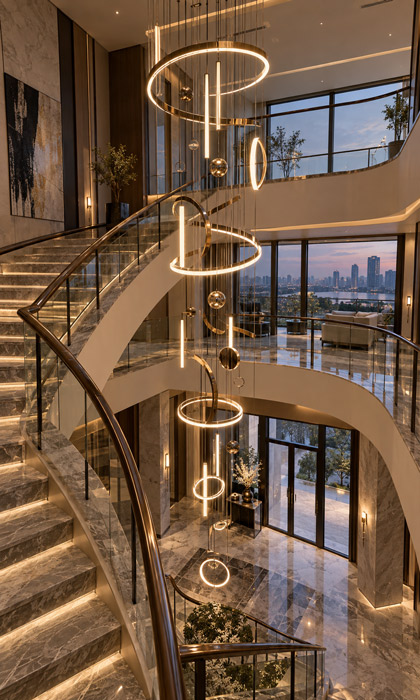
3. Build Vertical Drama with a Cascading Composition
A stairwell offers a chance to experience a chandelier from several heights. A cascading arrangement can connect those viewpoints through a sequence of suspended loops, short lines, or open geometric elements. The aim is to create a continuous visual relationship between levels.
Develop the composition around the actual stair and landing positions. A gradual change in length may complement a straight stair, while a rotating arrangement could respond to a curved route. Leave enough openness for the architecture and distant elements to remain visible through the installation.
Study the fixture from the lower entrance, intermediate landings, and upper floor. Avoid concentrating all the visual interest at the bottom, where it might disappear from an elevated viewpoint. Access for cleaning and component replacement should influence the arrangement from the beginning, especially where the installation extends through a tall void.
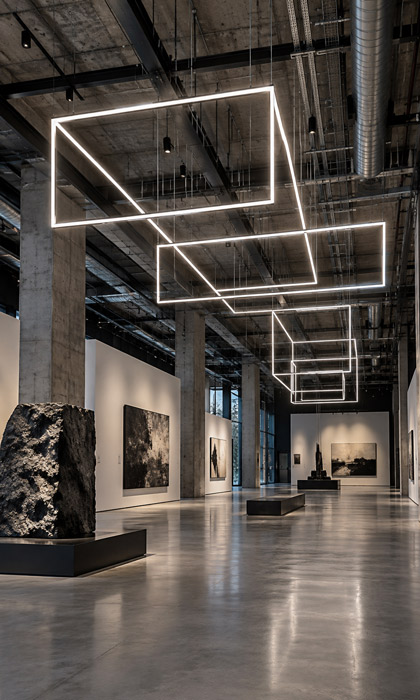
4. Echo the Architecture with Geometric Neon Frames
Rectangles, polygons, and intersecting lines can give an industrial interior a clear visual rhythm. In a gallery, showroom, or converted warehouse, a suspended frame can relate to the spacing of columns or the grid of the ceiling.
Choose the architectural reference carefully. If the ceiling already contains many visible services and structural lines, a single large outline may read more clearly than several overlapping shapes. In a quieter interior, a small group of repeated frames can introduce rhythm and depth.
Consider how the geometry changes as a visitor moves. Frames that appear balanced in a frontal rendering may overlap awkwardly from a side entrance. Test the main approaches in plan and perspective, and coordinate the placement with existing ceiling elements. A convincing geometric installation feels intentional from more than one fixed photographic viewpoint.
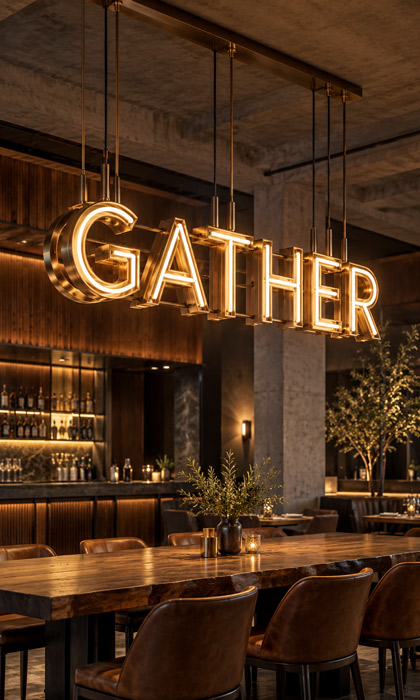
5. Turn Typography into a Suspended Centerpiece
A word or short phrase can become the structure of a chandelier. This direction is particularly relevant to restaurants, bars, and creative workplaces where language forms part of the interior identity. Sygns documents suspended text installations, while Patrick Nash Design shows how a steel armature can support neon lettering and contribute to its dimensional form.
Keep the message concise enough to read from the intended viewing distance. Decide whether it should be understood on arrival, from a seated position, or while moving around the fixture. Lettering wrapped around a circular frame creates a different experience from a phrase facing one main approach.
Give the typography room to stand out. Nearby signs, patterned surfaces, and prominent artwork can compete with the message. Discuss letter spacing, support placement, and cable routing together so the construction does not interrupt the words or create distracting shapes behind them.
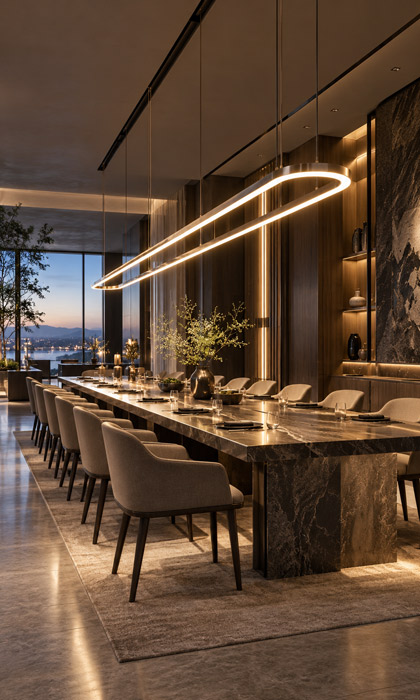
6. Anchor a Long Space with a Linear Neon Chandelier
A long dining table, reception desk, or bar offers a natural reference for an elongated chandelier. A suspended line, narrow loop, or sequence of connected forms can establish the area as a distinct destination within an open interior.
Align the composition with the furniture and the way the area is used. A fixture centered on a table may need a different position from one intended to emphasize the front edge of a reception counter. Consider the whole arrangement, including chairs, circulation routes, and the background seen from the entrance.
Keep the silhouette readable along its full length. If the composition has several elements, give their spacing a clear rhythm. Coordinate the chandelier with lighting for the surface below, and assess the result from seated as well as standing positions. The visual centerpiece and the practical lighting should support the same activity.
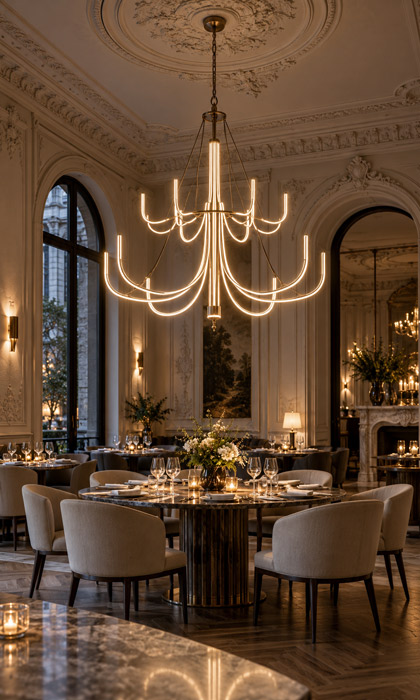
7. Reinterpret a Classic Chandelier Silhouette in Neon
A familiar branched chandelier outline can take on a different character when expressed through luminous lines. This is an interesting concept for a boutique hotel, a dining room with decorative plasterwork, or a historic interior receiving a contemporary addition.
Choose which features of the traditional form are essential. A central stem, curved arms, and a tiered profile may be enough to establish the reference. Simplifying smaller details helps preserve a clear silhouette and gives the surrounding architecture room to remain visible.
Explore the design in relation to the room's ornament, furniture, and finishes. A restrained light color can place emphasis on the outline, while a saturated hue makes color itself part of the statement. Review both options against the actual interior palette. Include the frame and suspension in the visual study, since these will remain part of the composition when the light is switched off.
How to Match the Chandelier to Your Space
Start with measured plans and elevations. Record the ceiling height, the footprint of the area, the furniture layout, and the main sightlines. For a tall space, include views from upper levels. This gives the designer a basis for evaluating width, depth, and suspension length together.
Use the following pairings as starting points for a design discussion.
|
Space |
Design direction to explore |
Main question to resolve |
|
Double-height lobby |
Layered rings or open clusters |
Does the composition hold the space from the entrance? |
|
Stairwell or atrium |
Cascading elements |
Does it work from every occupied level? |
|
Long table or reception desk |
Linear forms or elongated loops |
How does it align with the furniture and activity? |
|
Industrial loft or showroom |
Geometric frames |
How does it relate to beams and visible services? |
|
Bar or creative workspace |
Suspended typography |
Where should the message be readable? |
|
Interior with less vertical space |
Broad, shallow composition |
Can it fit without crowding sightlines or circulation? |
There is no single proportion that suits every sculptural chandelier. Compare a few scaled options in the actual room model, including their supports. Check the relationship to nearby windows, artwork, and other prominent objects. Leave enough visual breathing room for the silhouette to register clearly.
Choosing Light Color Materials and Supporting Lighting
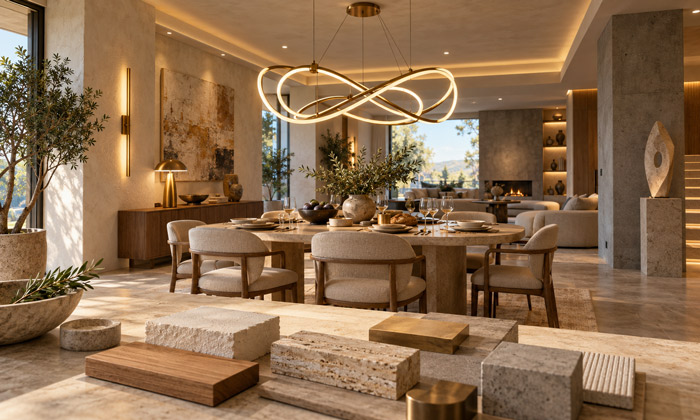
Choose light color alongside physical material samples. As a design direction, warm white can support an interior built around timber, textured plaster, and warm-toned stone. A saturated hue can establish a stronger graphic presence against concrete or a restrained neutral background. Test the combination before committing: the illuminated effect may differ from a digital rendering.
Think about the people and objects below the chandelier. Where faces, food, merchandise, or artwork need to look natural, evaluate the full lighting scheme with those subjects in place. Do not assume that a decorative colored fixture will provide every type of light the room needs.
Coordinate supporting wall, ceiling, or task lighting with the chandelier. Separate controls can help different activities receive appropriate lighting, provided the selected equipment supports the intended arrangement. Ask the supplier to confirm dimming and control compatibility rather than inferring it from the product's appearance.
Finally, review the unlit materials. Suspension wires, frames, joints, and ceiling connections all contribute to the daytime view. Decide which elements should be discreet and which should be visibly integrated into the sculpture.
What to Plan Before Commissioning a Custom Neon Chandelier
A useful design brief describes the space and the intended experience. Share photographs, measured drawings, reference images, and the main viewing positions. Explain whether the installation should welcome visitors, define a dining area, express a brand, or connect several floors visually.
Before approving fabrication, discuss these items with the design and installation team:
- Overall dimensions, suspension length, and the intended position in the room.
- Lighting technology, frame materials, total weight, and proposed attachment points.
- Available power, equipment locations, cable routes, and access for servicing.
- Light color, output requirements, dimming, and compatibility with the control system.
- Delivery access, installation sequence, maintenance arrangements, budget, and schedule.
Request drawings that show how the fixture connects to the building, together with appropriate product documentation. Large or complex pieces may also benefit from a material sample or a partial prototype. Use that review to resolve visible joints, construction details, and the appearance of the light before the complete installation is made.
FAQs
How Much Does a Custom Neon Chandelier Cost?
The cost of a custom neon chandelier depends on project requirements such as size, design complexity, lighting technology, frame construction, and electrical components.
When requesting a quotation, confirm whether it includes design work, mounting hardware, packaging, shipping, and installation. Itemized quotes make it easier to compare complete project costs.
Does a Neon Chandelier Use a Lot of Electricity?
Energy consumption depends on the fixture’s total power input and how long it operates each day.
Calculate usage by multiplying watts by operating hours and dividing by 1,000 to estimate kilowatt-hours. Request the complete system power rating, including power supply losses, for a more accurate estimate.
How Long Does a Neon Chandelier Usually Last?
The service life of a neon chandelier depends on the light source, electrical components, operating temperature, installation conditions, and daily usage.
For LED neon designs, check whether the stated lifetime refers only to the light source or the complete fixture. Also confirm the availability of replacement drivers and components.
Do Neon Chandeliers Produce Heat During Use?
Yes. Neon lighting systems can generate heat, especially from power supplies and electrical components.
The operating temperature depends on the technology, electrical load, and installation environment. Check manufacturer guidance for ventilation requirements, especially in enclosed ceiling installations.
Do Neon Chandeliers Make Buzzing or Humming Sounds?
Some neon lighting systems may produce audible noise from transformers, drivers, or power supplies.
Noise levels can vary depending on component quality, dimming settings, and installation methods. For quiet spaces, test the fixture at different brightness levels before installation. Unexpected or increasing noise should be inspected by the supplier or a qualified technician.