
How Soffit Lighting Supports Home Security
Best Areas for Exterior Soffit Lighting
Eliminate Dark Zones Around Entry Points
Use Proper Fixture Spacing
Avoid Glare and Harsh Shadows
Coordinate Lighting With Security Cameras
Combine Continuous and Motion-Activated Lighting
Protect Fixtures and Electrical Components
Conclusion
FAQs
Exterior soffit lighting can improve home security when fixtures are positioned to eliminate dark areas, expose access points, and support surveillance cameras. The effectiveness of the lighting depends less on brightness alone and more on strategic placement.
How Soffit Lighting Supports Home Security
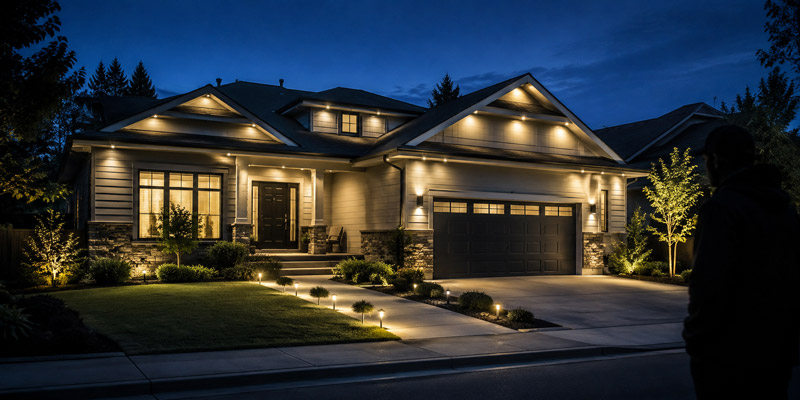
Soffit lights are installed beneath roof overhangs, where they direct light downward along exterior walls, walkways, doors, and windows. This elevated position makes the fixtures difficult to tamper with and allows them to illuminate large areas without taking up wall or ground space.
Well-placed soffit lighting can discourage trespassers by reducing the number of concealed areas around a property. It also helps residents identify visitors, notice unusual movement, and move safely around the home after dark.
Farrington, D. P., & Welsh, B. C. (2002). Improved street lighting and crime prevention. Justice Quarterly, 19(2), 313–342.
However, poor placement can create glare, deep shadows, or overexposed camera footage. A secure lighting plan should provide balanced coverage rather than flooding the entire property with excessive light.
Best Areas for Exterior Soffit Lighting
The most important locations are the points where someone could approach, enter, or hide near the home.
|
Location |
Security Purpose |
Placement Recommendation |
|---|---|---|
|
Front entrance |
Improves visitor identification |
Install above and slightly in front of the doorway |
|
Side and rear doors |
Exposes less-visible access points |
Center lights over each entrance and surrounding landing |
|
Garage doors |
Illuminates vehicles and driveway activity |
Space fixtures evenly across the garage soffit |
|
Ground-floor windows |
Reduces hiding places near windows |
Position lights between windows rather than directly above glass |
|
Side passages |
Prevents dark corridors beside the home |
Use evenly spaced fixtures along the full passage |
|
Patio or deck |
Improves visibility around rear living areas |
Cover steps, doors, and perimeter edges |
|
Outdoor cameras |
Enhances nighttime image quality |
Place lights beside or behind cameras, not directly in front |
Eliminate Dark Zones Around Entry Points
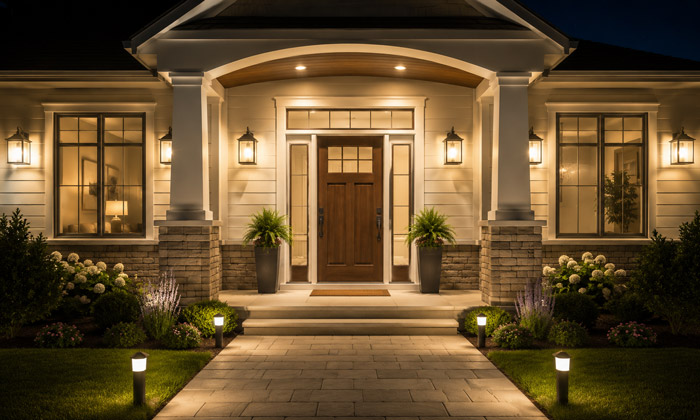
Doors and accessible windows should receive the strongest lighting coverage. A single light directly above a door may illuminate the entrance but leave the surrounding corners dark. Using additional fixtures on both sides of the area creates more even coverage and reduces shadows.
Haans, A., & de Kort, Y. A. W. (2012). Light distribution in dynamic street lighting: Two experimental studies on its effects on perceived safety, prospect, concealment, and escape. Journal of Environmental Psychology, 32(4), 342–352.
Side yards and rear entrances often require special attention because they are less visible from the street. Continuous soffit lighting along these areas can remove long, dark pathways that may otherwise provide concealed access.
Chalfin, A., Kaplan, J., & LaForest, M. (2022). Street light outages, public safety and crime attraction. Journal of Quantitative Criminology, 38, 891–919.
Fixtures placed too far apart create alternating bright and dark sections. Lights installed too closely may waste energy and produce uncomfortable glare.
For many residential applications, soffit lights are spaced approximately six to eight feet apart, although the correct distance depends on ceiling height, beam angle, fixture output, and the width of the area below. Narrow-beam lights require closer spacing, while wide-beam fixtures can cover larger surfaces.
The goal is consistent illumination across the property perimeter, especially near entrances and walkways.
Peña-García, A., Hurtado, A., & Aguilar-Luzón, M. C. (2015). Impact of public lighting on pedestrians’ perception of safety and well-being. Safety Science, 78, 142–148.
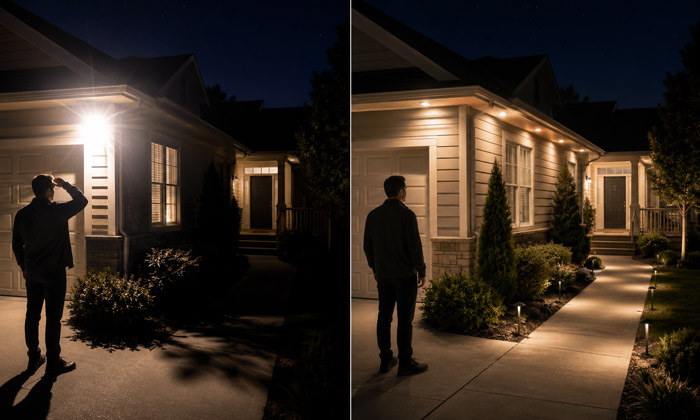
High-output lights are not always more secure. Excessive brightness can make it difficult for residents to see beyond the illuminated area. It may also create harsh shadows where someone could remain hidden.
Fixtures should direct light downward and slightly outward without shining into windows, neighboring properties, or the eyes of approaching visitors. Shielded or recessed soffit lights provide better control than exposed bulbs.
A neutral or warm-white color temperature, usually between 2700K and 4000K, is suitable for residential security lighting. Cooler light may improve visual clarity, but extremely blue lighting can feel harsh and create unnecessary light pollution.
Coordinate Lighting With Security Cameras
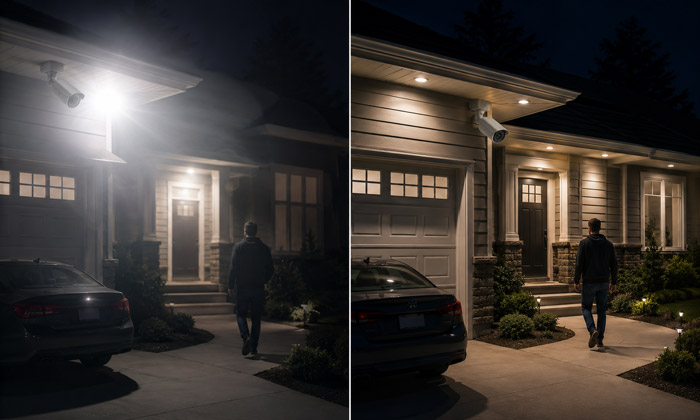
Soffit lighting can improve camera performance by providing stable, continuous illumination. Cameras usually capture better detail when the scene is evenly lit.
Lights should not point directly into the camera lens. Direct exposure can cause glare, washed-out images, or reduced visibility around faces and license plates. The camera should be positioned slightly below or between soffit fixtures, with light falling across the monitored area.
Before final installation, test the camera view at night. Check for reflections from windows, wet pavement, vehicles, and light-colored walls.
Combine Continuous and Motion-Activated Lighting
Continuous low-level lighting keeps important areas visible throughout the night. Motion-activated fixtures can provide additional brightness when movement is detected.
A layered setup is often more effective than relying only on motion sensors. Motion lights may activate too late, fail to detect slow movement, or trigger unnecessarily because of animals and vegetation. Low-level soffit lighting maintains basic visibility, while motion activation draws attention to activity.
Timers, photocells, and smart controls can ensure the system operates consistently without requiring manual adjustment.
Protect Fixtures and Electrical Components
Exterior soffit lights must be rated for damp or wet locations, depending on the amount of exposure. Sealed housings help protect the fixtures from moisture, insects, dust, and temperature changes.
Wiring should be installed according to local electrical requirements. Outdoor circuits may require ground-fault protection, weather-resistant components, and professional installation.
Secure fixtures should also be mounted high enough to prevent easy interference while remaining accessible for maintenance.
Exterior soffit lighting placement can significantly improve home security by illuminating entrances, windows, garages, side passages, and other vulnerable areas. The best results come from even fixture spacing, controlled brightness, reduced glare, and coordination with security cameras.
Strategic placement is more effective than simply installing brighter lights. A well-designed soffit lighting system removes hiding places, improves nighttime visibility, and makes the property appear actively monitored.
How Much Does It Cost to Install Exterior Soffit Lighting?
The total cost depends on the number of fixtures, soffit accessibility, wiring requirements, and whether new circuits are needed.
Retrofitting an existing home usually costs more than installing lights during construction because electricians may need to access concealed wiring spaces. Smart controls, premium LED fixtures, and complex rooflines can also increase labor and material costs.
Can Exterior Soffit Lights Be Added to an Existing Home?
Yes, soffit lights can often be retrofitted into an existing property. Installation is easiest when the soffit has accessible attic space or removable panels.
Homes with solid soffits, limited roof access, or extensive insulation may require additional cutting and wiring work. A qualified electrician should inspect the structure before determining the most practical installation method.
How Long Do LED Soffit Lights Typically Last?
Quality exterior LED soffit lights commonly provide tens of thousands of operating hours.
Their actual service life depends on fixture quality, heat management, weather exposure, voltage stability, and daily usage. Integrated LED fixtures may require full replacement when the light source fails, while fixtures with replaceable bulbs can be maintained more easily.
Do Exterior Soffit Lights Increase Property Value?
Professionally installed soffit lighting may improve curb appeal, nighttime usability, and a buyer’s perception of property maintenance.
It can make architectural features more visible and create a polished exterior appearance. However, its effect on resale value varies by market, installation quality, fixture style, and how well the system complements the home’s overall design.
Do Soffit Lights Attract Insects?
Exterior lights can attract insects, particularly fixtures that emit strong blue or ultraviolet wavelengths.
Warm-colored LEDs generally attract fewer insects than cooler, blue-toned lights. Keeping fixtures clean, using enclosed housings, and avoiding unnecessary overnight operation near doors can further reduce insect activity around entrances and outdoor living areas.
