


What Are Warm White LED Lights?
Do Warm White LEDs Emit Blue Light?
Why Can Warm White LED Lights Still Feel Uncomfortable?
Is Warm White Better Than Cool White for Your Eyes?
How to Set Up Comfortable Warm White Lighting
Are Warm White LEDs Suitable Before Bed?
FAQs
Warm white LED lights are generally safe for your eyes when used as intended for normal household lighting. Their warm appearance can feel comfortable, especially in the evening. However, a warm color does not prevent a light from being excessively bright, producing glare, or flickering.
The practical goal is to choose lighting that lets you see clearly without discomfort. Color temperature matters, but so do the fixture, its position, and how the light behaves when dimmed. Under typical conditions, retinal damage from the blue component of white LED lighting is not expected.
What Are Warm White LED Lights?
Warm white LEDs usually have a correlated color temperature of approximately 2700K to 3000K. They produce a yellowish-white appearance commonly associated with traditional household lighting.
The Kelvin rating describes the appearance of the light. It does not tell you how bright the bulb is or certify that it is comfortable for every person.
| Light appearance | Common color temperature | Typical visual impression |
|---|---|---|
| Warm white | 2700K–3000K | Yellowish-white |
| Neutral to cool white | Around 4000K | Whiter, less yellow |
| Daylight | Around 5000K–6500K | Cool, sometimes bluish-white |
These labels are approximate, and their use varies between products. Check the numerical color temperature when comparing bulbs.
Do Warm White LEDs Emit Blue Light?
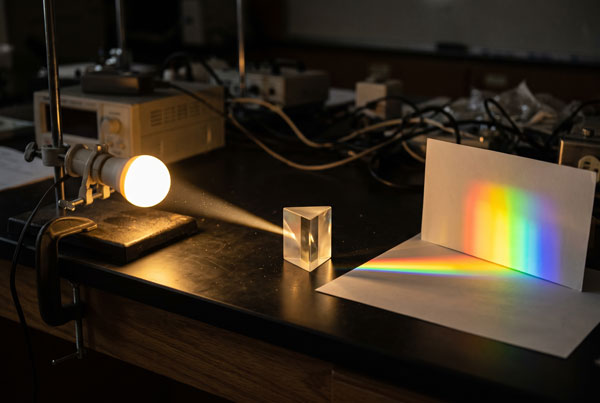
A warm white LED (left) dispersing through a triangular prism, revealing that it still emits blue and violet wavelengths despite its overall warm appeairance.
Yes. Warm white LEDs still contain blue light.
Many white LEDs combine a blue emitter with phosphor materials that convert some of its output into longer wavelengths. A warm appearance does not mean that the blue component has disappeared.
Warm white LEDs commonly have a smaller blue contribution than cooler white LEDs at comparable lighting levels. However, actual exposure also depends on the lamp’s spectrum, intensity, viewing position, and exposure time. A Kelvin rating alone cannot establish the amount of blue light reaching your eyes.
Blue light exposure also needs context. Findings involving intense light or experimental exposure conditions do not establish that ordinary room lighting causes the same effects. Current safety guidance considers white LEDs safe under reasonably foreseeable use; this does not extend to deliberately staring into intense light sources.
Why Can Warm White LED Lights Still Feel Uncomfortable?
A light can feel unpleasant without causing retinal injury. If a warm white lamp bothers your eyes, consider the following factors.

Glare From an Exposed Light Source
An uncovered bulb or visible row of LED chips can create a bright point in your field of view. Reflections from screens and glossy surfaces may add to the discomfort.
Try a shaded fixture, diffused lighting, or a different lamp position. The aim is to illuminate the activity while keeping the brightest part of the source out of your direct view.
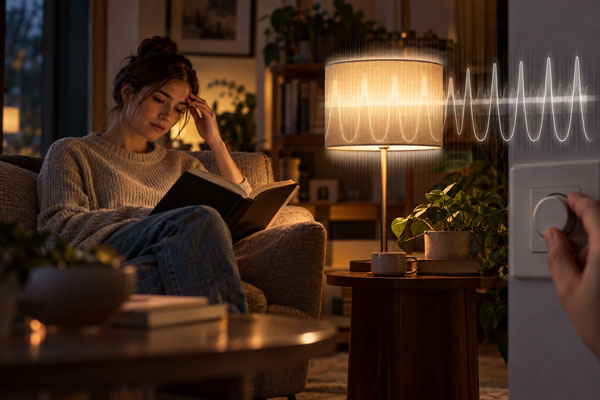
Flicker and Dimming Performance
LED light output can fluctuate rapidly over time. Its behavior depends on the driver electronics and, where fitted, the dimmer.
Some people are more sensitive to this modulation than others. A lamp that seems steady to one person may be uncomfortable for another, and its performance can change at different dimming levels.
Check for dimmer compatibility and look for measured flicker information where available. A warm color temperature does not establish low-flicker performance.

Poorly Balanced Lighting
A bright lamp in an otherwise dark room can feel uncomfortable. Conversely, lighting that leaves your reading material difficult to see is unlikely to provide a comfortable setup.
Adjust the task light together with the surrounding room lighting. Position it above or beside the activity so it illuminates the work without shining into your eyes.

Eye Strain With Another Cause
Dry eyes and an unsuitable glasses or contact lens prescription can contribute to tired eyes, intermittent blur, and headaches. Changing the bulb may not resolve those problems.
If discomfort continues after adjusting the lighting, an eye examination can help identify the cause.
Is Warm White Better Than Cool White for Your Eyes?
Warm white often feels more comfortable in relaxed indoor settings, but there is no single color temperature that suits everyone and every activity.
Someone may prefer warm white for evening reading and a more neutral appearance for daytime desk work. Those preferences do not make one setting universally safe and the other harmful.
A useful way to compare lights is to ask:
- Can I see the task clearly?
- Is the light source shining directly into my eyes?
- Are there distracting reflections?
- Does the light remain comfortable when dimmed?
Warmer lighting can support comfort, but appropriate brightness and positioning remain essential.
How to Set Up Comfortable Warm White Lighting
Start with the activity and where your eyes will be positioned. The following arrangements are practical starting points rather than medical prescriptions.
| Setting | Suggested arrangement | What to check |
|---|---|---|
| Bedside reading | A shaded, adjustable lamp directed toward the page | The bulb stays out of view when sitting or reclining |
| Living room | Several modest light sources distributed around the room | No single exposed lamp dominates the view |
| Desk | A task lamp positioned beside the work area | Minimal reflections on the screen or desktop |
| Kitchen counter | Shielded lighting directed onto the work surface | The light source is hidden from normal viewing angles |
Choose an adjustable output so you can match the light to the task. When using a dimmer, confirm compatibility with the bulb or fixture and check performance across the range you actually use.
If a new installation causes discomfort, change one factor at a time: reposition the fixture, reduce direct glare, adjust brightness, and assess dimming behavior. This makes it easier to identify what helps.
These suggestions follow lighting guidance emphasizing task illumination, shielding, and control of glare and light modulation.
Are Warm White LEDs Suitable Before Bed?
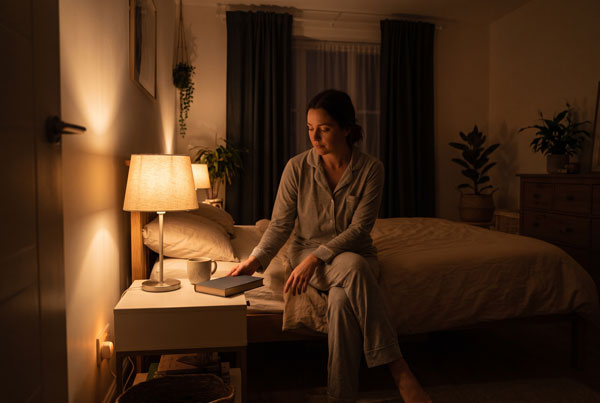
Warm white lighting is a reasonable choice for the evening, but brightness still matters. A brightly lit room does not become ideal for bedtime simply because its bulbs are warm white.
Light can influence the body’s sleep–wake timing, and blue-rich exposure at night is a particular concern. Lower the lighting as bedtime approaches while retaining enough illumination to move around safely.
Sleep effects and eye injury are separate issues: light can affect your evening alertness without damaging your retina.
For everyday use, combine warm white light with comfortable brightness, shielded fixtures, and reliable dimming. If you develop persistent eye pain or changes in vision, seek an eye examination rather than assuming that color temperature is responsible.
FAQs
1. Do I Need Blue Light Glasses Under Warm White LED Lighting?
Special blue light glasses are not generally necessary simply because you use ordinary warm white room lighting. For screen-related discomfort, evidence does not support blue light filtering glasses as an effective routine solution. Regular breaks, blinking, and addressing dry eyes or prescription problems are more useful starting points.
2. Do Warm White LED Bulbs Emit UV Radiation?
Ordinary white LEDs used for general lighting generally do not emit ultraviolet radiation. Their visible blue light is different from UV. Purpose-built UV LEDs are a separate product category and require precautions appropriate to their intended use.
3. Can Warm White Lighting Prevent Myopia in Children?
Warm white lighting is not an established treatment or prevention method for myopia. Research supports time outdoors as a way to reduce the risk of myopia onset in children. Changing an indoor bulb’s color does not replace outdoor activity or appropriate eye care.
4. Does a Higher CRI Mean an LED Is Safer for Your Eyes?
No. The color rendering index, or CRI, describes how faithfully a light renders object colors relative to a reference source. It is not an eye-safety rating. A higher CRI can be useful for activities involving color judgment, but it does not certify overall visual comfort.
5. Does Dimming a Warm White LED Make Its Color Warmer?
Not necessarily. Many LEDs maintain approximately the same color temperature as their output decreases. Products specifically designed for “dim-to-warm” operation shift toward a warmer appearance as they dim. Check the product specifications if you want that behavior; “dimmable” alone does not promise a color change.
